Fal.ai vs Replicate for Video Generation APIs
Most "Fal vs Replicate" content compares developer experience, SDK quality, and documentation — real considerations, but not the one that determines your actual bill. Both platforms host a wide, overlapping catalog of video models, which makes them a clean case for a direct price comparison on identical checkpoints rather than a feature checklist.
Shared models, priced side by side
| Model | Fal | Replicate | Replicate discount |
|---|---|---|---|
| Seedance 2.0 (720p) | $0.3034/sec | $0.1800/sec | 41% cheaper |
| Wan 3.0 (720p) | $0.1000/sec | $0.0500/sec | 50% cheaper |
| Veo 3.1 | $0.4000/sec | $0.2000/sec | 50% cheaper |
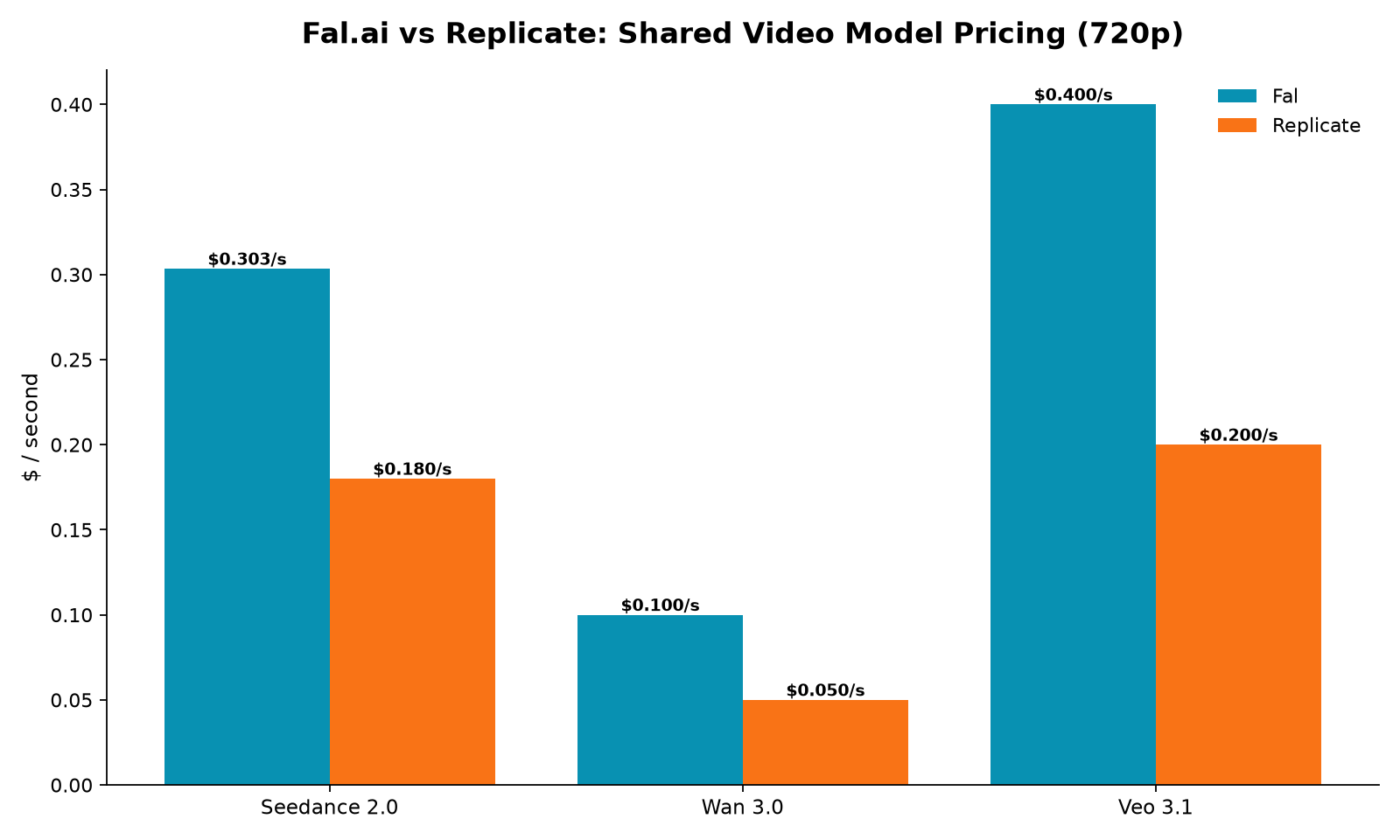
Across all three models where both platforms host the identical checkpoint, Replicate is cheaper — by a minimum of 41% and as much as 50%. This isn't one favorable comparison cherry-picked from a wider, more even spread; it's the consistent pattern across every model we found listed on both platforms.
Why the gap is this consistent
Fal has built its video/image generation product around fast onboarding for new models, polished SDKs, and a developer experience that's genuinely good to work with — that positioning tends to come with pricing closer to what a model creator's own reference rate is, rather than aggressive reseller pricing. Replicate's broader catalog spans thousands of models across many categories, and its video-specific pricing on the models above suggests a leaner-margin strategy for this category specifically, possibly to compete for volume against dedicated video-API platforms.
Neither platform's approach is wrong — a wider margin can fund better documentation, faster support response, or more reliable capacity during demand spikes, and cheaper pricing can mean thinner margins with less headroom to absorb an outage. Whether that tradeoff is worth 41-50% is a real decision, not a default one way or the other.
What "identical checkpoint" actually means here
It's worth being precise about the claim underlying this whole comparison: Fal and Replicate aren't running their own fine-tuned or modified versions of Seedance 2.0, Wan 3.0, or Veo 3.1 — they're serving the same released weights from ByteDance, Alibaba, and Google respectively, just on their own infrastructure. That's why a price comparison is meaningful at all: if either platform were serving a modified checkpoint, a price difference could partly reflect a real quality or capability difference rather than pure infrastructure margin. For these three models specifically, that's not the case — the only variable between a Fal request and a Replicate request for the same model is which company's GPUs and orchestration layer handle it.
Worked example
A team running 3,000 four-second Seedance 2.0 clips a month at 720p through each platform:
- Fal: 3,000 × 4 × $0.3034 = $3,640.80/month
- Replicate: 3,000 × 4 × $0.1800 = $2,160/month
That's a $1,480.80/month difference — 41% of Fal's bill — for identical output. Scale that to Veo 3.1 at the same volume and the 50% Replicate discount widens the absolute gap further, since Veo's base rate is higher to begin with.
What Fal is still worth paying for
Price isn't the only axis. If you're already deep into Fal's SDK across multiple models, or you've hit specific reliability or latency characteristics with Replicate that Fal doesn't share for your workload, a 41-50% premium might be a reasonable price for a specific, tested difference. What this comparison argues against isn't "always use Replicate" — it's picking either platform without checking the price gap for your specific model first, since the gap here is large enough that it's rarely a rounding error either way.
Neither is the whole market
Both Fal and Replicate are two hosts among several for each of these models — MachGen and Atlas Cloud both undercut Replicate's rate on Seedance 2.0 (see Where to Get the Cheapest Seedance API), and Pika ties Replicate's rate on Veo 3.1 while OpenRouter's resale channel prices at parity with Replicate too on the standard tiers (see Veo 3.1 API Pricing Comparison Across Providers). A two-way comparison is a useful starting point, but the full picture across every host is usually where the largest saving is found.
Frequently asked questions
Does Replicate's pricing advantage hold on every model, or just these three? These three are the models where both platforms happen to host the identical checkpoint in VideoRouter's registry — Replicate's broader catalog includes many models Fal doesn't carry and vice versa, so this comparison only speaks to genuine overlap, not Replicate's catalog-wide pricing strategy.
Is Fal's SDK/documentation quality worth a 41-50% premium? That's a judgment call specific to your team's workflow, not something a pricing comparison can answer for you. What this article establishes is the size of the premium you'd be paying for that difference, so you can make the tradeoff deliberately rather than defaulting to one platform without realizing there's a price gap at all.
Do Fal and Replicate differ in which resolution tiers they support? Check each model's specific listing — the 720p comparison above is the tier where both platforms carry a directly comparable price, but tier availability isn't guaranteed to match exactly, especially at the extremes (very low or very high resolution).
Should I split traffic between Fal and Replicate rather than picking one? That's a reasonable approach if you value having failover across two structurally different platforms (different infrastructure, different reliability profiles) more than capturing 100% of Replicate's price advantage. VideoRouter's default routing without an explicit provider pin already does something like this automatically, weighted toward the cheaper option.
Are there other models where Fal is actually the cheaper of the two? Possibly — this article covers three specific models where we found direct overlap; it's not an exhaustive survey of every model both platforms carry. Check the specific model you need against both platforms' current rates before assuming the pattern in this article holds universally.
How to route between them
import requests

# Explicit Replicate pin
job = requests.post(
    "https://videorouter.sh/api/v1/videos",
    headers={"Authorization": "Bearer llmr_sk_live_...", "Content-Type": "application/json"},
    json={
        "model": "bytedance/seedance-2.0/replicate",
        "prompt": "a paper airplane gliding over a city",
        "resolution": "720p",
        "duration_secs": 4,
    },
).json()
Swap the trailing /replicate for /fal to pin the other way, or drop the provider suffix entirely to let automatic routing pick the cheaper healthy deployment for you — see /docs/provider-selection for the full pinning reference.