The Cheapest AI Video APIs in 2026
If you search for "the cheapest AI video API," you'll find a lot of confident-sounding listicles that rank platforms first through fifth and call it a day. Almost none of them ask the question that actually determines your bill: cheapest for which model?
That distinction matters more in video generation than it does almost anywhere else in AI infrastructure, because a video API platform isn't really a single product with a single price. It's a marketplace of listings, one per model, each hosted through a different upstream provider, each carrying that provider's own margin, GPU cost structure, and pricing strategy. A platform can be the cheapest place to run one model and, at the same time, one of the more expensive places to run the model released the week after. Below, we'll show that in real numbers across four widely used video models, and make the case for why "cheapest platform" is the wrong question to be asking in the first place.
Cheapest is a per-model question, not a per-platform one
Here's the plainest way to see it. We pulled live per-second pricing for the same four models — Seedance 2.5, Wan 3.0 Prime, Veo 3.1, and MiniMax H3 — across every host in our own price registry that serves them, and ranked the cheapest verified host for each.
| Model | Tier | Cheapest host | Price | Priciest tested host | Price | Spread |
|---|---|---|---|---|---|---|
| Seedance 2.5 (ByteDance) | 720p text-to-video | MachGen | $0.19/sec | Fal.ai | $0.473/sec | 2.5x |
| Wan 3.0 Prime (Alibaba) | 480p text-to-video | Pika (via fal.ai resale) | $0.051/sec | OpenRouter (real invoiced rate) | $0.17/sec | >3x |
| Veo 3.1 (Google) | Flagship tier | Replicate / Pika (tie) | $0.20/sec | Google official (via DeepInfra/MachGen) / WaveSpeed (tie) | $0.40/sec | 2x |
| MiniMax H3 | 768p tier | MachGen | $0.04/sec | MiniMax (official) / Pika / WaveSpeed (tie) | $0.08/sec | 2x |
Look at the "cheapest host" column. It's not the same platform twice. MachGen wins Seedance 2.5 and MiniMax H3. Pika's resale channel (through fal.ai) wins Wan 3.0 Prime outright and ties for the win on Veo 3.1. No single platform in this table is the cheapest option across all four models, and the spreads aren't small rounding differences — they range from 2x to more than 3x for the identical underlying checkpoint. If you picked one "cheapest video API" and routed every model's traffic through it by default, you'd be overpaying on at least two or three of these four models, guaranteed, no matter which platform you picked.
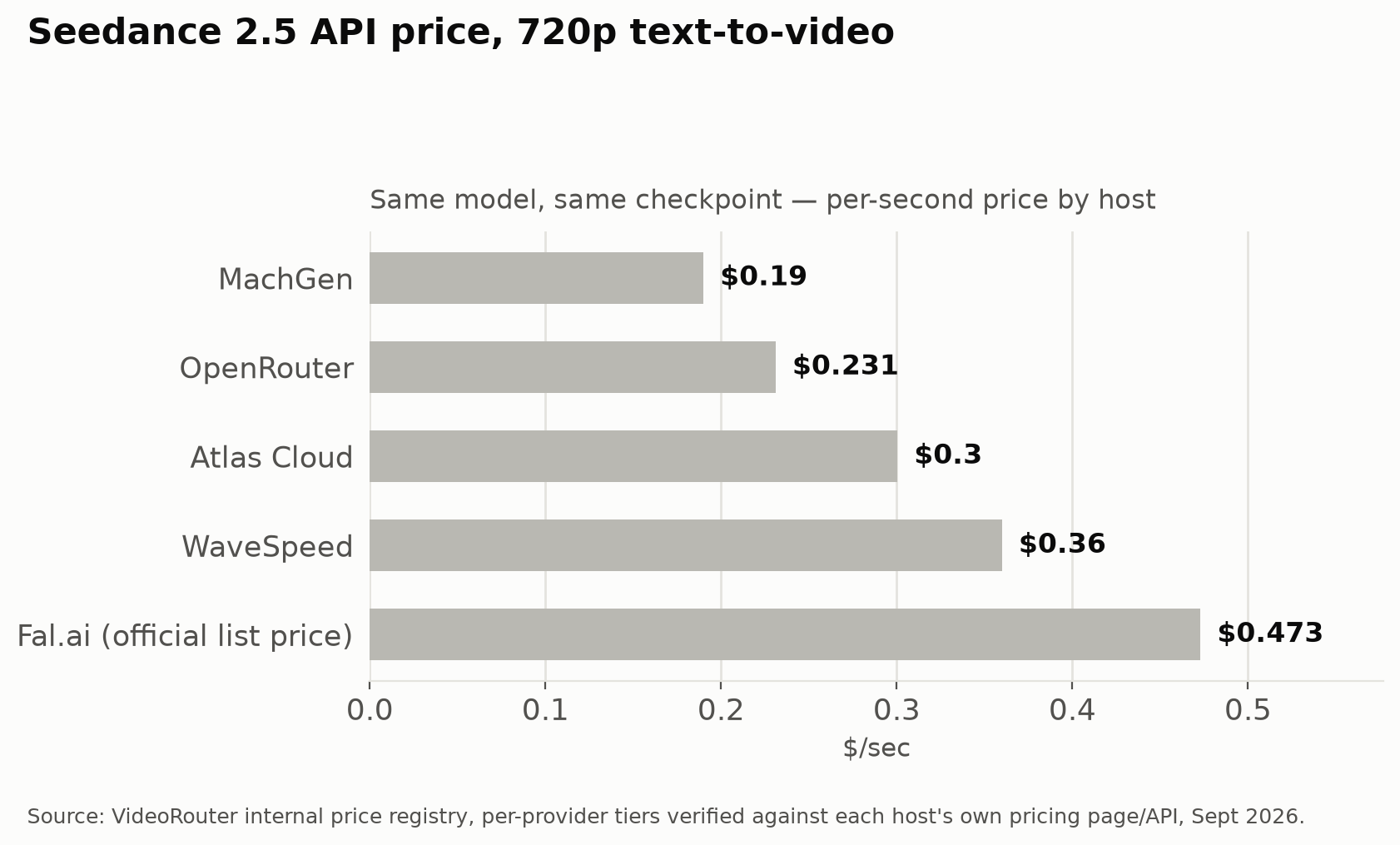
The Seedance 2.5 chart above makes the point visually: this is one model, one resolution tier, one checkpoint — and the price more than doubles depending purely on which provider is serving the request underneath. Nothing about the output changes. The only variable is which host's infrastructure and margin structure you're paying into.
Why the gap exists
It's worth understanding why this happens instead of just accepting it as a curiosity. Video generation models are typically released by one creator — ByteDance for Seedance, Alibaba for Wan, Google for Veo, MiniMax for their own line — and then licensed or opened up for other companies to host. Each of those hosting companies runs its own GPU fleet, negotiates its own compute costs, and sets its own margin on top. Some platforms specialize in being fast to list a model the day it's released and charge closer to the official rate. Others specialize in being a lower-cost reseller, buying compute more efficiently or accepting thinner margins to win price-sensitive traffic. A few, including general-purpose LLM routers that have recently expanded into video, are pricing a newer product line and haven't necessarily optimized it yet — see the Wan 3.0 Prime number in the table above, where a real live-invoiced test against one such platform came back at roughly 2.5x that platform's own advertised catalog rate for the model, and more than 3x the cheapest tested host. That's not an accusation of bad faith; it's simply what happens when a listing sits behind a single upstream provider with no second host inside the same platform to undercut it.
The turbo/fast effect
There's a second pattern worth knowing about even if you don't have exact numbers for every variant: within almost any video model family, the flagship checkpoint and the "turbo," "fast," or older-generation variant of the same family are priced very differently, and not by a small margin. Model creators typically ship a flagship model optimized for quality first, then follow up with a distilled or lower-step variant optimized for speed and cost. Hosts pass that cost difference straight through. You can see a version of this pattern in the numbers above too — Veo 3.1's flagship tier runs $0.20 to $0.40 per second depending on host, while Google's own "Fast" tier of the same model line is priced dramatically lower, commonly somewhere in the $0.03 to $0.15 per second range depending on which host is serving it. If your use case can tolerate a faster, lower-fidelity checkpoint — background video, drafts, high-volume batch generation, anything where you're not shipping the flagship output directly to a paying customer — checking whether a turbo or fast variant exists for the model family you're using is often the single biggest lever you have on cost, bigger than shopping between hosts for the same flagship checkpoint.
The general shape holds across model families even where we don't have a second specific number to quote here: a distilled or "fast" checkpoint of a video model line commonly runs well below the flagship release's price on the same host, because it's cheaper to compute and the creator prices it that way from the start.
Resolution and duration multiply the gap, not just the base rate
Per-second pricing tables like the one above make it easy to forget that duration and resolution stack multiplicatively on top of whichever per-second rate you're comparing. A five-second clip costs five times the per-second rate; doubling resolution or moving to a higher-fidelity tier of the same model often changes the per-second rate itself, not just the output size. That means the dollar gap between "cheapest host" and "priciest host" for a given model doesn't stay fixed as your usage grows — it scales with it. At low volume, a $0.19 versus $0.47 per-second difference on Seedance 2.5 might look like pocket change. At the volume a shipping product actually generates, that same per-second gap turns into hundreds or thousands of dollars a month, purely as a function of which host happens to be handling the request. This is part of why picking a host once, early, and never revisiting the decision is a more expensive habit than it looks like at first — the mistake doesn't stay small as usage scales, it scales right along with it.
It's also worth being honest that price isn't the only variable that matters when picking a host — latency, queue behavior, output consistency, and uptime all factor into a real decision. But those are largely orthogonal to which host happens to be cheapest for a given model on a given day, and a lot of teams never actually check the price question at all, defaulting instead to whichever platform they integrated against first. The comparisons in this article are about making sure price is at least part of that decision, not the only part of it.
Three worked comparisons
It helps to see what this looks like in dollars at realistic volumes rather than just per-second rates.
Say you're generating 500 five-second Seedance 2.5 clips a month at 720p. At MachGen's $0.19/sec rate, that's 500 × 5 × $0.19 = $475/month. Run the identical job through Fal.ai at $0.473/sec and the same workload costs 500 × 5 × $0.473 = $1,182.50/month — a difference of over $700/month for output that is, model-for-model, the same.
Now take Wan 3.0 Prime at a lower resolution tier, say 1,000 three-second clips a month. Through Pika's resale channel at $0.051/sec, that's 1,000 × 3 × $0.051 = $153/month. Route the same volume through the platform where our live-invoiced test landed at $0.17/sec, and you're at 1,000 × 3 × $0.17 = $510/month — more than three times the cost for the same model, the same output.
One more: a smaller team doing 200 MiniMax H3 clips a month at four seconds each. MachGen's $0.04/sec rate puts that at 200 × 4 × $0.04 = $32/month. The official MiniMax rate, WaveSpeed, and Pika's resale channel are all clustered at $0.08/sec, doubling the bill to $64/month for the same volume. That's a small absolute number at this scale, but the ratio is identical to the larger examples above — and it compounds fast once volume grows past a hobby project.
None of these are edge cases. They're the same model, same tier, same output, with the only variable being which host's API you happened to pick.
Why a static "top 5 cheapest" list goes stale
Here's the problem with writing (or reading) an article like this one and treating its numbers as permanent. Hosting providers change their prices. Discounts expire or get extended. New platforms enter with promotional rates that undercut everyone for a few months and then normalize. A model that's cheapest at one host today can lose that position within weeks if a competitor drops its rate or a new reseller enters the market. Atlas Cloud's Seedance 2.5 rate in the table above, for instance, is a current discounted rate — twenty percent off their own official price — which by definition is a number that can move. Any blog post, including this one, is a snapshot of pricing on the day it was written. Six months from now, some of the "cheapest host" entries in that first table will likely have changed, and a reader relying on a screenshot of this article to make a purchasing decision could easily end up routing traffic to what used to be the cheapest option and no longer is.
That's the actual argument for using a live comparison tool instead of a static list: not that static lists are useless (this one reflects real, verified pricing as of today), but that pricing itself doesn't stay static, and a list can't update itself.
Where VideoRouter fits
This is the exact problem VideoRouter (videorouter.sh) was built around. Instead of publishing a snapshot ranking and hoping it stays accurate, VideoRouter shows a live per-model price comparison table on each model's page, pulled from its own cross-provider price registry — the same underlying data used for the numbers in this article — so you can check which host is currently cheapest for the specific model and tier you're about to call, on the day you're calling it, rather than relying on a blog post written months earlier. It also handles automatic failover across hosting providers for the same model, so if the host you're routing to goes down or slows down, requests can shift to another provider serving the identical checkpoint without you having to hardcode that logic yourself. For a market where the cheapest option changes by model and by month, that's less a convenience feature and more a fairly direct answer to the question this whole article has been circling: cheapest according to what, and cheapest as of when.