Video Model API Gateway: OpenRouter vs fal.ai vs Replicate vs WaveSpeed
If you're building a product on top of Seedance, Kling, Veo, Wan, Flux, or any of the dozen other video and image models that shipped in the last year, you've probably noticed a problem: every model has its own SDK, its own auth scheme, its own polling logic for async jobs, and its own pricing unit (per second, per megapixel, per credit). Calling five providers directly means maintaining five integrations.
That's the gap "AI API gateways" (also called model routers or inference aggregators) fill — one endpoint, one API key, many models behind it. But not all gateways are the same shape, and — this is the part that catches people off guard — the same underlying model can cost wildly different amounts depending on which gateway you call it through. This article walks through the major players for video and image generation specifically (as opposed to text/chat, where routing is a much older, more commoditized problem), what actually differs between them, and what that difference costs you in dollars.
At a glance
| OpenRouter | fal.ai | Replicate | WaveSpeed AI | Atlas Cloud | Pika (resale) | |
|---|---|---|---|---|---|---|
| Models | ~broad chat catalog; video/image added 2026, narrower | Deep diffusion/media catalog, fast to add new releases | Broadest community catalog + curated "Official Models" | 1,000+ models, image/video/audio/3D | 400+ models, chat+image+video+audio | Pika's own models + resold third-party models |
| API shape | Unified OpenAI-style endpoint | Per-model REST endpoints, consistent schema | Per-model REST endpoints, async predictions | Per-model REST endpoints | Unified pay-as-you-go endpoint | REST, via api.dev.pika.art |
| Providers per model | Usually single-sourced for video/image | Single-sourced (fal hosts it directly) | Single-sourced (Replicate hosts it) | Single-sourced | Single-sourced | Single-sourced |
| Pricing unit | Per-second (video), per-image | Per-second, per-image, per-megapixel | GPU-second or per-output, depends on listing | Per-second, per-image, scales with resolution/duration | Per-second, per-image | Per-second, per-image |
| Failover across hosts | No — one upstream per listing | No | No | No | No | No |
| Billing model | Pay-as-you-go, per-request | Prepaid credits, 365-day expiry | Pay-as-you-go | Pay-as-you-go, credit top-ups | Pay-as-you-go, no subscription | Credits (consumer) / pay-as-you-go (API) |
| Image generation | Yes, 30+ models, 8 providers (as of mid-2026) | Yes, deep catalog | Yes | Yes | Yes | Yes (own + resold) |
| Video generation | Yes, added April 2026 | Yes | Yes | Yes | Yes | Yes |
The important row is the fourth one. None of these platforms fail over across hosts for the same model — if you call Seedance 2.5 through WaveSpeed and WaveSpeed has an outage or a price change, you're not automatically routed to a cheaper or more available host serving the same checkpoint. That's a meaningfully different capability from "many models in one API," and it's the gap the rest of this article, and VideoRouter, are built around.
The gateways
OpenRouter
OpenRouter is best known as a chat-model router, but it added a video generation API in April 2026 and a unified image API in June 2026. It's a natural first stop because of that existing developer mindshare, and it does give you request/response normalization across providers.
The catch for media specifically: OpenRouter's video and image catalogs are narrower than its text catalog, and (unlike its LLM routing, where the same model is often served by several inference providers with automatic failover) most video and image models on OpenRouter are single-sourced — there's one upstream provider behind each entry, so "routing" mostly means picking a model, not shopping across providers for the same model. We cover this in more depth in a companion article on whether OpenRouter is a good fit for video/image.
fal.ai
fal.ai is a serving platform built specifically for diffusion and generative media models, and it's usually the fastest place to get a newly released open-weight video or image model live behind an API — often within days of a model's release. Pricing is per-model and transparent (published per-image or per-second rates on fal.ai/pricing), billed only on successful generations, on a prepaid-credit model. Image generation on fal.ai runs roughly $0.02–$0.09 per image depending on the model (Flux Schnell around $0.025, Flux Pro around $0.05); video runs from about $0.05/sec (Wan 2.5) up to $0.40/sec (Veo 3).
Atlas Cloud
Atlas Cloud positions itself as a broad, pay-as-you-go aggregator — 400+ models across chat, image, video, and audio behind one endpoint, no subscriptions. It tends to run at the aggressive end of the price range: images from roughly $0.003–$0.032 each, video from about $0.038/sec, and it's frequently the cheapest place to find older or "turbo/fast" variants of popular open-weight models (e.g., Wan 2.2 Turbo Spicy around $0.026/sec) once the newest generation has pushed them down the priority list elsewhere.
Replicate
Replicate popularized the "run any model on serverless GPUs" model, and it still has one of the broadest catalogs of community-published models. Its pricing is a mix: most community models bill by raw compute time (GPU-second rates from about $0.000225/sec on a T4 up to $0.0122/sec on an 8×H100 cluster), while a curated set of "Official Models" (including Veo and Kling video) bills by output unit instead. This dual model means the same nominal task can be priced very differently depending on which listing you call — text-to-image models on Replicate commonly land around $0.04–$0.12/image, and video models frequently exceed $0.50 per generation, both noticeably above fal.ai's equivalent rates.
WaveSpeed AI
WaveSpeed markets itself on raw inference speed as much as price, with a catalog north of 1,000 models spanning image, video, audio, and 3D. Pricing is per-model and shown live next to the generate button before you submit, scaled by the parameters you choose (resolution, duration, batch size). Published examples range from about $0.005 for a Flux Dev image up to $0.15/sec for Kling O3 video — a wide enough band that "WaveSpeed is cheap" or "WaveSpeed is expensive" both depend entirely on which model you're calling.
Pika Labs
Pika is a bit different from the others on this list: it's a model creator, not a gateway. Pika doesn't publish a first-party API — if you want programmatic access to Pika's video models, you go through a reseller, most commonly fal.ai, where Pika v2.2 text-to-video runs about $0.20 for a 5-second 720p clip and $0.45 at 1080p. It's a useful example of a broader pattern: many model creators (Pika included) don't run their own developer-facing API at all, so "which gateway sells this model" is a real decision even before you get to price.
Why the price difference is so large
Put these numbers side by side and the spread is stark. For comparable video generation work, published per-second rates across these platforms span roughly $0.022–$0.40 per second — a model at the top of that range can cost more than 15x the same class of workload at the bottom. Image generation shows the same pattern at a smaller scale: commonly $0.003–$0.12 per image across the platforms above, a 40x spread for what a user experiences as "generate one picture."
Pull a single, identical model across every host and the pattern holds even more concretely. Here's ByteDance's Seedance 2.5 at 720p, same checkpoint, priced by five different gateways:
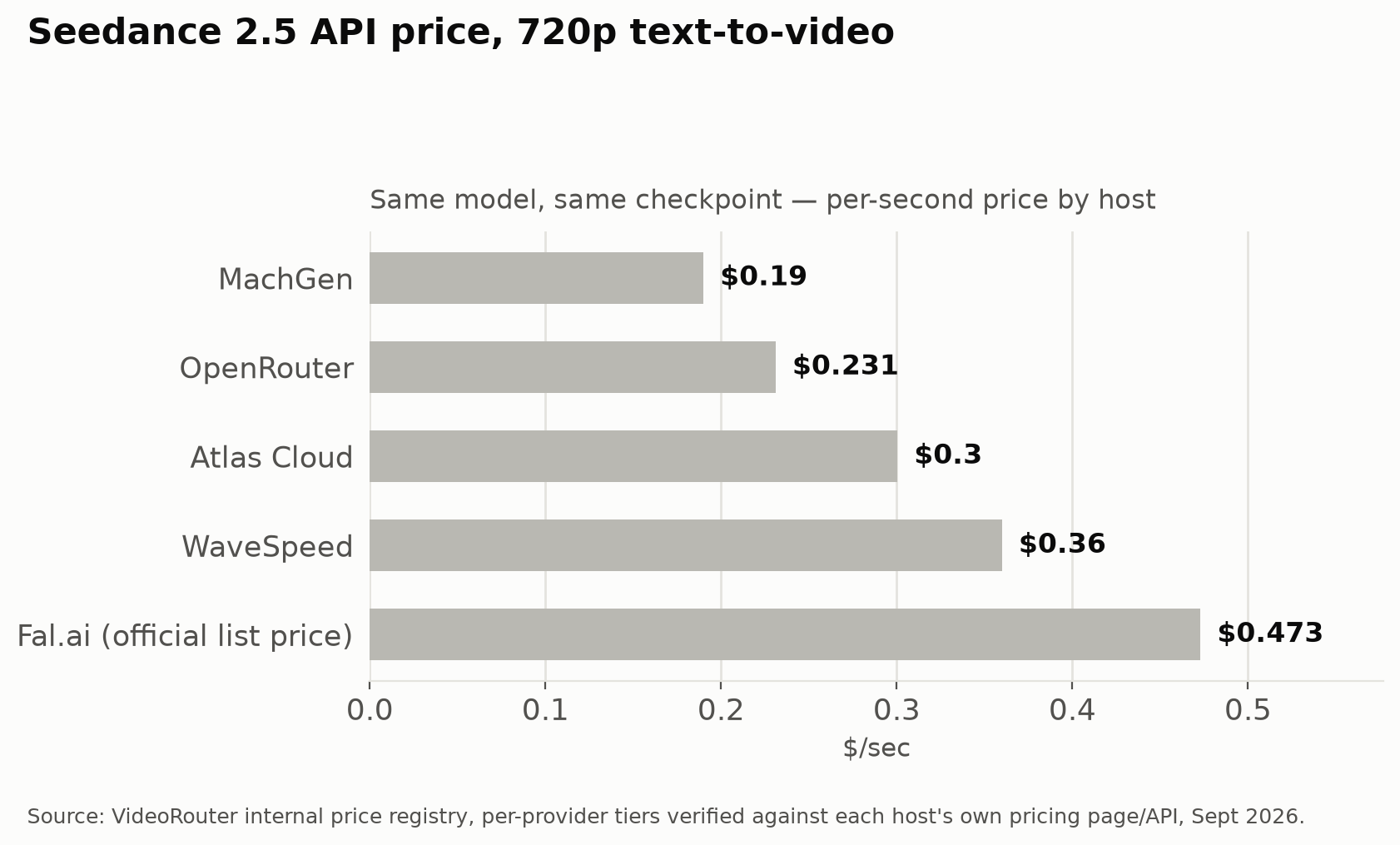
That's a 2.5x spread for literally the same model producing literally the same output. Nothing about quality, latency guarantees, or SLA changes that number — it's almost entirely a function of which host's markup you happen to be paying.
A few things drive this:
- Resale margin. Most of these gateways don't own the models they serve — they're calling the model creator's own API (or renting the GPUs to self-host an open-weight checkpoint) and adding a markup. Margins vary a lot by platform and by how much competitive pressure exists on a given model.
- Compute vs. output pricing. Platforms that bill by raw GPU-second (like much of Replicate's catalog) pass through hardware cost directly; platforms that bill a flat per-output rate (most of fal.ai, Atlas Cloud, WaveSpeed) have smoothed that into a single number, which can land above or below the "true" compute cost depending on how efficiently the model runs and how competitive the category is.
- Model generation. Older or "turbo/fast" variants of a model family are frequently priced far below the newest release, even when quality is close enough for many use cases — Wan 2.2 Turbo Spicy at ~$0.026/sec versus flagship video models above $0.15/sec is a good example.
- Model exclusivity. Some models genuinely have only one legitimate host (the creator's own API); others are open-weight and hosted by five different platforms, each free to set its own price with no coordination between them.
The practical implication
If you're building on top of video or image generation and you pick a single gateway, you're implicitly accepting whatever markup that gateway has put on the specific model you use — and you have no visibility into whether the model next door, on a different platform, does the same job for a fraction of the cost. The fix most teams eventually land on is the same one that happened for LLM routing a few years ago: a layer that tracks live pricing across providers and lets you route to (or at least compare against) the cheapest legitimate host for a given model, instead of hardcoding one vendor's API and its markup into your product.
That's the specific problem VideoRouter is built to solve for video and image models — one API, live cross-provider price comparison per model, and automatic failover — but regardless of which tool you end up using, the takeaway from this research holds on its own: check the per-second or per-image rate before you commit to a provider. For popular models, the difference is rarely small.