AI Video API Pricing Comparison 2026
This page is meant to function as a reference, not a one-time news post. AI video and image generation pricing changes often enough that a comparison written once and left alone stops being trustworthy within a few months — providers add discounts, launch new tiers, adjust rates as GPU costs shift, and new entrants show up with promotional pricing. Our plan is to keep this page updated as that happens, rather than let it quietly go stale the way most "pricing comparison" posts do. What follows is where things stand as of September 2026: how seven major ways to access video and image generation models — OpenRouter, fal.ai, Replicate, WaveSpeed AI, Atlas Cloud, Pika Labs (as a reseller, not a first-party model host), and VideoRouter — actually price things, structure billing, and differ in catalog breadth and provider redundancy.
Before the table, a word on why this is harder to compare than it looks. "Pricing" for video generation isn't one number the way an LLM's per-token price is close to one number. It varies by model, by resolution, by duration, sometimes by provider serving the same model, and the billing structure underneath (prepaid credits vs. metered pay-as-you-go vs. subscription) changes what a "price" even means in practice. The table below normalizes what it can and is explicit about where it can't.
The comparison table
| Platform | Pricing model / unit | Typical video $/sec | Typical image $/image | Catalog breadth | Cross-provider failover | Live per-model price comparison | Billing structure |
|---|---|---|---|---|---|---|---|
| OpenRouter | Per-model listing, usually one upstream provider per model | $0.03–$0.47+ depending on model/tier (see worked examples below) | Varies by model; part of a 30+ model image catalog across 8 providers | Video: added April 2026, day-one models included Seedance 2.0/1.5, Veo 3.1, Wan 2.7/2.6, Sora 2 Pro. Image: added June 2026, 30+ models across Google, OpenAI, Black Forest Labs, Recraft, ByteDance, Sourceful, Microsoft, xAI (includes Nano Banana 2 / Seedream 4.5 as of Sept 2026) | Provider-routing params (provider.order, only, ignore, sort, allow_fallbacks) exist and work for its broader LLM catalog; for most individual video/image listings there's typically a single upstream host, so failover across hosts for the same media model is limited today |
No — one price per model listing | Pay-as-you-go, unified billing with OpenRouter's chat/LLM usage |
| fal.ai | Per-model, transparent pricing published at fal.ai/pricing | Model-dependent; among the pricier hosts for some models (e.g. $0.473/sec for Seedance 2.5 720p), competitive on others via resale listings (e.g. Wan 3.0 Prime resold via Pika at $0.051/sec) | Model-dependent; competitive on commoditized models (e.g. Seedream 4.0 at ~$0.03/image) | Very broad; usually fastest to list newly released open-weight models | No — fal.ai serves as the single upstream for most of its own listings | No | Prepaid credits, no subscription |
| Replicate | Mix of raw GPU-second billing (most community models) and flat per-output pricing (curated "Official Models" including Veo/Kling) | $0.20/sec for Veo 3.1 flagship (Official Models flat pricing); GPU-second billing varies widely for community models | Varies; community catalog pricing is GPU-second based and not directly comparable per-image | Huge community model catalog plus a smaller curated Official Models set | No — one path per model | No | Pay-as-you-go, GPU-second or flat-output billing depending on model |
| WaveSpeed AI | Per-model, shown live before submission, scaled by resolution/duration/batch size | $0.075/sec (Wan 3.0 Prime), $0.36/sec (Seedance 2.5 720p), $0.40/sec (Veo 3.1 flagship), $0.08/sec (MiniMax H3) | $0.027/image (Seedream 4.0) | 1,000+ models; markets itself on inference speed | No — single-provider listings | No | Pay-as-you-go |
| Atlas Cloud | Per-model, pay-as-you-go aggregator pricing | $0.300456/sec (Seedance 2.5 720p, current discounted rate, -20% off official $0.37557), $0.0612/sec (Wan 3.0 Prime 480p) | Not covered in current registry | 400+ models spanning chat, image, video, audio; often among the cheaper hosts for older/turbo variants | No — aggregates listings, doesn't fail over between them for the same model | No | Pay-as-you-go, no subscription |
| Pika Labs (as reseller) | Consumer app uses credit-based subscriptions; developer-facing resale (via fal.ai and Pika's own api.dev.pika.art) is per-model metered pricing | $0.051/sec (Wan 3.0 Prime, cheapest tested host for that model), $0.20/sec (Veo 3.1 flagship, tied cheapest), $0.08/sec (MiniMax H3) | $0.03/image (Seedream 4.0) | Resells Pika's own models plus many others (Wan, Seedream, Veo, MiniMax H3) — functions as a small aggregator itself, not a single-model vendor | No — each resold model has one path through Pika's channel | No | Consumer app: credit-based subscription. Developer API resale: metered pay-as-you-go |
| VideoRouter | Per-model, sourced from the cheapest verified host in its cross-provider registry | Varies by model — shows the actual current range across hosts rather than one fixed number | Varies by model, same approach | Spans the models available across its underlying hosting providers (MachGen, Atlas Cloud, WaveSpeed, fal.ai, DashScope, OpenRouter, Pika, and others depending on model) | Yes — automatic failover across hosting providers for the same model | Yes — live per-model price comparison table on each model's page | Flat low fee on top of the underlying host's price, rather than a hidden markup baked into a single host's rate |
A few things to note about reading this table honestly. Where a "typical $/sec" cell shows one number, that's a real price point from our own registry for a specific model and tier, not an average across the platform's entire catalog — video pricing genuinely doesn't collapse into a single representative number, and any comparison claiming otherwise is oversimplifying. Where we didn't have verified numbers for a platform-model pairing, we left it out rather than estimate.
What the "no failover, no live comparison" columns actually mean
The two columns worth lingering on are cross-provider failover and live per-model price comparison, because every platform in this table except VideoRouter shows "No" on both — and that's not a coincidence, it's structural. OpenRouter, fal.ai, Replicate, WaveSpeed, Atlas Cloud, and Pika's resale channels are each, for a given video or image model, typically a single path to a single upstream host. That's true even for platforms with enormous overall catalogs like WaveSpeed's 1,000+ models or Atlas Cloud's 400+ — breadth of catalog and redundancy within a single listing are different properties, and having a lot of models doesn't mean any individual model has more than one host behind it on that platform. If that one host has an outage, slows down, or raises its price, there's no automatic second option inside the same platform to shift to. You'd need to notice, then manually switch to a different platform's listing for the same model — assuming you'd built your integration to make that easy, which most direct integrations aren't.
That gap is exactly what "cross-provider failover" and "live per-model price comparison" are answering. They're two sides of the same underlying capability: knowing, for any given model, which hosts currently serve it, what each one currently charges, and being able to route to (or fail over to) whichever one is actually up and priced well right now instead of whichever one you happened to integrate against first.
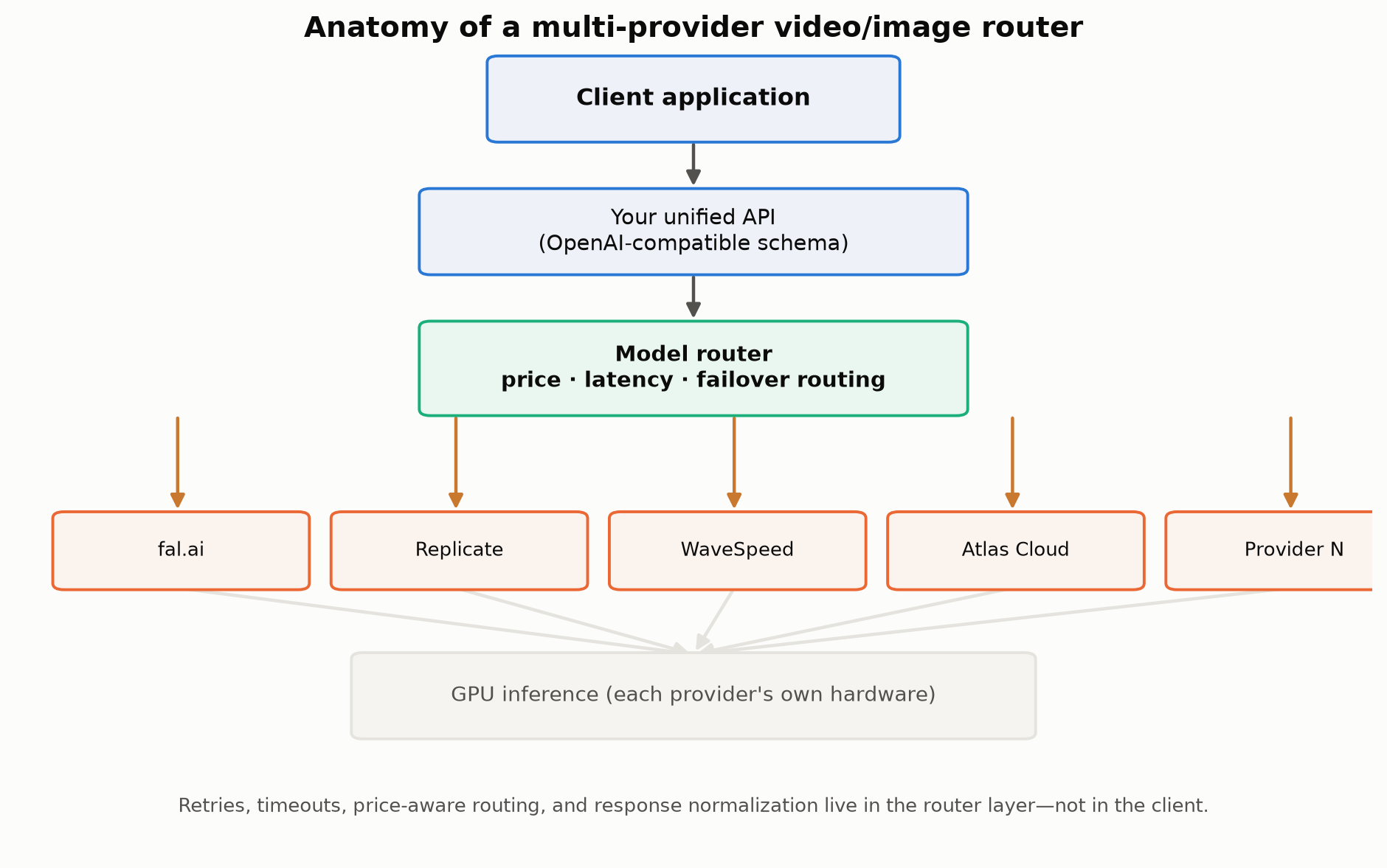
The diagram above is the structural difference in one picture: a direct integration is a single line from your application to one host for one model, while a router sits in between and can see, and choose between, several hosts serving the same model at once. Everything in the table's failover and live-comparison columns is downstream of that one architectural choice.
Three worked examples using real numbers
To make the table concrete, here's what it looks like to actually run workloads through a few of these platforms.
Example 1: Seedance 2.5 at moderate volume. A team generating 300 clips a month, five seconds each, at 720p. Through WaveSpeed at $0.36/sec: 300 × 5 × $0.36 = $540/month. Through Atlas Cloud's current discounted rate of $0.300456/sec: 300 × 5 × $0.300456 ≈ $450.68/month. Through fal.ai's official $0.473/sec: 300 × 5 × $0.473 = $709.50/month. Same model, same output, a difference of roughly $260/month between the cheapest and priciest of these three platforms alone — before even counting MachGen, which sits lower still at $0.19/sec ($285/month for the same volume).
Example 2: Wan 3.0 Prime with a redundancy scenario. A product doing 800 three-second clips monthly at 480p, split across two hosts for redundancy: half through DashScope (Alibaba's own official API) at $0.068/sec, half through WaveSpeed at $0.075/sec. That's (400 × 3 × $0.068) + (400 × 3 × $0.075) = $81.60 + $90 = $171.60/month for a manually-built two-host redundancy setup. The same total volume routed entirely through the cheapest verified host, Pika's resale channel at $0.051/sec, would cost 800 × 3 × $0.051 = $122.40/month — cheaper than the "redundant" split above, while still needing a mechanism to detect and fail over if that single host has a problem.
Example 3: mixed model, single-vendor OpenRouter lock-in risk. A team that standardized on OpenRouter for both chat and video, running Wan 3.0 Prime at moderate volume — 500 two-second clips a month. Our own live-invoiced test against OpenRouter's Wan 3.0 Prime endpoint came back at $0.17/sec actually billed, roughly 2.5x OpenRouter's own advertised catalog price for that model. At that real rate: 500 × 2 × $0.17 = $170/month. The same volume through the cheapest verified host for that model, Pika's resale channel at $0.051/sec: 500 × 2 × $0.051 = $51/month — a difference of $119/month, more than 3x, for output that is the same underlying Wan 3.0 Prime checkpoint either way.
None of these examples require unusual assumptions. They're ordinary monthly volumes for a small-to-midsize product, using pricing that's already in the table above.
A note on timeliness: single-vendor dependency is a live risk right now
There's a reason "which platforms actually fail over across hosts" isn't a hypothetical concern in 2026. OpenAI notified developers on March 24, 2026 that its Videos API and the entire Sora 2 model family (sora-2, sora-2-pro, and dated snapshots) would be deprecated and removed from the API on September 24, 2026 — nine days from when this comparison was last checked. OpenAI's deprecation notice lists no recommended replacement model; there is currently no OpenAI-hosted video model to migrate to. This is separate from the consumer Sora app, which was already discontinued back in April 2026. Third-party resellers — Pika, Replicate, DeepInfra, and MachGen among them — currently still serve Sora 2 Pro because they call OpenAI's backend under their own business agreements, but that's an "as of now" arrangement, not a guarantee. Anyone who built directly against OpenAI's native Sora 2 API needs a new host for that workload imminently, and anyone building against a single vendor for any model, video or otherwise, just watched a live example of why that's a real operational risk and not just a theoretical one.
Where VideoRouter fits
VideoRouter (videorouter.sh) is the row in the table above built specifically to answer the question the rest of this comparison keeps raising: which host is cheapest right now, for this specific model, and what happens if that host has a problem. It's one OpenAI-compatible-style API across video, image, and speech models spanning many hosting providers, with a live per-model price comparison table on each model's page (drawing on the same kind of cross-provider registry data used throughout this article) and automatic failover across hosts if one goes down. Rather than a hidden markup folded into a single host's price, it applies a flat low fee on top of whichever verified host is actually serving the request. Given how often the "cheapest host" and "most reliable host" answers change per model, as this comparison has hopefully shown with real numbers rather than assertions, that's a fairly direct answer to a problem the rest of the table demonstrates is both real and ongoing.