Where to Get the Cheapest Seedance API (2.0, 2.0 Fast, 2.0 Mini, and 2.5 Compared)
"Cheapest Seedance API" is actually two separate questions, and most people only ask the first one. The first is "which host is cheapest for the Seedance checkpoint I'm already using." The second — usually more valuable, and almost never asked — is "am I even using the right Seedance checkpoint for what I'm building." ByteDance ships Seedance as a family: the flagship 2.5, the previous-generation 2.0, and two smaller/faster 2.0 variants (2.0 Fast, 2.0 Mini). The price difference between the cheapest host for the same checkpoint is real but bounded — 2 to 3x. The price difference between checkpoints, at each one's own cheapest host, is not bounded the same way. That's the number worth knowing before you shop between hosts at all.
The whole family, cheapest verified host, 480p
| Model | Cheapest host | Price (480p) | vs. Seedance 2.5 |
|---|---|---|---|
| Seedance 2.0 Mini | Atlas Cloud | $0.0112/sec | 7.6x cheaper |
| Seedance 2.0 Fast | Atlas Cloud | $0.0270/sec | 3.1x cheaper |
| Seedance 2.0 | MachGen | $0.060/sec | 1.4x cheaper |
| Seedance 2.5 | MachGen | $0.085/sec | baseline |
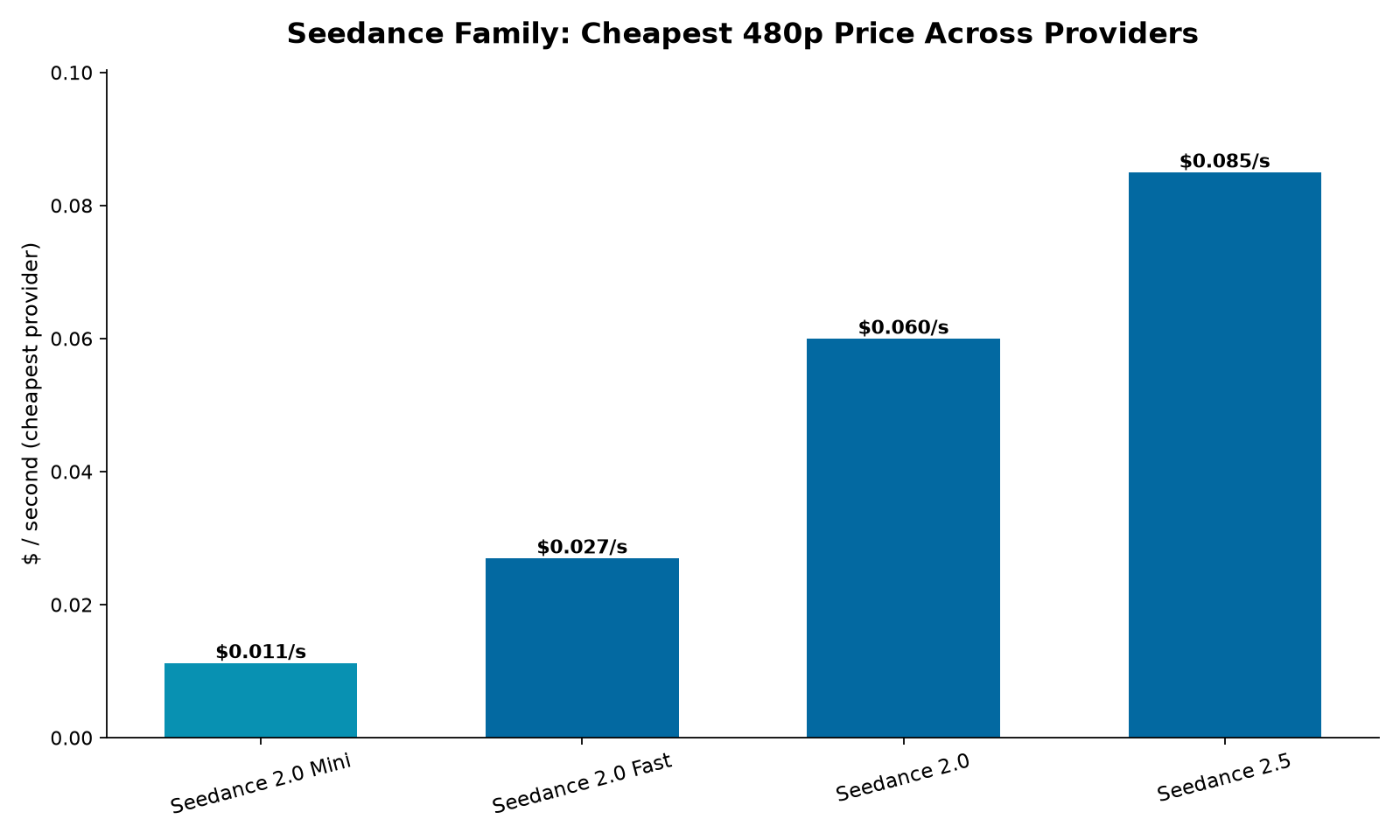
Seedance 2.0 Mini, at its cheapest host, is under 15% of the price of Seedance 2.5 at its cheapest host — a bigger gap than you'll find between any two hosts serving the same checkpoint. If your use case can tolerate the quality difference between Mini and the flagship, that decision saves more money than any amount of host-shopping on 2.5 ever will.
Full per-provider breakdown, 480p tier
| Provider | Seedance 2.0 Mini | Seedance 2.0 Fast | Seedance 2.0 | Seedance 2.5 |
|---|---|---|---|---|
| Atlas Cloud | $0.0112 | $0.0270 | $0.0900 | $0.1397 |
| MachGen | $0.0280 | $0.0450 | $0.0600 | $0.0850 |
| TOAPIS | $0.0327 | $0.0524 | $0.0651 | $0.0947 |
| OpenRouter | $0.0336 | $0.0404 | $0.0673 | $0.1028 |
| Fal | $0.0721 | $0.2419* | — | $0.2205 |
| WaveSpeedAI | $0.0600 | $0.1000 | $0.1200 | $0.1800 |
*Fal prices Seedance 2.0 Fast as a flat per-clip rate rather than a 480p-specific tier — shown here for reference, not a like-for-like comparison to the tiered rows above it.
A pattern jumps out immediately: MachGen is cheapest for the two larger checkpoints (2.0 and 2.5), but Atlas Cloud is cheapest for the two smaller/faster ones (2.0 Fast and 2.0 Mini). There's no single "cheapest Seedance host" — the answer depends on which checkpoint you're calling, which is exactly the trap a static "top provider" recommendation falls into.
When each checkpoint is the right call
Seedance 2.5 is the flagship for a reason — best prompt adherence, best motion coherence, the checkpoint you reach for when output quality is directly customer-facing and you're not generating at volumes where cost dominates the decision.
Seedance 2.0 is a generation behind 2.5 but meaningfully cheaper at every host that serves both (roughly 30-45% less at the same tier). Worth testing directly against 2.5 for your specific prompts before assuming you need the newer checkpoint — the quality gap is real but narrower than the price gap for a lot of use cases.
Seedance 2.0 Fast trades some motion quality for a distilled, lower-step generation process, which is why it's priced at roughly a third of full 2.0's rate. Good fit for drafts, previews, high-volume batch jobs, or any pipeline where a human reviews output before it ships and can regenerate with the flagship checkpoint only for the clips that need it.
Seedance 2.0 Mini is the cheapest tier in the family by a wide margin and the right default for anything genuinely high-volume and non-customer-facing: internal tooling, A/B-testing prompt variations before committing flagship-tier spend, or any workflow generating far more clips than a human will ever individually review.
Worked example: a tiered pipeline
Take a product generating 5,000 clips a month, where roughly 80% are draft/preview generations a user might discard and 20% are final, shipped output.
- All-flagship approach (5,000 clips, all Seedance 2.5 at MachGen, $0.085/sec, 4 sec avg): 5,000 × 4 × $0.085 = $1,700/month
- Tiered approach (4,000 drafts on Seedance 2.0 Mini at Atlas Cloud, $0.0112/sec; 1,000 finals on Seedance 2.5 at MachGen, $0.085/sec, 4 sec avg): (4,000 × 4 × $0.0112) + (1,000 × 4 × $0.085) = $179.20 + $340 = $519.20/month
That's a 70% reduction in spend for the same total clip volume, purely from routing draft-tier traffic to the cheapest checkpoint that's good enough for a draft, and reserving the flagship spend for output that actually ships. This is a bigger lever than shopping hosts for a single checkpoint, and the two aren't mutually exclusive — you'd want to do both.
A second worked example: pure volume, no tiering
Not every product can tier drafts vs finals — sometimes every clip you generate ships. For that case, the checkpoint choice alone (independent of tiering strategy) is still the biggest lever. Take 10,000 clips a month at 4 seconds average, all shipped:
- All Seedance 2.5, MachGen: 10,000 × 4 × $0.085 = $3,400/month
- All Seedance 2.0, MachGen: 10,000 × 4 × $0.060 = $2,400/month
- All Seedance 2.0 Fast, Atlas Cloud: 10,000 × 4 × $0.027 = $1,080/month
Dropping from the flagship to 2.0 Fast — without any tiering logic, just a checkpoint swap — cuts spend by 68% at this volume. Whether that's viable depends entirely on whether 2.0 Fast's output quality clears your bar for shipped content, which is worth testing on your actual prompts rather than assuming either way.
Frequently asked questions
Is Seedance 2.0 Mini good enough for anything customer-facing, or only internal use? It depends heavily on your prompts and how discerning your audience is — Mini trades real quality for its price, and for some use cases (abstract backgrounds, short loops, low-stakes content) that trade is invisible to end users; for others (close-up character animation) it's obvious. Test on your actual prompts before deciding either way rather than assuming from the price alone.
Do all four checkpoints support the same resolution tiers? No — check each checkpoint's own listing at each host, since Mini and Fast don't necessarily support the same tier ceiling as full 2.0 or 2.5. The 480p comparisons in this article are the tier all four checkpoints support in common at the hosts shown.
Can I A/B test checkpoints automatically based on a quality threshold? That requires your own evaluation logic on top of the generated output — VideoRouter doesn't currently score generation quality for you, so a tiered pipeline like the one in the worked example above needs your own review step (human or automated) deciding which drafts get promoted to a flagship re-run.
Does switching checkpoints require a new integration? No — every Seedance checkpoint shares the identical /v1/videos request shape; only the model field changes, so the tiered pipeline above is a routing decision in your own application code, not four separate API integrations.
Is there a checkpoint even cheaper than 2.0 Mini? Not currently within the Seedance family specifically — Mini is the smallest ByteDance ships. If your use case is genuinely price-sensitive beyond what Mini offers, compare against other model families entirely (see MiniMax H3 API Pricing, which prices below Seedance 2.5 at several hosts) rather than assuming Seedance's cheapest tier is the market's cheapest option.
How to call any checkpoint in the family
All four checkpoints share the same request shape against VideoRouter's /v1/videos endpoint — only the model field changes:
import requests

job = requests.post(
    "https://videorouter.sh/api/v1/videos",
    headers={"Authorization": "Bearer llmr_sk_live_...", "Content-Type": "application/json"},
    json={
        "model": "bytedance/seedance-2.0-mini",  # swap for -fast, or drop the suffix for full 2.0 / 2.5
        "prompt": "a paper airplane gliding over a city at sunset",
        "resolution": "480p",
        "duration_secs": 4,
    },
).json()
Because the request shape doesn't change between checkpoints, moving traffic between tiers — say, promoting a Mini-generated draft's prompt to a 2.5 flagship run once a user approves it — is a one-line change to the model field, not a new integration. See Seedance 2.5 API Pricing: Every Provider Compared for the full per-tier pricing table on the flagship checkpoint alone, and /docs/video-generation for the complete request reference.