Veo 3.1 API Pricing Comparison Across Providers
Google's Veo 3.1 is one of the clearer examples in video generation of "buying direct doesn't mean buying cheap." Google's own listed rate for Veo 3.1 is $0.40/sec — and that exact same rate shows up at DeepInfra, MachGen, and WaveSpeedAI. But Replicate and Pika both serve the identical model at $0.20/sec, exactly half. If you're calling Veo 3.1 through Google, or through a host pricing it at parity with Google, you're paying double for no difference in output.
Full pricing table
| Provider | Price |
|---|---|
| Pika | $0.20/sec |
| Replicate | $0.20/sec |
| OpenRouter | $0.20/sec (720p/1080p), $0.40/sec (4K) |
| Google (direct) | $0.40/sec |
| DeepInfra | $0.40/sec |
| MachGen | $0.40/sec (720p/1080p), $0.60/sec (2160p) |
| WaveSpeedAI | $0.40/sec (all tiers) |
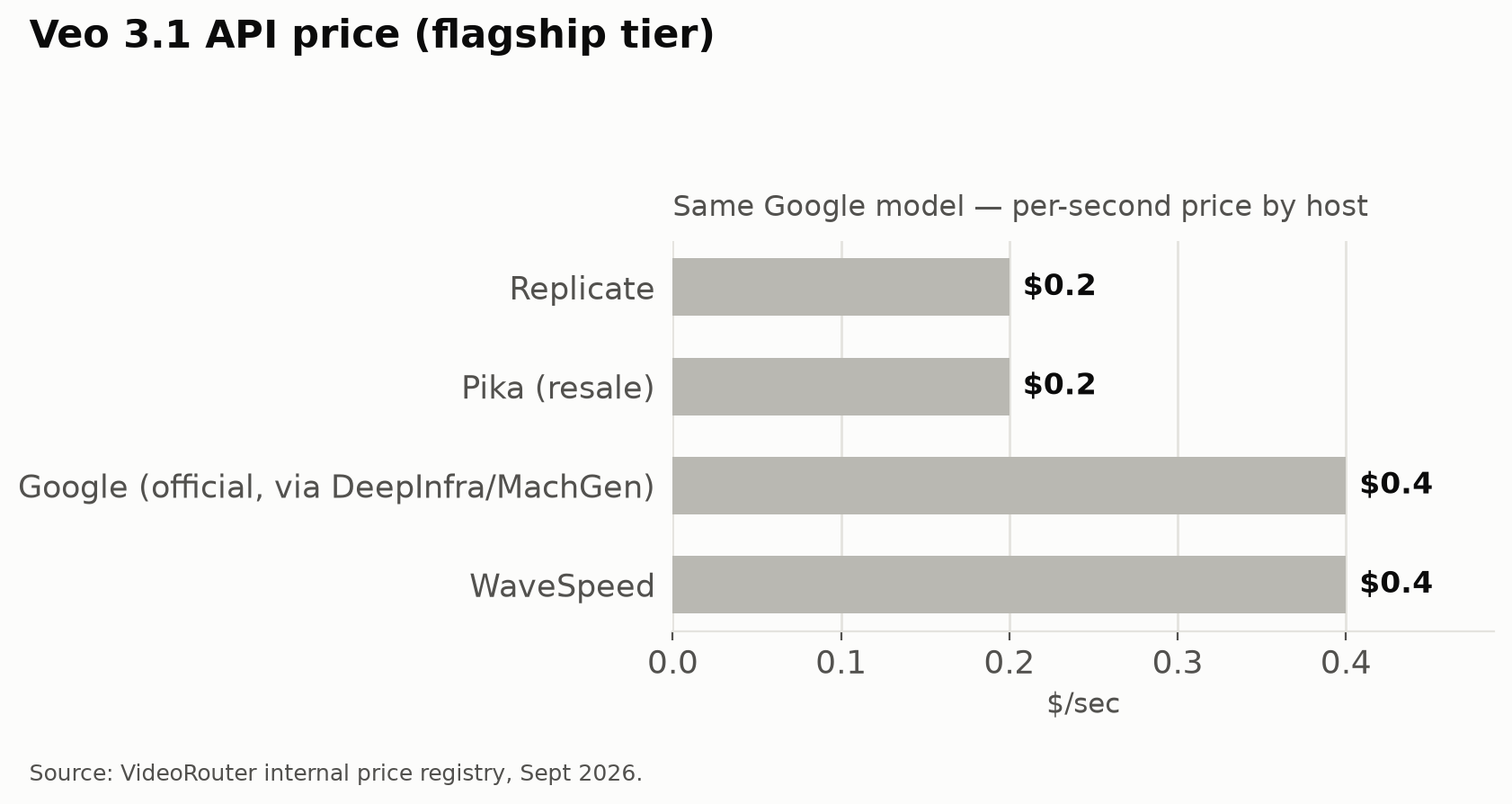
Three hosts — Pika, Replicate, and OpenRouter at the standard tiers — cluster at exactly $0.20/sec. Four others cluster at $0.40/sec. There's no gradient here, no middle tier: it's essentially a two-price market, and picking the wrong side of it costs exactly 2x on every second of video you generate.
The 2160p (4K) exception
At the highest resolution tier, the gap narrows in relative terms but MachGen still charges a premium ($0.60/sec vs. everyone else's $0.40/sec at 4K/2160p), while OpenRouter holds its 720p/1080p-to-4K ratio at exactly 2x ($0.20 → $0.40). If your use case needs the top resolution tier specifically, re-check pricing at that tier rather than assuming the standard-tier cheapest host stays cheapest — it usually does, but MachGen's 2160p rate is the one place in this table where the ranking shifts.
What this costs at real volume
A product generating 1,000 eight-second Veo 3.1 clips a month — a realistic volume for a premium feature gated behind a paid tier:
- Pika or Replicate: 1,000 × 8 × $0.20 = $1,600/month
- Google direct, DeepInfra, or WaveSpeedAI: 1,000 × 8 × $0.40 = $3,200/month
That's a flat $1,600/month difference — the entire cost of the cheaper option, again, for zero difference in the model or its output. At 5,000 clips a month, the gap is $8,000/month.
Why "call Google directly" isn't the cheap option
It's a common assumption that going straight to the model creator cuts out a reseller's margin and gets you the best price. Veo 3.1 is a clean counterexample: Google's own $0.40/sec rate is 2x what Replicate and Pika charge for the identical model. This happens because a model creator's own API is often priced to reflect the full cost of running first-party infrastructure at guaranteed availability, while a third-party host serving the same weights may be running leaner infrastructure, absorbing thinner margins to win volume, or simply pricing more aggressively because Veo access isn't their entire business the way it is Google's. The lesson generalizes past Veo specifically: never assume "direct from the creator" is the price floor without checking.
How Veo 3.1 compares to other flagship models on price
At its cheapest verified host ($0.20/sec, Pika/Replicate), Veo 3.1 is more expensive per second than Seedance 2.5's cheapest host ($0.085/sec, MachGen — see Seedance 2.5 API Pricing) but in the same range as MiniMax H3's mid-tier pricing before discounts. None of these are directly interchangeable — different models have different strengths, and picking a model purely on price without checking whether it actually produces acceptable output for your use case is its own mistake. But if you're evaluating multiple flagship-tier models for the same product feature and haven't yet locked into one, checking the cheapest-host price across candidates before committing is worth doing at the same time you're evaluating quality — the two decisions inform each other.
Veo 3.1 vs the Fast and Lite variants
Google also ships Veo 3.1 Fast and Veo 3.1 Lite — meaningfully cheaper checkpoints in the same family, not just resolution tiers of the flagship. If your use case doesn't need flagship-tier fidelity, that's a bigger lever than shopping hosts for the flagship model — see Veo 3.1 vs Veo 3.1 Fast vs Veo 3.1 Lite: Pricing and When to Use Each for the full breakdown.
A second worked example: annual cost at scale
Monthly numbers can undersell how large this gap gets over a year. A product generating 3,000 ten-second Veo 3.1 clips a month, annualized:
- Pika or Replicate: 3,000 × 10 × $0.20 × 12 = $72,000/year
- Google direct, DeepInfra, or WaveSpeedAI: 3,000 × 10 × $0.40 × 12 = $144,000/year
A $72,000/year difference, for identical output, purely as a function of which of these seven hosts happens to be serving the request. That's the kind of gap that changes a line item in an actual budget review, not just a rounding error in a per-second rate table.
Frequently asked questions
Is Google's own $0.40/sec rate ever justified over the $0.20/sec hosts? If you specifically need Google's own SLA, support relationship, or data-handling terms for compliance reasons, that's a real, non-price reason to pay the premium. Absent a specific requirement like that, there's no output-quality difference to justify it — it's the identical model.
Does DeepInfra offer anything WaveSpeedAI or MachGen don't, given they're priced the same? Possibly, in areas this article can't verify with the confidence it can verify price — infrastructure region, existing account relationships, or bundled pricing on other models you already use through one of them. Price alone doesn't distinguish between DeepInfra, MachGen, and WaveSpeedAI in this table; something else would need to.
Why is OpenRouter cheaper than Google direct here, when OpenRouter is a resale channel in most other comparisons in this series? OpenRouter's Veo 3.1 rate happens to match Pika and Replicate's $0.20/sec at the standard tiers — a different pattern than Kling, where OpenRouter carries a 67% markup (see Kling v3.0 API Pricing). Resale markups aren't a fixed property of OpenRouter as a platform; they vary by which underlying host OpenRouter itself is reselling for each specific model.
Can I test Veo 3.1's quality without committing to a specific host? Yes — since the model is identical across every host, a single test generation at whichever host you're already integrated with tells you what you need to know about the model itself; the host choice only affects price, not output quality.
How often should I re-check this comparison? There's no fixed interval that's correct for every team — the honest answer is "often enough that a price change wouldn't have gone unnoticed and cost you real money before you caught it," which for most teams means checking at whatever cadence you already review infrastructure spend, not waiting for a scheduled annual review.
How to call it
import time
import requests

resp = requests.post(
    "https://videorouter.sh/api/v1/videos",
    headers={"Authorization": "Bearer llmr_sk_live_...", "Content-Type": "application/json"},
    json={
        "model": "google/veo-3.1",
        "prompt": "a lighthouse beam sweeping across a foggy harbor",
        "resolution": "1080p",
        "aspect_ratio": "16:9",
        "duration_secs": 8,
    },
)
job = resp.json()

while job["status"] not in ("completed", "failed"):
    time.sleep(5)
    job = requests.get(
        f"https://videorouter.sh/api/v1/videos/{job['id']}",
        headers={"Authorization": "Bearer llmr_sk_live_..."},
    ).json()
With no explicit provider pin, requests route toward the cheaper healthy deployments (Pika, Replicate) rather than uniformly at random across all seven hosts in the table — see /docs/provider-selection to pin a specific host if you need deterministic routing. VideoRouter's Veo 3.1 model page keeps this comparison live as rates move.