Fal.ai vs WaveSpeedAI: Video API Pricing Compared
Unlike Fal vs Replicate, where one platform consistently undercuts the other across every shared model, Fal and WaveSpeedAI split the difference depending on which model you're looking at. That makes this comparison a better illustration of a general rule than a simple "pick this one" verdict: the right host isn't a property of the platform, it's a property of the specific model.
Shared models, priced side by side
| Model | Fal | WaveSpeedAI | Cheaper by |
|---|---|---|---|
| Seedance 2.5 (720p) | $0.473/sec | $0.360/sec | WaveSpeedAI, 24% |
| Veo 3.1 | $0.400/sec | $0.400/sec | tie |
| Wan 3.0 (720p) | $0.100/sec | $0.100/sec | tie |
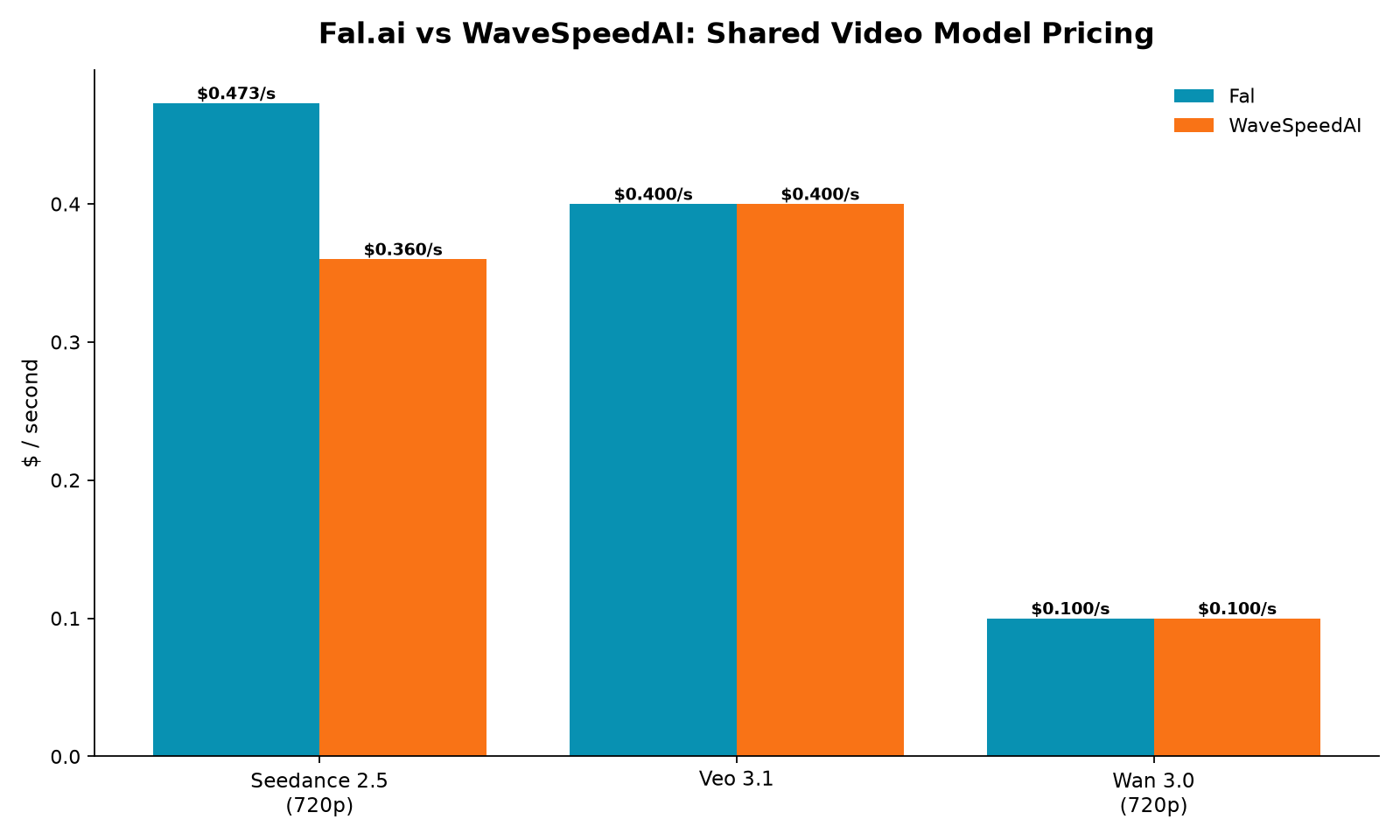
On two of the three models in this table, Fal and WaveSpeedAI price at exact parity. On the third — Seedance 2.5 — WaveSpeedAI is 24% cheaper. There's no consistent directional bias here the way there is with Replicate; if you're already integrated with either platform, switching wholesale to the other buys you nothing on two-thirds of this comparison and a real but moderate saving on the third.
Why this pair behaves differently than Fal vs Replicate
Price parity across multiple models between two independent platforms usually means both are pricing close to the same underlying reference rate — likely near what the model creator itself charges, or near a shared upstream compute cost neither platform has meaningfully undercut. That's a different competitive dynamic than Fal vs Replicate, where Replicate consistently prices below Fal across the board — evidence of a genuinely different margin strategy rather than both platforms converging on the same number independently.
Checking for tier-level differences before assuming full parity
The Veo 3.1 and Wan 3.0 ties in the table above are at the specific tiers shown (Veo 3.1's standard rate, Wan 3.0's 720p rate) — that doesn't automatically mean every resolution tier of both models ties between these two hosts too. Wan 3.0's other tiers (see Wan 3.0 API Pricing) show both Fal and WaveSpeedAI at the same $0.05/720p-equivalent rate cluster, so the parity does appear to hold across tiers for Wan 3.0 specifically — but that's a fact worth verifying per model rather than assuming generalizes automatically from one tier to the whole model.
When the 24% gap is worth acting on
Seedance 2.5 is the one model here where checking twice pays off. A team running 2,000 five-second Seedance 2.5 clips a month at 720p:
- Fal: 2,000 × 5 × $0.473 = $4,730/month
- WaveSpeedAI: 2,000 × 5 × $0.360 = $3,600/month
That's a $1,130/month saving — real money, though smaller than the gaps you'll find checking the full provider table for Seedance 2.5 (see Seedance 2.5 API Pricing: Every Provider Compared), where MachGen prices at $0.19/sec — 60% below Fal, more than double WaveSpeedAI's discount.
The actual lesson
The reason to run this comparison model-by-model rather than trusting a single "X is cheaper than Y" verdict is exactly what this table shows: the same two platforms can be tied on one model and 24% apart on another, with no way to predict which from the platform's general reputation alone. A blanket "always use WaveSpeedAI over Fal" conclusion would have been wrong two-thirds of the time in this specific comparison. Check per-model, every time, rather than picking a platform once and defaulting to it for everything you integrate afterward.
What price parity tells you (and doesn't)
Two models tied and one 24% apart isn't a large enough sample to draw a sweeping conclusion about Fal's or WaveSpeedAI's general pricing philosophy the way three-for-three would. It's evidence for a narrower, more useful claim: for at least some models, these two platforms are pricing off something close to the same reference point (likely proximity to the model creator's own listed rate), while for others — Seedance 2.5 among them — one has room to undercut the other. The practical takeaway is the same one this whole series keeps landing on: check per model, because the platform-level relationship between any two hosts isn't fixed across their entire overlapping catalog.
Frequently asked questions
If two platforms tie on price, does it matter which I pick? For the specific model where they tie, no — on price. Reliability, latency, and existing account relationships become the deciding factors once price stops being one, which is a genuinely different decision process than the host comparisons elsewhere in this series where price alone settles it.
Could the Seedance 2.5 gap close over time? It's possible — nothing prevents either platform from adjusting its rate. Since Fal and WaveSpeedAI tie on two of the three models here, it wouldn't be surprising if pricing pressure eventually pulled Seedance 2.5 toward parity too, but that's speculation, not something this article can verify ahead of time.
Does WaveSpeedAI have the same two-listing pattern here that it has for MiniMax H3? Not for the three models in this comparison specifically — WaveSpeedAI's Seedance 2.5, Veo 3.1, and Wan 3.0 listings used here are each a single rate, unlike its dual native/resell H3 listings (see MiniMax H3 API Pricing). Always check whether a host has more than one listing for a given model before assuming a single quoted rate is the only one available.
Is there a fourth model where Fal and WaveSpeedAI both compete? Likely, since both platforms carry broad catalogs — this article covers the three models where the price comparison was cleanest to verify against VideoRouter's registry. Check VideoRouter's models page for the current full overlap if you need a specific model not covered here.
How to route between them
import requests

job = requests.post(
    "https://videorouter.sh/api/v1/videos",
    headers={"Authorization": "Bearer llmr_sk_live_...", "Content-Type": "application/json"},
    json={
        "model": "bytedance/seedance-2.5/wavespeed",
        "prompt": "a paper airplane gliding over a city",
        "resolution": "720p",
        "duration_secs": 5,
    },
).json()
Swap /wavespeed for /fal to pin the other way — see /docs/provider-selection for the full reference, or drop the provider suffix to let automatic routing pick a healthy deployment for you.