The Best AI Inference Platform in 2026: WaveSpeedAI vs Replicate vs Fal.ai vs Novita vs Runware vs Atlas Cloud
Search "best AI inference platform 2026" and most of what comes back is written by one of the platforms being ranked — which is a structural problem, not a quality one. A vendor's own comparison page can be accurate on every individual fact and still be useless for a buying decision, because the scoring is set up in advance to land on "we win." This is a comparison of the same six platforms — WaveSpeedAI, Replicate, Fal.ai, Novita AI, Runware, and Atlas Cloud — written by VideoRouter, a company that routes traffic to several of these platforms as upstream providers, and has no reason to crown any single one of them the winner.
The scope here is specifically image and video generation. All six platforms are pitched as broad "AI inference" infrastructure, but where they actually compete head-to-head — where you can put the same model behind two platforms and diff the invoice — is generative media. That's also the part of this market VideoRouter's own pricing tables track live, so every number below is traceable, not typed from a press release.
Quick comparison
| Platform | Catalog (self-reported) | Pricing model | Notable trait |
|---|---|---|---|
| WaveSpeedAI | 1,000+ models, image/video/audio/3D | Per-model, pay-per-use | Broad catalog, fast to list new checkpoints |
| Replicate | 1,000+ community models + curated "Official Models" | GPU-second or per-output, depends on listing | Largest open-source/community ecosystem |
| Fal.ai | 1,000+ (curated) | GPU-second for custom apps, per-output for hosted models | Proprietary inference engine, fastest on FLUX-family pipelines |
| Novita AI | 200+ models + GPU instances | Pay-as-you-go, per-hour for GPU instances | Hybrid model API + dedicated GPU rental |
| Runware | 374 first-party-listed + thousands community/CivitAI | Compute-time (open models) or flat-rate (closed partner models) | No pre-flight pricing API — see below |
| Atlas Cloud | 300+ models across chat/image/video/audio | Token- or unit-based, pay-as-you-go | Full-modal single endpoint, aggressive pricing on older/turbo variants |
Catalog-size claims above are each platform's own marketing number, not something we can independently verify — take "1,000+" and "400,000+"-style figures as directional, not audited. The pricing claims further down are not: those come from our own cross-provider rate tables, built from the same data that renders on every model's public pricing page.
The six platforms, briefly
WaveSpeedAI runs a large, fast-moving catalog and prices per-model, shown live before you submit a job. In our own tables it's frequently mid-pack on price — sometimes the cheapest host for a given checkpoint (Grok Imagine Video at $0.05/sec, cheapest of five providers), sometimes the most expensive (MiniMax H3 at 1080p, $0.16/sec against Atlas Cloud's $0.08/sec for the same model) — which tracks with a platform that lists a lot of models rather than optimizing margin on each one.
Replicate popularized "run any model on serverless GPUs," and still has the broadest long-tail of community-published models. Pricing is genuinely bifurcated: community listings bill raw GPU-seconds (from ~$0.0001/sec on a T4 up to low cents on multi-H100 clusters), while curated "Official Models" (Veo, Kling, and others) bill a flat per-output rate instead. In our tables Replicate is often the cheapest or tied-cheapest source for Google's Veo line — Veo 3.1 Fast at $0.10/sec, half of what several other hosts charge for the identical model.
Fal.ai built a dedicated inference engine for diffusion and generative media and is usually first to ship a newly released open-weight model. It isn't uniformly cheap or expensive — on Seedance 2.5 at 480p it's the most expensive of eight providers we track ($0.2205/sec, 2.6x MachGen's $0.085/sec), but on MiniMax H3 at 768p it's the cheapest of five ($0.06/sec, undercutting WaveSpeedAI and Replicate at $0.08/sec each). That split is the honest takeaway on Fal: strong per-model, not strong as a blanket policy.
Novita AI pairs a smaller model-API catalog with rentable GPU instances (H200, RTX 5090, H100) — a genuinely different shape from the other five, which don't sell raw compute at all. On the two model families we track it against other platforms, Novita is competitive rather than exceptional: it ties WaveSpeedAI exactly on all three Kling v3.0 tiers ($0.084/$0.112/$0.42 per second for Std/Pro/4K), and undercuts WaveSpeedAI, Replicate, and Atlas Cloud on MiniMax H3 at 768p ($0.069/sec vs. $0.08/sec).
Atlas Cloud is a full-modal aggregator — chat, image, video, and audio behind one endpoint. It's frequently the cheapest source for older or "turbo/fast" model variants once a newer generation has shipped, and it's the cheapest of eleven tracked providers for MiniMax H3 at 1080p ($0.08/sec) and for Wan 3.0 at the 720p-ESR tier ($0.064/sec). Its catalog is smaller than WaveSpeedAI's or Fal's, which is the trade for that pricing.
Runware is the odd one out on this list, and worth a longer look, because the difference isn't about price at all.
The thing nobody else's comparison mentions: Runware has no pricing API
Every other platform on this list — and every provider VideoRouter has onboarded by pulling from a self-reporting catalog endpoint (Novita included) — exposes a /models-style API that returns price alongside model metadata. You can query it once and know, in advance, exactly what a call will cost.
Runware doesn't. Its modelSearch endpoint returns rich metadata (architecture, capabilities, trigger words, generation defaults) for its catalog, including direct CivitAI marketplace integration — but no price or cost field anywhere in that schema. The only place price appears via API is after a generation runs, via an opt-in includeCost: true flag on the request itself. There's no bulk, pre-flight way to ask "what would this cost me" — you either run the job, use Runware's own Playground UI, or read a static docs page that Runware itself caveats as covering only "popular models and common configurations," not the full catalog.
That's a meaningfully different integration shape from the other five platforms, independent of whether Runware's actual prices are competitive (its own FAQ cites $0.0006–$0.24 per image, a wide enough band that "cheap" or "expensive" depends entirely on which model you mean — the same caveat that applies to every platform in this piece). If your product needs to show a user a price before they commit to a generation, or needs to budget spend programmatically ahead of time, Runware requires you to build that estimation yourself; every other platform here hands it to you in the catalog response.
Same model, different platform: what it actually costs
Marketing claims about "up to 90% cheaper" or "4x faster" are hard to falsify because they're rarely pinned to one specific, checkpoint-identical comparison. Here's MiniMax H3 at the 768p tier — same model, same resolution — across five of the six platforms above (Runware excluded; per the previous section, there's no pre-flight number to compare):
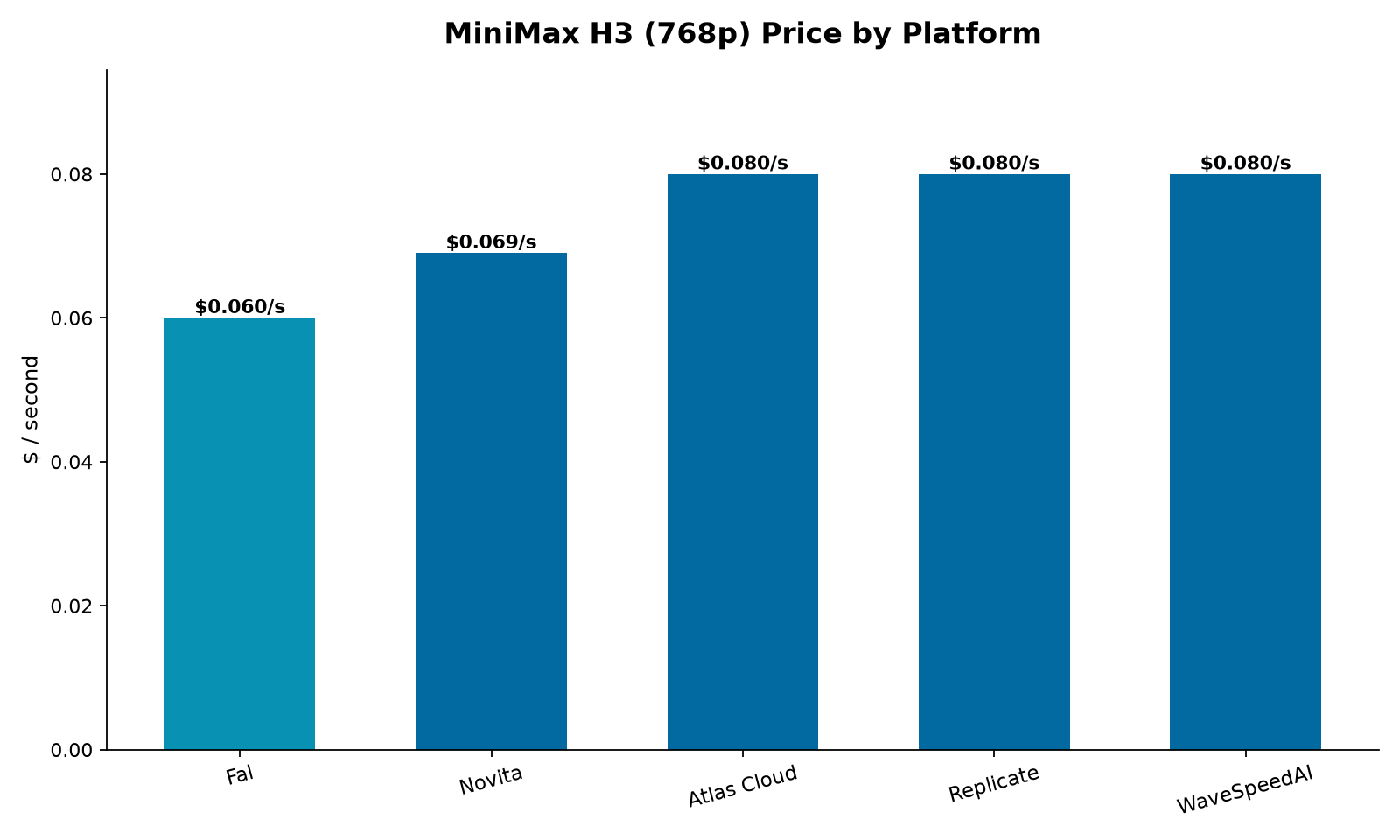
The spread is real but modest — 33% between cheapest and priciest, not the 10x-plus gaps you sometimes see on newer or exclusivity-driven checkpoints (Seedance 2.5 at 480p spans $0.085 to $0.2205/sec across the providers we track, a 2.6x range). The lesson holds across both cases: the "best" platform depends on which specific model you're calling, not on a single overall winner across the whole catalog.
| Model | Cheapest here | Priciest here | Spread |
|---|---|---|---|
| MiniMax H3 (768p) | Fal — $0.06/sec | WaveSpeedAI / Replicate / Atlas Cloud — $0.08/sec | 1.33x |
| Kling v3.0 Std | Novita / WaveSpeedAI (tied) — $0.084/sec | — | tie |
| Veo 3.1 Fast | Replicate — $0.10/sec | (up to $0.30/sec elsewhere in our full tracking, outside this six) | 3x |
Verdicts by use case
- Widest catalog with the fastest access to brand-new open-weight releases: Fal.ai or WaveSpeedAI. Both list new checkpoints quickly; neither is reliably cheaper than the other on any given model, so pick based on which specific models you need.
- Cheapest raw compute for a custom pipeline you control: Replicate, if you're comfortable with GPU-second billing and building your own cost estimation on top of it.
- Cheapest for a specific, already-popular checkpoint (Kling, MiniMax H3): Novita AI is consistently at or near the floor on the two model families we track it against, without the catalog breadth of the larger platforms.
- You also need raw GPU rental, not just model APIs: Novita is the only platform on this list selling both in one account.
- Full-modal (chat + image + video + audio) in a single endpoint, budget-conscious: Atlas Cloud, especially for older or "fast" model variants.
- You need to know the price before you commit to a call: avoid Runware for that specific workflow, or budget engineering time to build your own price-estimation layer on top of its post-hoc
includeCostfield.
None of these six platforms fails over across each other for the same model — pick WaveSpeedAI for Seedance 2.5 and its outage or price change is your product's outage or price change, full stop. That's the specific gap VideoRouter is built to close: one API that already routes to several of the platforms above (among others) per model, live pricing comparison instead of a marketing claim, and automatic failover if one host goes down. It doesn't make the comparison above moot — knowing which platform is actually cheapest for the model you care about is useful information regardless of how you end up calling it — but it does mean you don't have to bet your product on getting that pick right once and never revisiting it.