fal.ai vs VideoRouter: What Seedance 2.5, Seedance 2.0, Wan 3.0, MiniMax H3 and Kling 4.0 Cost on Each
fal.ai is the default answer to "where do I call a video model from": new models show up there within days, the SDKs are good, and every model page states its price. That last part is what makes it easy to compare. fal publishes what it charges, so you can put the number next to what the same checkpoint costs elsewhere.
We did that for five popular models: ByteDance's Seedance 2.5 and Seedance 2.0, Alibaba's Wan 3.0, MiniMax H3, and Kling's newest, Kling 4.0. On all five, VideoRouter's price per second at the headline tier is lower than fal's, by 13% to 69%. VideoRouter also lists fal as one of its own hosts, so this isn't an either/or choice, and the last two sections cover where fal is the better call.
We checked the numbers on October 26, 2026. fal's rates come from its own pricing API and model pages. VideoRouter's come from the price tables behind our model pages. Nothing is typed from memory.
The headline numbers: 720p (2K for H3), USD per second of generated video
| Model | VideoRouter | fal.ai | VideoRouter is lower by |
|---|---|---|---|
| Seedance 2.5 (720p) | $0.1454 | $0.4730 | 69% |
| Seedance 2.0 (720p) | $0.1307 | $0.3034 | 57% |
| Wan 3.0 (720p) | $0.0512 | $0.1000 | 49% |
| MiniMax H3 (2K) | $0.0666 | $0.1300 | 49% |
| Kling 4.0 (720p) | $0.1368 | $0.1570 | 13% |
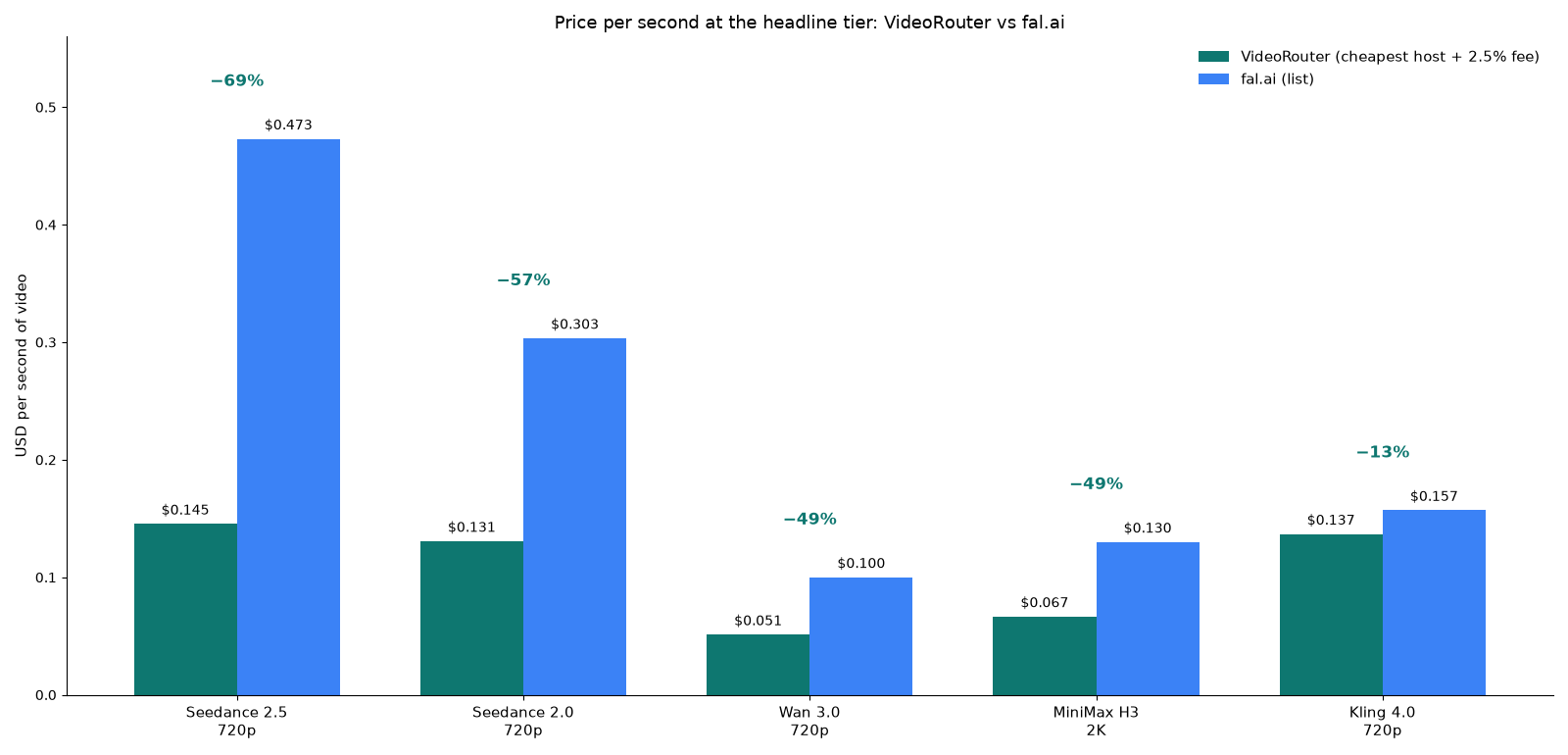
It is the same checkpoint on both sides. fal isn't serving a modified version of Seedance or Wan, and neither is any host behind VideoRouter, so the difference is price and nothing else we can measure. (We don't score output quality per host yet, so "identical weights" is not the same claim as "identical output". See same model, different output quality across providers.)
How we got the numbers
fal's side. We queried fal's pricing API (GET /v1/models/pricing) for the five text-to-video endpoints on October 26:
| Endpoint | Rate fal returns |
|---|---|
| Seedance 2.5 | $0.0214 per 1,000 tokens |
| Seedance 2.0 | $0.014 per 1,000 tokens |
| Wan 3.0 | $0.05 per second (480p base) |
| MiniMax H3 | $0.05 per second (480P base) |
| Kling 4.0 | $0.157 per second (720p) |
Two notes. For Seedance, a billable video token is width × height × 24 / 1024 per second, so the per-second figure depends on resolution. The 720p numbers in the table are the ones fal's model pages state ($0.4730 per second for Seedance 2.5). On Seedance 2.0 the pure formula gives $0.3024 against the $0.3034 in our table, a 0.3% difference we've left as is. And the pricing API returns one base number per endpoint, so the higher tiers for Wan and H3 (720p, 1080p, 2K) come from our own price table rather than from that call.
VideoRouter's side. VideoRouter doesn't have a rate card of its own. It lists what each upstream host charges for a model, and bills you that host's price plus a flat 2.5% platform fee. Every VideoRouter figure in this article is the cheapest host that lists the tier, times 1.025, and the host is named so you can check it.
Seedance 2.5
Seedance 2.5 is where the gap is widest, because fal prices it at a premium to every other host we route.
| Tier | VideoRouter | fal.ai | Lower by |
|---|---|---|---|
| 480p | $0.0871 (MachGen) | $0.2205 | 60% |
| 720p | $0.1454 (SoCheap-Overseas) | $0.4730 | 69% |
| 1080p | $0.4932 (TOAPIS) | $1.1640 | 58% |
Read the 720p row carefully. The $0.1454 figure comes from a lower-priced "low" row on one host. The next-cheapest 720p host is MachGen at $0.2004 per second including our fee, which is still 58% below fal. If you're building something customer-facing, look at the host's availability and terms on the Seedance 2.5 page before assuming the lowest row is the right one. Either way, the saving is above 50%.
For reference, 15 host rows serve Seedance 2.5 on VideoRouter, including fal's own.
Seedance 2.0
| Tier | VideoRouter | fal.ai | Lower by |
|---|---|---|---|
| 480p | $0.0610 (MachGen) | $0.1345 | 55% |
| 720p | $0.1307 (MachGen) | $0.3034 | 57% |
| 1080p | $0.3224 (MachGen) | $0.6820 | 53% |
| 4K | $0.6217 (OpenSand) | $1.5552 | 60% |
The spread is consistent across tiers: fal sits at roughly 2.1 to 2.5 times the cheapest host. The 4K row is the most expensive tier on the table, so it is also where the dollar gap is largest, $0.93 per second.
Wan 3.0
| Tier | VideoRouter | fal.ai | Lower by |
|---|---|---|---|
| 480p | $0.0256 (Replicate) | $0.0500 | 49% |
| 720p | $0.0512 (Replicate) | $0.1000 | 49% |
| 1080p | $0.1025 (Replicate) | $0.2000 | 49% |
fal charges $0.05, $0.10 and $0.20 per second, which are Alibaba's own list prices. Replicate lists the model at half that, and four more hosts (SandBase, TOAPIS, Pika, Atlas Cloud) sit between $0.06 and $0.08 at 720p, all below fal. Wan 3.0 is the cleanest example in this comparison because it's billed flat per second everywhere, with no token conversion to argue about.
MiniMax H3
| Tier | VideoRouter | fal.ai | Lower by |
|---|---|---|---|
| 768P | $0.0410 (kie.ai) | $0.0600 | 32% |
| 2K | $0.0666 (kie.ai) | $0.1300 | 49% |
At 2K, fal charges MiniMax's own list price of $0.13 per second, and so do MiniMax and Pika. Several hosts are below that: SandBase at $0.104, Novita at $0.1104, and kie.ai at $0.065. At 768P fal is closer to the pack at $0.06, with kie.ai and SandBase below it.
Kling 4.0
Kling 4.0 is the closest race in this comparison, and it's worth showing because it's the one where the gap is smallest.
| Tier | VideoRouter | fal.ai | Lower by |
|---|---|---|---|
| 720p | $0.1368 (SandBase, MachGen) | $0.1570 | 13% |
| 1080p | $0.2047 (SandBase, MachGen) | $0.2350 | 13% |
fal's published rates are $0.157 per second at 720p and $0.235 at 1080p, and its pricing API confirms the 720p figure. The cheapest hosts we route are SandBase and MachGen at $0.1335 and $0.1998 before our fee. Atlas Cloud sits at $0.1429 and $0.2139, while TOAPIS and Runware charge the same as fal, and WaveSpeed is above it.
Two cautions. First, a 13% gap is real but small: at 1,000 five-second 720p clips it's about $101 a month, so the fee and any integration cost matter more here than on Seedance. Second, we haven't run a live generation on fal's Kling 4.0 endpoints. An earlier attempt on an older fal endpoint family accepted the job and returned nothing, so the price above is fal's published rate and not a charge we've seen on a real fal invoice.
What 1,000 clips costs
At 720p (2K for H3), 1,000 five-second clips is 5,000 seconds of output.
| Model | VideoRouter | fal.ai | Difference |
|---|---|---|---|
| Seedance 2.5 (720p) | $727 | $2,365 | $1,638 |
| Seedance 2.0 (720p) | $653 | $1,517 | $864 |
| Wan 3.0 (720p) | $256 | $500 | $244 |
| MiniMax H3 (2K) | $333 | $650 | $317 |
| Kling 4.0 (720p) | $684 | $785 | $101 |
The gap scales linearly, and it is far smaller on Kling 4.0 than on the Seedance rows. A product shipping 10,000 Seedance 2.5 clips a month is looking at $16,380 a month between the two, on the same model.
Where VideoRouter isn't cheaper
We'd rather be specific about this than leave you to find it.
- When fal is the cheapest host, VideoRouter costs 2.5% more. On some models fal's price is the lowest on the market or tied for it, and VideoRouter routes to fal at fal's price plus our fee. Examples from the live tables: LTX-2.5 Pro at 720p is $0.12 per second on fal against $0.1230 on VideoRouter, MiniMax H3 Max Turbo at 480P is $0.025 against $0.0256, and the Flux 3 video-edit rows are within the same 2.5%. If those are your only models, going direct to fal saves you that fee.
- Reference video changes fal's math. fal's Seedance pricing notes that when video inputs are provided the price is multiplied by 0.6. Our fal row bills the full output-only rate regardless, so on a reference-video-heavy workload check fal's own estimate before comparing. Reference images and reference video affect the bill on every platform, and a headline per-second rate doesn't capture it.
- Lower-priced host rows trade off something. The cheapest Seedance 2.5 720p row is a "low" row on one host. Look at availability and terms before pinning your production traffic to it.
- Prices move. These are October 26, 2026 numbers. Host prices change regularly, and fal's can too.
What fal is still good for
fal is usually the fastest place to get a newly released model behind an API, its SDKs are well regarded, and every model page states a price, which is the reason this comparison was possible at all. If you're tied into fal's SDK across many models, or you've measured latency or reliability on fal that you wouldn't give up, a premium can be a reasonable thing to pay. The point of the numbers above is to show how big that premium is on these four models, so you pay it on purpose.
And you don't have to leave fal to use VideoRouter. fal is one of the hosts VideoRouter routes to, and you can pin it per request by adding the host to the model id, for example minimax/h3/fal. That gives you fal's rate plus the flat fee, with failover to other hosts available when you don't pin.
Frequently asked questions
Is it the same model on fal and VideoRouter? Same checkpoint, yes. Seedance 2.5 on one is ByteDance's Seedance 2.5 on the other. Output can still differ between hosts running the same weights, and we don't currently score per-host quality, so a price comparison alone doesn't prove outputs are identical.
Does the 2.5% fee apply on top of the VideoRouter prices in the tables? No, the VideoRouter column already includes it. The fal column is fal's published rate with nothing added.
Why is fal's Seedance 2.5 so much higher than other hosts? fal's published rate is $0.0214 per 1,000 tokens. Other hosts list the same model at about half that or less. We can't see anyone's cost structure, so we can't say why. We can say what's published.
How do I check what I was actually charged? On VideoRouter the cost is returned with the generation and can be looked up per request. On fal, its pricing API shows the rate you should expect before you submit. We didn't test per-request cost lookup on fal for this article.
Can I use both? Yes. If fal is your current platform, the practical question is whether the gap on the models you generate most justifies a second integration. At the volumes in the worked example above, it usually does. For the wider picture across more platforms, see the comparison of OpenRouter, Comfy, Higgsfield and VideoRouter on the same four models and Fal vs Replicate for video generation APIs.