Novita vs WaveSpeedAI for Kling API Access
Not every host comparison ends with a clear winner, and Kling v3.0 access through Novita versus WaveSpeedAI is the cleanest example of that in this whole series. At every tier — Std, Pro, and 4K — the two hosts charge exactly the same rate. That's a genuinely different, and genuinely useful, answer than "host A beats host B": it tells you price isn't the variable that should decide this particular choice.
Full pricing table
| Tier | Novita | WaveSpeedAI | Difference |
|---|---|---|---|
| Std | $0.084/sec | $0.084/sec | 0% |
| Pro | $0.112/sec | $0.112/sec | 0% |
| 4K | $0.420/sec | $0.420/sec | 0% |
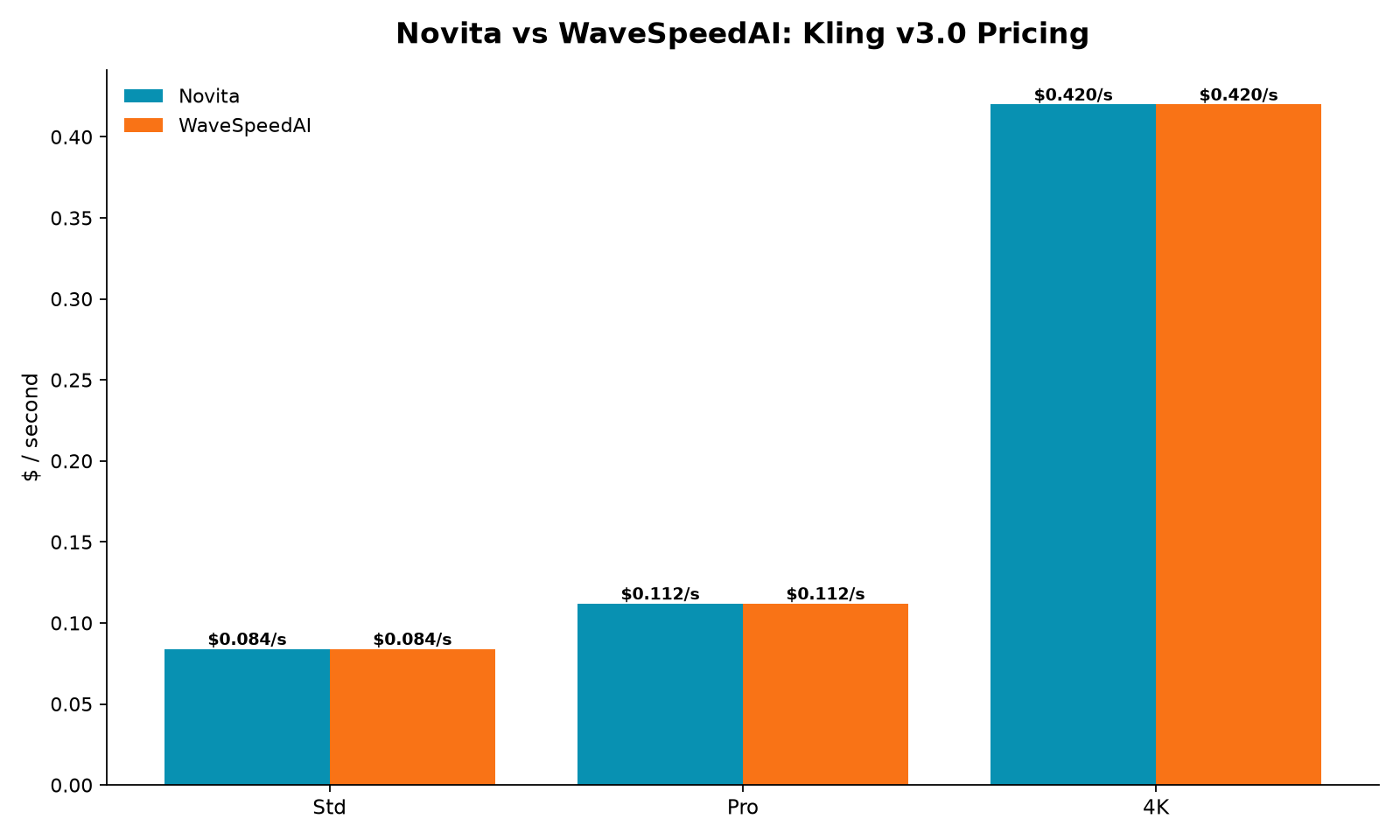
Zero percent difference at three separate tiers isn't a coincidence you'd expect from two hosts independently arriving at the same number through separate cost structures. The far more likely explanation is that one of these hosts is effectively reselling the other's capacity, or both are pricing directly off the same upstream rate card set by whoever controls access to Kling for third-party hosts, with neither adding or shaving a margin relative to the other.
What this means for your decision
Since price is a tie, the decision comes down to factors this article can't verify with the same confidence as pricing, because neither is tracked anywhere in VideoRouter's own registry the way price is: uptime, queue depth under load, and regional latency. If you already have infrastructure or an account relationship with one of these two hosts for other models, that's a perfectly good reason to default to the same host for Kling too — there's no price penalty for doing so, which isn't true of most of the comparisons in this series.
What a price tie tells you about the underlying market
A three-tier, exact-match tie between two independent hosts is a stronger signal than a tie at a single tier would be — it's much less likely to be coincidental once you see it repeat across Std, Pro, and 4K. The most likely explanation is that neither Novita nor WaveSpeedAI is adding an independent margin on top of whatever rate card governs third-party Kling access; both are passing through close to the same underlying cost. That's useful context beyond just "these two are tied" — it suggests there isn't a third, cheaper host quietly undercutting both of them that a wider search would turn up, since if there were room to price lower and still turn a margin, it's a reasonable bet at least one of two independent competitors would have taken it already.
Compare against the resale channel instead
Where this comparison does matter is against OpenRouter's resale channel, which prices both Std and Pro at a consistent 67% markup over the Novita/WaveSpeedAI rate:
| Tier | Novita / WaveSpeedAI | OpenRouter | Markup |
|---|---|---|---|
| Std | $0.084/sec | $0.140/sec | +67% |
| Pro | $0.112/sec | $0.187/sec | +67% |
That's the real decision in the Kling market: not Novita vs WaveSpeedAI (a tie), but either of those two versus the resale channel (a consistent, avoidable 67% premium). See Kling v3.0 API Pricing: Std vs Pro vs 4K Compared for the full breakdown including the 4K tier, which isn't listed through OpenRouter at all.
Worked example
A team generating 2,000 five-second Kling Pro clips a month:
- Novita or WaveSpeedAI (either — they're tied): 2,000 × 5 × $0.112 = $1,120/month
- OpenRouter: 2,000 × 5 × $0.187 = $1,870/month
The choice that actually saves $750/month here is "avoid the resale channel," not "pick the right one of Novita or WaveSpeedAI" — because there is no wrong one of those two on price.
Frequently asked questions
If two hosts price identically, why would VideoRouter's registry list both? Redundancy is valuable independent of price — if one host has an outage or capacity issue, having a second host at the identical price to fail over to means you don't have to accept a worse rate just to keep serving requests during an incident. This is exactly the case where "identical price, two hosts" is strictly better than "identical price, one host."
Does this tie hold for every Kling version, or just v3.0? Check each version separately — this article's data covers Kling v3.0 specifically (Std, Pro, 4K). Earlier Kling versions may have different hosting arrangements entirely, with no guarantee the same two hosts even both carry them.
Is there a scenario where I'd want to pin to one of these two over the other despite the price tie? Yes — if you've observed a reliability or latency difference specific to your traffic pattern with one of them, or if you already have infrastructure/billing set up with one, that's a legitimate reason to prefer it even at identical price. The point of this article isn't "it never matters which you pick" — it's "price specifically doesn't decide it, so look at what does."
Why does OpenRouter's markup on Kling differ from its markup on Veo 3.1? Resale markups aren't a fixed percentage OpenRouter applies universally — they depend on what OpenRouter itself pays the underlying host for each specific model. See Veo 3.1 API Pricing Comparison Across Providers, where OpenRouter actually matches the cheapest hosts rather than carrying a markup, for the contrast.
Should I always assume two hosts pricing identically means they're related? Not necessarily related in a corporate sense — it can also mean both are independently pricing off the same upstream rate card set by whoever controls third-party access to the model, with neither able to differentiate on cost. Either explanation leads to the same practical conclusion: price won't be the deciding factor between them.
How to route
import requests

job = requests.post(
    "https://videorouter.sh/api/v1/videos",
    headers={"Authorization": "Bearer llmr_sk_live_...", "Content-Type": "application/json"},
    json={
        "model": "kling-v3.0-pro/novita",  # or /wavespeed — priced identically
        "prompt": "a kite surfer carving across a turquoise bay",
        "duration_secs": 5,
    },
).json()
With no provider pin at all, default routing already avoids the pricier resale channel in favor of the two tied hosts — see /docs/provider-selection for pinning explicitly if you have a specific operational reason to prefer one of the two.