Wan 3.0 API Pricing: Every Provider Compared
Alibaba's Wan 3.0 is one of the widest-spread models in our entire price registry — not because any single host is pricing it unusually high or low, but because more independent hosts compete to serve it than almost any other video model we track. Eleven separate providers list Wan 3.0, and the gap between the cheapest and most expensive of them is over 4x for the identical checkpoint. That's a strong signal of what happens to price when a model has enough hosting competition: it compresses hard at the bottom, while at least one host still prices near what you'd pay calling the model creator directly.
Full pricing table, 480p tier
| Provider | Price (480p) |
|---|---|
| Replicate | $0.0250/sec |
| Atlas Cloud | $0.0400/sec |
| MachGen | $0.0410/sec |
| Pika | $0.0325/sec |
| Fal | $0.0500/sec |
| Alibaba (direct) | $0.0500/sec |
| WaveSpeedAI | $0.0500/sec |
| TOAPIS | $0.0500/sec |
| OpenRouter | $0.1063/sec |
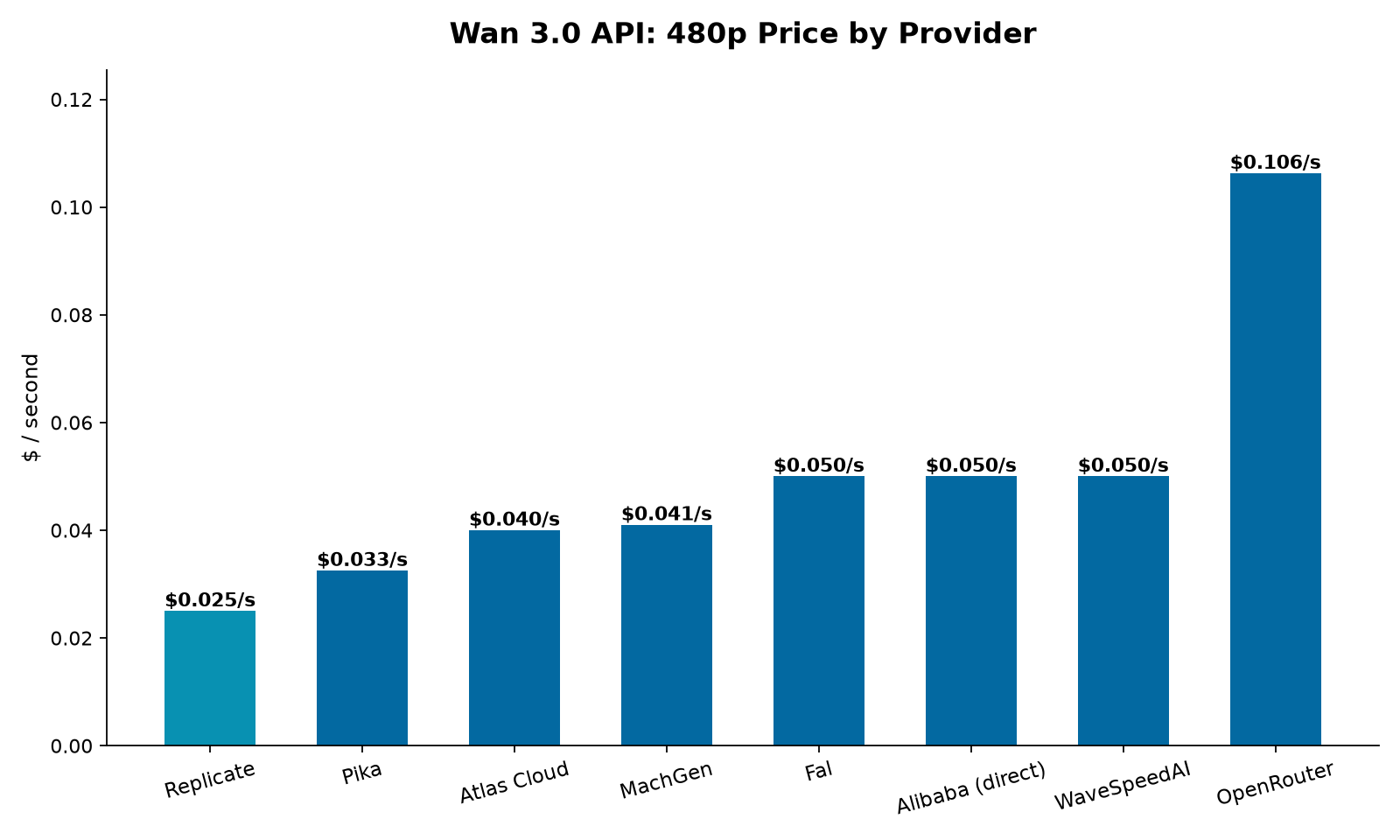
Replicate is the standout here: at $0.025/sec it's a full 4.25x cheaper than OpenRouter's resale rate for the same model, and roughly 2x cheaper than the cluster of hosts (Fal, Alibaba direct, WaveSpeedAI, TOAPIS) all sitting at exactly $0.05/sec. Notice that "buying direct from Alibaba" doesn't get you the best price — it gets you the median price. The cheapest option in this entire table is a third-party reseller, not the model creator.
Higher tiers scale the same gap
Wan 3.0's 720p and 1080p tiers roughly double and quadruple the 480p rate respectively at every host, so the ratio between cheapest and most expensive host holds steady as you move up in resolution — this is a per-host multiplier, not a per-tier one:
| Provider | 720p | 1080p |
|---|---|---|
| Replicate | $0.0500/sec | $0.1000/sec |
| Atlas Cloud | $0.0800/sec | $0.1600/sec |
| Fal / Alibaba / WaveSpeedAI / TOAPIS | $0.1000/sec | $0.2000/sec |
| OpenRouter | $0.2125/sec | $0.4250/sec |
At 1080p, the gap between Replicate and OpenRouter widens from $0.081/sec to $0.325/sec in absolute terms — the percentage spread is identical, but the dollar impact of picking the wrong host grows with every step up in resolution.
Picking a resolution tier
Wan 3.0's three tiers — 480p, 720p, 1080p — aren't just a size choice, they're a cost multiplier applied consistently across every host: 720p costs almost exactly 2x the 480p rate, and 1080p costs almost exactly 4x it, at every provider in the table above. That consistency across hosts (rather than each host pricing its own tier ratio independently) suggests the multiplier is set at the model-creator level and passed through, not a host-specific margin decision. Practically, that means the tier decision and the host decision are independent choices you can reason about separately: pick the cheapest host for whichever tier you need, rather than assuming a host that's cheap at 480p necessarily stays cheapest at 1080p (in Wan 3.0's case it does, but that's not guaranteed to be true for every model — verify per model rather than assuming the ranking is resolution-invariant).
For most consumer-facing video features, 720p is the practical default — enough resolution to look intentional on a phone screen, without paying the 1080p multiplier for detail most viewing contexts won't resolve anyway. Reserve 1080p for output that's genuinely going to be viewed full-screen or on a larger display where the extra resolution is visible.
What this costs at real volume
A team generating 3,000 four-second clips a month at 720p:
- Replicate: 3,000 × 4 × $0.05 = $600/month
- Fal / Alibaba direct / WaveSpeedAI / TOAPIS: 3,000 × 4 × $0.10 = $1,200/month
- OpenRouter: 3,000 × 4 × $0.2125 = $2,550/month
Going from OpenRouter's resale rate to Replicate's direct rate is a $1,950/month saving on identical output at this volume — over 76% of the bill, with zero change to the model, prompt, or quality.
Why Replicate specifically undercuts everyone here
Replicate has historically competed on being a straightforward, developer-first hosting layer for a wide catalog of open and licensed models, and its Wan 3.0 pricing reflects a thin-margin, high-volume strategy rather than a premium one. That's not true of every model in Replicate's catalog — check the specific model before assuming Replicate is always the cheapest host across the board — but for Wan 3.0 specifically, it currently is, and by a wide enough margin that it's worth verifying before you integrate against any other host by default.
Wan 3.0 vs Wan 3.0 Prime
Alibaba also ships a "Prime" variant of Wan 3.0 at a higher price point across every host that carries both — Prime is a separate checkpoint, not a resolution tier of the base model, and it's priced roughly 2x the base model at most hosts. If you're choosing between the two, see Wan 3.0 vs Wan 3.0 Prime: Which Should You Call? for the full comparison and when the Prime checkpoint's extra cost is actually worth paying.
A second worked example: high resolution, high volume
At 1080p and higher volume — 8,000 six-second clips a month — the same host ranking holds, but the dollar gap grows sharply:
- Replicate: 8,000 × 6 × $0.10 = $4,800/month
- Atlas Cloud: 8,000 × 6 × $0.16 = $7,680/month
- OpenRouter: 8,000 × 6 × $0.425 = $20,400/month
The gap between Replicate and OpenRouter at this volume is $15,600/month — over $187,000/year — for output that is, model and weights, identical. This is the kind of number that makes "which host am I actually routing to" worth checking on a recurring basis, not just once at integration time.
Frequently asked questions
Why does Wan 3.0 have so many hosts compared to some other models in this series? Alibaba has licensed Wan broadly to third-party hosts, similar to how MiniMax has done with H3 (see MiniMax H3 API Pricing) — both are cases where the model creator has prioritized wide distribution over exclusivity, which produces exactly the kind of price competition shown in this table.
Is Alibaba's own direct listing ever the cheapest option? Not currently, at any tier in this table — Alibaba direct sits at the same $0.05/sec rate as Fal, WaveSpeedAI, and TOAPIS, all clustered above Replicate and Atlas Cloud. This is a recurring pattern in this series: buying direct from the model creator is not a reliable way to get the lowest price.
How stable is Replicate's pricing lead here? Not something this article can promise going forward — Replicate's rate could rise, or another host could undercut it, at any time. What's verifiable is the current spread; check VideoRouter's Wan 3.0 page for the live numbers rather than treating this table as fixed.
Should I default every Wan 3.0 request to Replicate? If price is your primary concern and you haven't hit any Replicate-specific reliability issue with your workload, yes — that's what unpinned automatic routing already biases toward. If you need guaranteed placement rather than a bias, pin explicitly (see /docs/provider-selection).
Does Wan 3.0's pricing pattern hold at the Prime variant too? No — Wan 3.0 Prime is priced and hosted differently, with a narrower set of hosts and Replicate not among them. See Wan 3.0 vs Wan 3.0 Prime for the full comparison.
How to call it
import requests

job = requests.post(
    "https://videorouter.sh/api/v1/videos",
    headers={"Authorization": "Bearer llmr_sk_live_...", "Content-Type": "application/json"},
    json={
        "model": "alibaba/wan-3.0",
        "prompt": "a paper boat floating down a rain-slicked street at night",
        "resolution": "480p",
        "aspect_ratio": "16:9",
        "duration_secs": 4,
    },
).json()
With no explicit provider pin, VideoRouter's default routing weights selection toward the cheaper healthy deployments in the table above rather than picking uniformly at random — see /docs/provider-selection for pinning to a specific host (Replicate, for the lowest guaranteed rate) if you want deterministic routing instead. VideoRouter's own Wan 3.0 model page keeps this comparison live as prices move, since an 11-provider market like this one is exactly the kind that reshuffles fastest.