If you search "best video generation API" you'll get a pile of listicles that mash together two completely different questions. The first is which model produces the video you want — the actual neural network doing the generation, trained and owned by a lab like Google or ByteDance. The second is which service you call to run a request against that model — the API layer that takes your HTTP call, queues the job, runs it on someone's GPUs, and hands back a URL. These are not the same decision, and conflating them is why so many "best API" posts read like marketing copy for a single vendor.
A useful way to think about it: the model is the actor, the platform is the theater. Sora doesn't run on OpenAI's servers exclusively forever, Kling isn't locked to one distributor, and Wan is open enough that half a dozen hosts serve it. Picking a model tells you what the output will look like. Picking a platform tells you what your integration, uptime, and bill will look like. This article covers both, and it leads with a fact that makes the distinction unavoidable: as of this writing, OpenAI is about to stop being a place you can call for its own flagship video model at all.
The model layer: what's actually generating your video
OpenAI Sora — and a shutdown you need to know about now
OpenAI notified developers on March 24, 2026 that the Videos API and the entire Sora 2 model family — sora-2, sora-2-pro, and their dated snapshots — are deprecated and will be removed from the API on September 24, 2026. If you're reading this close to that date, that's days away, not months. This is separate from the consumer Sora app, which was already shut down back in April 2026. OpenAI's own deprecation table lists no recommended replacement model, which means there is currently no OpenAI-hosted video model to migrate your workload to when the lights go out. If you built a product on the native Sora 2 API, you need a new host for that traffic imminently. Some third-party resellers — Pika, Replicate, and others — still serve Sora 2 Pro through business agreements with OpenAI's backend as of this writing, but treat that as a "true for now" fact, not a guarantee, since OpenAI hasn't announced what happens to those arrangements once the API itself is gone.
The practical takeaway isn't "avoid Sora content forever" — it's that betting a production pipeline on a single model's single native API is a specific, identifiable risk, and this is as clean an example of that risk materializing as you'll find in 2026.
Google Veo 3.1
Veo is Google's flagship video model, and its 3.1 release is generally positioned as a strong option when audio-synced generation and prompt adherence matter — it's a common pick for ad-style and narrative clips where you want the model to interpret a fairly literal scene description well. Veo 3.1 also ships a cheaper "Fast" tier alongside the flagship tier, so if you're evaluating it, make sure any price you're looking at specifies which tier it's quoting — the flagship and Fast pricing aren't in the same ballpark.
MiniMax H3
MiniMax's H3 model has built a reputation as a workhorse choice — it's frequently the cheapest capable option across the hosts that serve it, which makes it a reasonable default for high-volume use cases (batch content generation, testing pipelines, anything where you're generating far more clips than you'll ever ship) where you don't need frontier-tier fidelity on every single output.
Kuaishou/Kwai Kling
Kling, from Kuaishou (also known as Kwai), has a strong track record on motion quality and has been a go-to model for creators who need believable human movement and camera work rather than static or dreamlike output. It's commonly used in social and short-form content pipelines for that reason.
ByteDance Seedance
Seedance is ByteDance's entry, and the 2.5 generation in particular is widely resold — it's one of the models where you'll see the widest price spread across hosts for the literal same checkpoint (more on that below), which makes it a good case study for why the platform question matters as much as the model question.
Alibaba Wan
Wan is Alibaba's video model family and, notably, has meaningful open-weight availability, which is part of why it shows up on so many different hosting platforms — anyone can stand up a Wan endpoint once weights are available, unlike a fully closed model where only the lab (or its direct partners) can serve it. Wan 3.0 Prime is a newer flagship-tier release in the family.
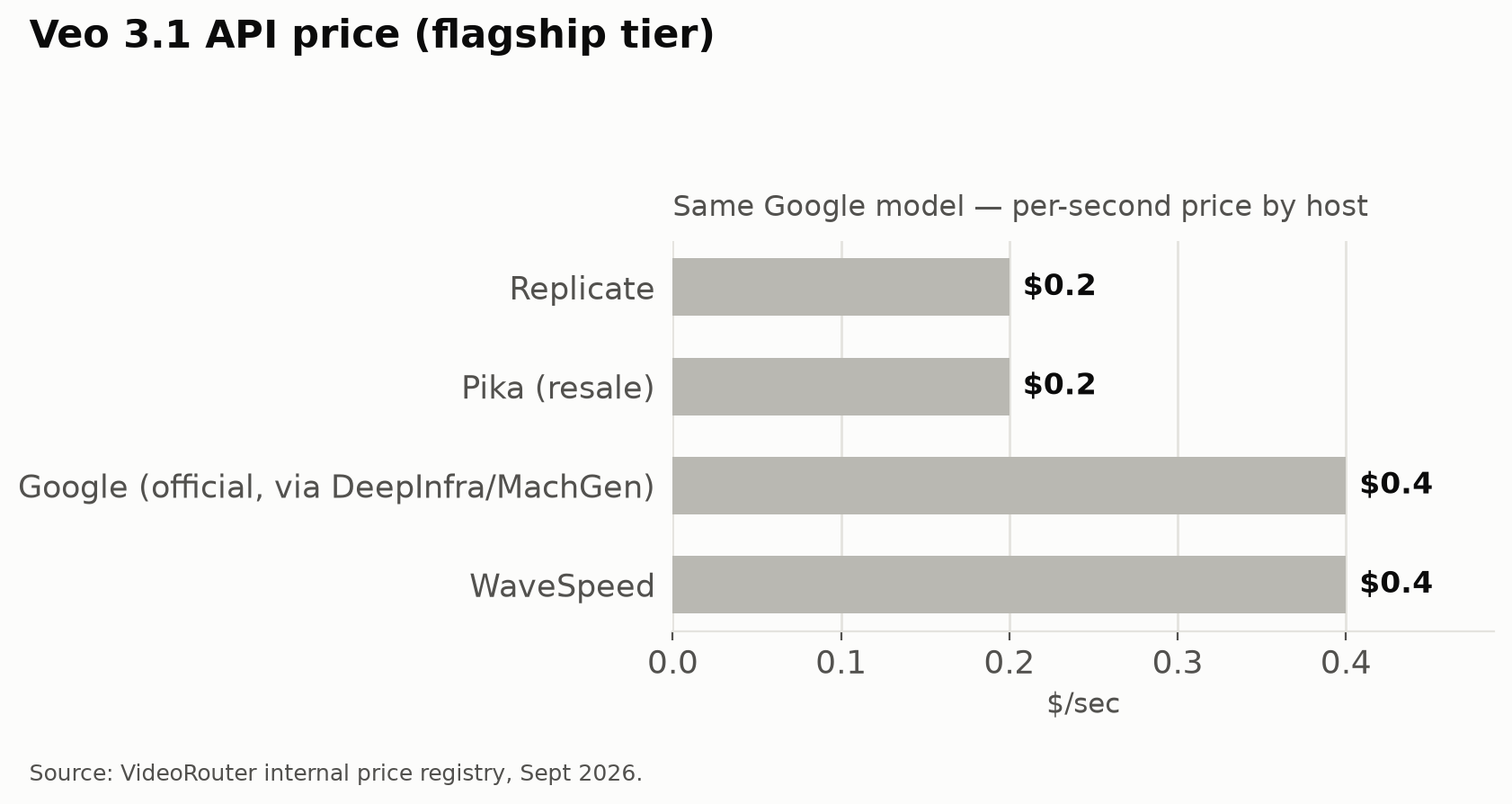
That chart is Veo 3.1's flagship tier, priced per second, across a handful of real hosts: Replicate and Pika both come in at $0.20/sec, while Google's own official rate (as served through DeepInfra or MachGen at the official price) and WaveSpeed both land at $0.40/sec — a full 2x gap for calling the identical model. That's not a rounding error, and it's the core argument for why "which model" and "which host" have to be evaluated separately: the model decision is about output quality and fit for your use case, and the host decision is a straightforward, checkable cost-and-reliability comparison you can run before you commit.
The platform layer: where you actually send the request
Once you've picked a model (or a shortlist of two or three), the question becomes who you call to run it. Here's the honest rundown of the major options.
fal.ai is a serving platform built specifically for diffusion and generative media models. It's usually among the fastest to list a newly released open-weight model, runs on prepaid credits with no subscription commitment, and publishes transparent per-model pricing on its pricing page. If you want to be first to try something the week it drops, fal is a reasonable default to check.
Replicate is a serverless-GPU model host with an enormous community model catalog — the kind of place where you'll find long-tail and experimental models nobody else bothers to list. Its pricing is a mix: most community models bill by raw GPU-seconds consumed, while a curated set of "Official Models" (which includes Veo and Kling) uses flat per-output pricing instead. Worth knowing which pricing model you're looking at before you estimate a bill.
WaveSpeed AI runs a catalog of over 1,000 models and markets itself primarily on inference speed — how fast a job actually completes, not just how it's priced. Pricing is shown live before you submit a job, scaled by resolution, duration, and batch size, so you can see the real number before you commit rather than reverse-engineering it from a rate card.
Atlas Cloud is a broad pay-as-you-go aggregator spanning chat, image, video, and audio models — 400+ at last count — with no subscription required. It's often one of the cheaper hosts for older or "turbo" model variants specifically, which is worth checking if you don't need the absolute newest checkpoint of a given model.
VideoRouter takes a different approach: rather than being one more host with its own catalog and its own prices, it sits in front of most of the hosts above (and more) behind a single API, with a live price-comparison table per model and automatic failover if one host is down or degraded. The pitch isn't "we're the cheapest host" — it's that you don't have to pick a host at all, or maintain integrations with five of them, to get the cheapest available price for a given model at request time.
Models to platforms, at a glance
| Model | Creator | Notable hosting platforms |
|---|---|---|
| Sora 2 / Sora 2 Pro | OpenAI | OpenAI (native API shutting down Sept 24, 2026); resold via Pika, Replicate, DeepInfra, MachGen |
| Veo 3.1 | Google (official), Replicate, Pika, WaveSpeed, DeepInfra/MachGen | |
| MiniMax H3 | MiniMax | MiniMax (official), Novita, Pika, WaveSpeed, MachGen |
| Kling | Kuaishou/Kwai | fal.ai, Pika, various resellers |
| Seedance 2.5 | ByteDance | MachGen, OpenRouter, Atlas Cloud, WaveSpeed, fal.ai |
| Wan 3.0 Prime | Alibaba | DashScope (official), Pika (via fal.ai), Atlas Cloud, fal.ai, WaveSpeed, OpenRouter |
That Seedance and Wan rows are worth sitting with for a second. Real per-second pricing pulled from a cross-provider price registry shows Seedance 2.5 at 720p ranging from roughly $0.19/sec on the cheapest listed host up to about $0.47/sec on the priciest — a 2.5x spread for the same checkpoint. Wan 3.0 Prime at 480p spreads even wider in practice: the cheapest listed rate is around $0.05/sec, while a real invoiced test job against one aggregator's advertised catalog price came back at roughly $0.17/sec — more than 3x the cheapest host, and more than double what that same aggregator's own catalog page advertised. That kind of gap between an advertised rate and an invoiced rate is exactly the sort of thing you can't catch by reading a pricing page; you only catch it by actually running the job, or by using a layer that's already run it and tracks the real numbers.
What actually differs between hosts calling the same model
It's tempting to assume that once you've picked a model, every host serving it is interchangeable — same weights, same output, so just take the cheapest price. In practice a few things vary host to host even for the identical checkpoint, and they're worth checking before you commit to one.
Latency and queueing behavior differ meaningfully. Video generation jobs aren't instant — they're queued, run, and polled — and how long a host makes you wait depends on how much spare GPU capacity it's running and how it prioritizes traffic under load. A host that's cheaper per second but queues your job behind a backlog during peak hours isn't actually cheaper if your product has a latency expectation. Second, supported input modes vary: not every host that serves a given model exposes the same feature surface — some support image-to-video (animating a starting frame) or reference-to-video (constraining output to reference images, video, or audio) for a model, others only expose plain text-to-video for the same underlying checkpoint, because building out the extra input handling is separate integration work for the host, not something that comes for free with access to the weights. Third, resolution and duration ceilings can differ by host even for the same model family — one host might cap a model at 5 seconds while another supports 10, or offer a 1080p tier that another host hasn't wired up yet. And fourth, and this is the one that's hardest to catch from documentation alone: advertised catalog prices don't always match what you're actually billed. The Wan 3.0 Prime example above — a real invoiced job coming back at more than double one aggregator's own advertised rate — is a concrete instance of that gap, and it's the kind of thing you only find by testing with a real job or relying on someone who already has.
None of this means you need to manually benchmark every host for every model before shipping. It does mean "same model, so just pick whichever host is cheapest on paper" is a slightly riskier shortcut than it sounds, especially for anything latency-sensitive or anything that depends on image-to-video or reference-to-video specifically.
Picking between "which model" and "which host"
If you're building something new, the practical order of operations is: shortlist two or three models based on the output quality your use case actually needs (motion fidelity for Kling-style work, audio sync for Veo, cost efficiency for MiniMax H3, open-weight flexibility for Wan), then treat the hosting decision as a separate, ongoing cost-and-reliability problem rather than a one-time choice you bake into your code. Prices move, hosts have outages, and — as the Sora situation makes clear — sometimes an entire native API disappears with nine days' notice and no replacement. Hardcoding a single host's base URL into your product is a decision that's easy to make once and expensive to unmake later.
This is the specific gap VideoRouter is built to close: one integration that gives you access to most of the models discussed above — Seedance, Kling, Veo, Wan, MiniMax H3, and others — through a single OpenAI-compatible-style API, with a live price comparison across the hosts serving each model and automatic failover if your first-choice host is down. You still pick the model. You just don't have to separately shop, integrate, and monitor five different hosts to make sure you're not overpaying for it.