Kling v3.0 vs Wan 3.0: Flat-Rate vs Tiered Pricing Compared
Kling v3.0 and Wan 3.0 are priced on fundamentally different structures, which makes a straight side-by-side more useful than it first looks. Kling charges one flat per-second rate for each of its three named tiers (Std, Pro, 4K) — resolution isn't a separate parameter that changes the price. Wan 3.0 charges a per-second rate that scales directly with a resolution parameter (480p, 720p, 1080p, 4K) on a single model. That structural difference means "which is cheaper" depends entirely on which resolution you're actually requesting from Wan, not just which Kling tier you're comparing against.
Cheapest verified host, side by side
| Kling tier | Rate (Novita/WaveSpeedAI) | Wan 3.0 tier | Rate (Replicate/Atlas Cloud) |
|---|---|---|---|
| — | — | 480p | $0.025/sec |
| Std | $0.084/sec | 720p | $0.050/sec |
| — | — | 1080p | $0.100/sec |
| Pro | $0.112/sec | — | — |
| 4K | $0.420/sec | 4K | $0.160/sec (Atlas Cloud) |
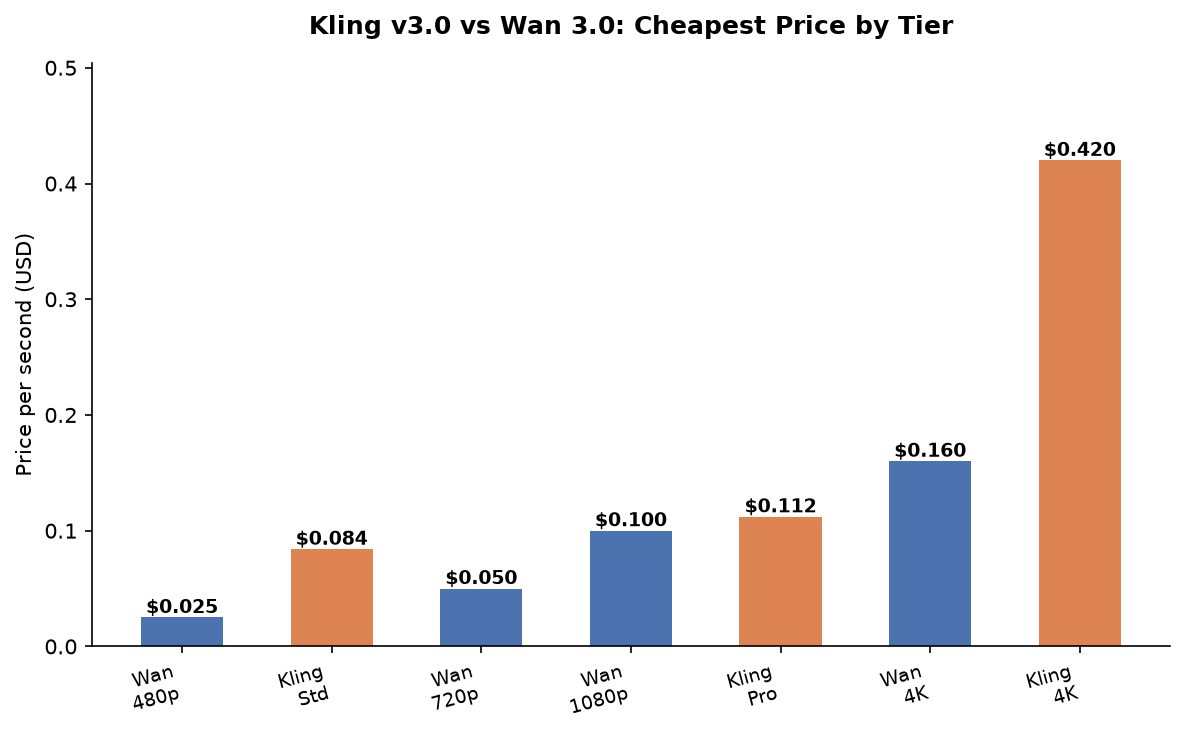
At 480p, Wan is 4.4x cheaper than Kling's Std tier ($0.025 vs $0.084). That gap narrows sharply by 720p, where Wan ($0.05) is still cheaper than Kling Std but by a much smaller margin (40%). By 1080p, Wan's rate ($0.10) has actually climbed past Kling Std's flat $0.084/sec — the one point in this comparison where Kling is the cheaper option. At the top tier, Wan's 4K rate through Atlas Cloud ($0.16/sec) undercuts Kling's 4K ($0.42/sec) by 62%, the widest gap in the whole table.
The practical implication: resolution changes which model wins
Because Kling's price doesn't move with resolution and Wan's does, the "cheaper model" answer flips depending on what you're actually generating:
- Generating at 480p or low-resolution drafts: Wan 3.0 is the clear cost winner, by a wide margin.
- Generating at 720p: Wan is still cheaper, but the gap has shrunk to a point where Kling's other qualities (motion coherence, prompt adherence) might reasonably tip the decision even without a price advantage.
- Generating at 1080p: Kling Std is actually the cheaper of the two — the only tier pairing in this table where that's true.
- Generating at 4K: Wan pulls back ahead by the widest margin in the comparison.
This is a genuinely different shape than most model-vs-model comparisons in this series, where one model is simply cheaper across the board. Here, the resolution you request is doing as much work in deciding "which model is cheaper" as the model choice itself.
Kling Pro vs Wan's higher tiers
Kling Pro ($0.112/sec) sits between Wan's 720p ($0.05) and 1080p ($0.10) rates — closer to 1080p, in fact just 12% above it. If you're evaluating Pro against Wan specifically because you need better fidelity than Std/720p offers, Wan at 1080p is the fairer price comparison point, not Wan at 720p.
Where Wan 3.0 Prime fits into this
Wan also ships a "Prime" variant, priced roughly double the base model at most hosts (see Wan 3.0 vs Wan 3.0 Prime). Prime's cheapest host at 720p (Pika, $0.105/sec) is actually pricier than Kling Std ($0.084/sec) at the same nominal tier — and Prime at 1080p ($0.21/sec, Pika) costs nearly double Kling Pro. If you're comparing Kling against "the best Wan can offer" rather than the base checkpoint, Kling comes out ahead at both 720p and 1080p once Prime is the Wan side of the comparison instead of base Wan 3.0.
What this costs at real volume
A team generating 3,000 five-second clips a month at whichever tier they've settled on:
At 720p (Wan) vs Std (Kling): - Wan 3.0, Replicate: 3,000 × 5 × $0.050 = $750/month - Kling Std, Novita/WaveSpeedAI: 3,000 × 5 × $0.084 = $1,260/month
Wan saves $510/month (40%) at this tier.
At 1080p (Wan) vs Std (Kling): - Wan 3.0, Replicate: 3,000 × 5 × $0.100 = $1,500/month - Kling Std, Novita/WaveSpeedAI: 3,000 × 5 × $0.084 = $1,260/month
The ranking flips — Kling Std is now $240/month (16%) cheaper than Wan at 1080p, for the same clip count.
A second worked example: 4K at scale
A team generating 500 four-second clips a month at the top tier of each model:
- Wan 3.0 4K, Atlas Cloud: 500 × 4 × $0.160 = $320/month
- Kling 4K, Novita/WaveSpeedAI: 500 × 4 × $0.420 = $840/month
At 4K, Wan is $520/month cheaper — 62% less — the largest proportional gap anywhere in this comparison. If your use case genuinely requires 4K output, that's a much larger lever than any of the mid-tier comparisons above.
Frequently asked questions
Are Kling's Std/Pro/4K tiers actually locked to specific output resolutions? Check VideoRouter's Kling v3.0 model page and /docs/video-generation for the exact resolution each tier outputs — this article compares tiers by name and price, not by an assumed resolution mapping, since Kling's pricing doesn't expose resolution as a request parameter the way Wan's does.
Does Wan's per-tier multiplier stay consistent enough to predict prices at tiers not shown here? Yes, roughly — Wan 3.0's rate scales close to 2x per resolution step (480p → 720p → 1080p) at most hosts, a pattern documented in Wan 3.0 API Pricing. Kling has no equivalent per-tier multiplier to predict from, since its three tiers are independently priced rather than scaled from a base rate.
Is this comparison different if I use OpenRouter for either model? Yes — OpenRouter carries a 67% markup on Kling Std/Pro (see Kling v3.0 API Pricing) and a much larger 325% markup on base Wan 3.0 at 480p (see Which AI Video API Host Has the Biggest Resale Markup?). Both models get meaningfully more expensive through that channel, and Wan's markup is proportionally far worse, which can erase its cost advantage over Kling entirely if you're routing both through OpenRouter.
Should I pick a model purely based on this price crossover? No — this article only answers the price question. Kling and Wan have real quality and style differences that matter more than a sub-20% price gap at 1080p; test both on your actual prompts before deciding, and let this comparison break ties only when quality is already roughly equivalent for your use case.
Which model has the wider host roster, for redundancy purposes? Wan 3.0, by a large margin — eleven hosts for the base checkpoint versus effectively two independently-priced hosts (plus one resale channel) for Kling. If failover breadth matters as much as price, that's a real point in Wan's favor independent of the per-tier pricing above.
How to call either one
import requests

# Kling v3.0 Std
job = requests.post(
    "https://videorouter.sh/api/v1/videos",
    headers={"Authorization": "Bearer llmr_sk_live_...", "Content-Type": "application/json"},
    json={"model": "kling-v3.0-std", "prompt": "a kite surfer carving across a turquoise bay", "duration_secs": 5},
).json()

# Wan 3.0 at 720p
job = requests.post(
    "https://videorouter.sh/api/v1/videos",
    headers={"Authorization": "Bearer llmr_sk_live_...", "Content-Type": "application/json"},
    json={"model": "alibaba/wan-3.0", "prompt": "a kite surfer carving across a turquoise bay",
          "resolution": "720p", "duration_secs": 5},
).json()
See How to Call the Kling API and How to Call the Wan 3.0 API for the full integration walkthroughs, including provider pinning for each.