Seedance 2.5, Seedance 2.0, Wan 3.0 and MiniMax H3: What Each Costs on Higgsfield, Comfy, OpenRouter and VideoRouter
Four video models account for most of the "which API should I use" questions we see: ByteDance's Seedance 2.5 and Seedance 2.0, Alibaba's Wan 3.0, and MiniMax's H3. Four platforms keep coming up as the places to buy them: Higgsfield, Comfy (the Comfy Router), OpenRouter, and VideoRouter. The model is the same checkpoint on all of them. The price is not.
We checked every number in this article on October 19, 2026: Higgsfield through its own estimate endpoint, Comfy from its published rate card, OpenRouter from its live /videos/models listing, and VideoRouter from the price tables behind our own model pages. Nothing here is typed from memory, and where a number is an estimate or can't be verified, we say so.
The short version: on all four models, VideoRouter's price per second is lower than the other three at the headline tier. The gap ranges from 14% (Seedance 2.0 against OpenRouter) to 69% (Seedance 2.5 against Higgsfield). There is one honest exception, covered in the Higgsfield section, where a promotional price could undercut us if it applies to your account.
The headline numbers: 720p (2K for H3), USD per second of generated video
| Model | VideoRouter | OpenRouter | Comfy | Higgsfield (list) |
|---|---|---|---|---|
| Seedance 2.5 (720p) | $0.1454 | $0.2311 | $0.3305 | $0.4622 |
| Seedance 2.0 (720p) | $0.1307 | $0.1512 | $0.2162 | $0.3024 |
| Wan 3.0 (720p) | $0.0512 | $0.1000 | $0.1000 | $0.1000 |
| MiniMax H3 (2K) | $0.0666 | $0.1300 | $0.1859 | $0.1300 |
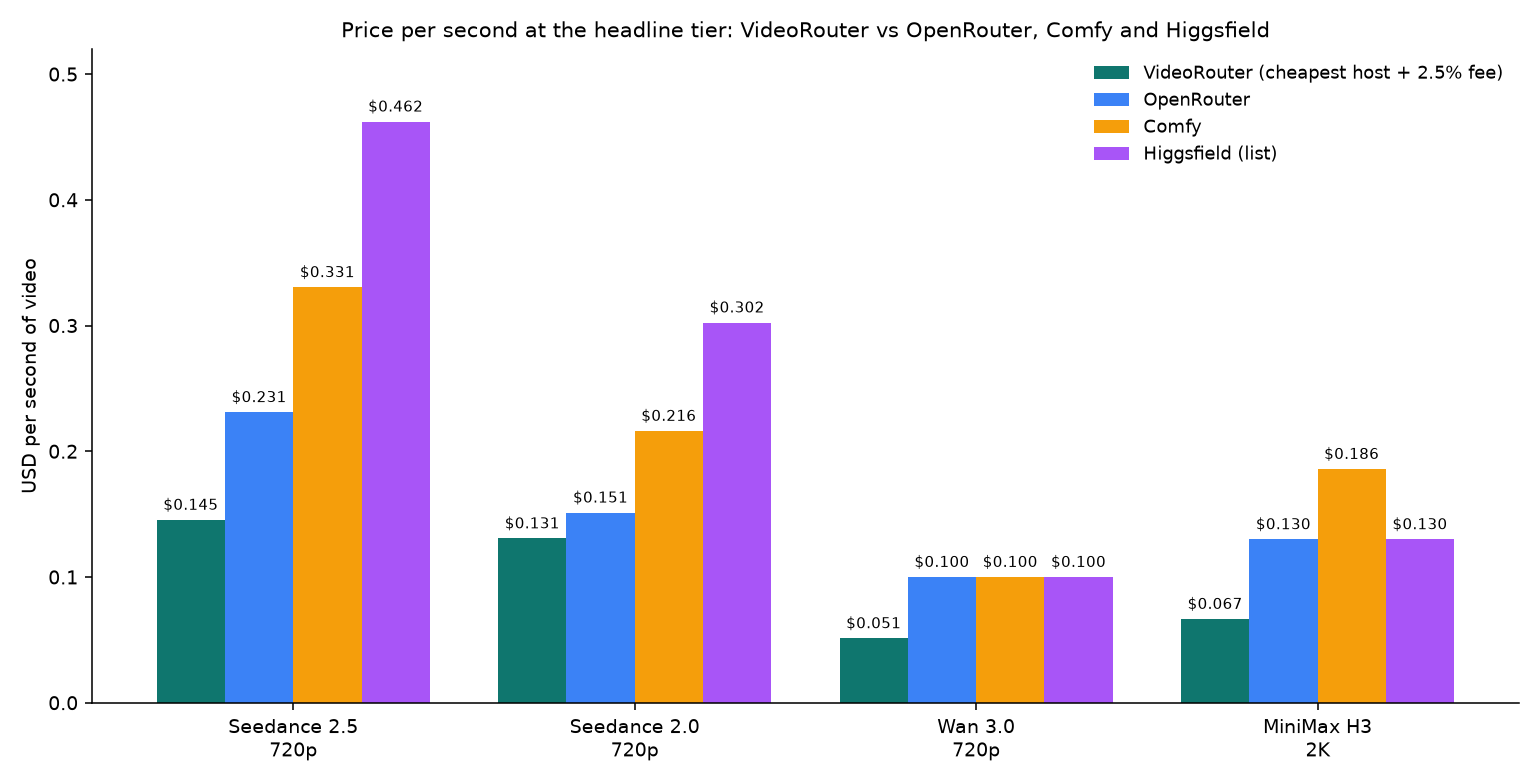
Every platform is serving the same model, so differences here are pure price. We use 720p for three models because it is the tier all four platforms offer in common, and 2K for H3 because OpenRouter and Higgsfield only offer H3 at 2K. Full per-tier tables follow.
How we compared, and why you should care about the method
A per-second price from one platform isn't automatically comparable to a per-second price from another. Four things needed normalizing.
1. VideoRouter's price is a cheapest-host price plus a flat fee. VideoRouter doesn't have a rate card of its own. It lists what each upstream host charges for a model, and bills you the host's price plus a flat 2.5% platform fee. The VideoRouter column in every table below is the cheapest host that lists the tier, multiplied by 1.025. The host behind each number is named, so you can see what you're actually buying.
2. Seedance is billed per token on three of the four platforms. Comfy, OpenRouter and Higgsfield publish Seedance prices per 1,000 or 1,000,000 video tokens, not per second. The conversion is tokens per second = width × height × 24 / 1024, which is the formula all three platforms publish for a billable video token. For 16:9 video that is about 9,607 tokens per second at 480p, 21,600 at 720p, 48,600 at 1080p and 194,400 at 4K. We checked the formula against Higgsfield's own pre-computed figure: its documentation states $0.2056 per second at 480p for Seedance 2.5, and the formula on its published $0.0214 per 1,000 tokens gives exactly that.
3. List price versus discounted price. Higgsfield's estimate endpoint returns a price that already includes any account discount. On our account that discount was 15% for the models that return a numeric estimate. Seedance and Wan return a pricing description instead of a number, stated "before any applicable customer discount", so we use list prices for those and flag it. We use Higgsfield's list price throughout, so the comparison is like-for-like with Comfy's and OpenRouter's published rates.
4. Advertised versus invoiced. Everything in the tables is the advertised price. For one model, Wan 3.0 on OpenRouter, our own test job was invoiced at a different price than advertised. That is covered in the Wan section rather than buried in a table.
Seedance 2.5
Seedance 2.5 is ByteDance's current flagship, and it is the model with the biggest price spread in this comparison: $0.2056 to $0.0788 per second at 480p, a 2.6x difference for identical output.
| Tier | VideoRouter | OpenRouter | Comfy | Higgsfield (list) |
|---|---|---|---|---|
| 480p | $0.0808 (SoCheap) | $0.1028 | $0.1470 | $0.2056 |
| 720p | $0.1454 (SoCheap-Overseas) | $0.2311 | $0.3305 | $0.4622 |
| 1080p | $0.4073 (SoCheap) | not offered | $0.8131 | $1.1372 |
A few things stand out.
Higgsfield's token rate for 2.5 is $0.0214 per 1,000 tokens, which is 2.1x the rate OpenRouter lists ($0.0107 per 1,000). That's the same checkpoint. Comfy sits in between at $0.0153 per 1,000 for 480p and 720p, which its rate card lists for the BytePlus-served route.
OpenRouter only offers 480p and 720p for Seedance 2.5, according to its model listing. There is no 1080p option, so if you need 1080p the choice is between Comfy, Higgsfield and VideoRouter. At 1080p, VideoRouter's cheapest host is half of Comfy's price and 64% below Higgsfield's.
The 720p cell comes from a lower-priced host row. VideoRouter's cheapest 720p price is SoCheap's overseas "low" row at $0.1419 per second, compared with $0.1768 on SoCheap's official row. Both are listed on the model page, and which you want depends on the availability and guarantees you need. If you pin the official row at 720p, the VideoRouter figure is $0.1812 per second including our fee, still 22% below OpenRouter and 45% below Comfy.
For the full list of the 15 host rows that serve Seedance 2.5, see the Seedance 2.5 pricing breakdown.
Seedance 2.0
Seedance 2.0 is a generation behind, which makes it a genuinely different buying decision from 2.5: the quality gap is real but narrow, and the price gap is large. It is also the model where OpenRouter is closest to competitive.
| Tier | VideoRouter | OpenRouter | Comfy | Higgsfield (list) |
|---|---|---|---|---|
| 480p | $0.0610 (MachGen) | $0.0673 | $0.0962 | $0.1345 |
| 720p | $0.1307 (MachGen) | $0.1512 | $0.2162 | $0.3024 |
| 1080p | $0.3224 (MachGen) | $0.3742 | $0.5351 | $0.6804 |
| 4K | $0.6217 (OpenSand) | $0.7776 | $1.1120 | $1.5552 |
OpenRouter lists Seedance 2.0 at $7 per million video tokens, already low, which is why it lands within 9% to 14% of VideoRouter at 480p through 1080p. This is the one place where OpenRouter is a reasonable single-host choice on price alone.
Comfy's rate for Seedance 2.0 is $10.01 per million tokens, 43% above OpenRouter's $7. Higgsfield's is $14 per million, double OpenRouter's. Neither lists anything that justifies the premium: it is the same ByteDance model, same tiers, same output.
At 4K the story changes: Higgsfield and Comfy both discount the 4K token rate ($8 and $5.72 per million respectively), but even so the per-second price is $1.55 and $1.11. VideoRouter's cheapest 4K host (OpenSand) comes out at $0.62.
Wan 3.0
Wan 3.0 is Alibaba's model, and it is the simplest of the four to compare because every platform bills it per second at a flat rate per resolution. It is also where the single biggest percentage gap appears, because three of the four platforms publish exactly Alibaba's own list price.
| Tier | VideoRouter | OpenRouter (advertised) | Comfy | Higgsfield (list) |
|---|---|---|---|---|
| 480p | $0.0256 (Replicate) | $0.0500 | $0.0500 | $0.0500 |
| 720p | $0.0512 (Replicate) | $0.1000 | $0.1000 | $0.1000 |
| 1080p | $0.1025 (Replicate) | $0.2000 | $0.2000 | $0.2000 |
OpenRouter, Comfy and Higgsfield all charge $0.05, $0.10 and $0.20 per second. That is Alibaba's direct list price. Three of the four platforms in this comparison charge Alibaba's list price with no discount. VideoRouter is 49% lower at every tier because Replicate lists the model at half of Alibaba's price, and several other hosts (SandBase, TOAPIS at $0.03 per second for 480p) are not far behind.
One caution about OpenRouter. The advertised price in the table above is what OpenRouter's listing says today. On September 14, 2026, we ran a real 2-second, 480p Wan 3.0 job through OpenRouter and the invoice came to $0.2125, which is $0.10625 per second, 2.125x the advertised $0.05. Wan 3.0 Prime showed the same pattern at 2.5x. That was one test job at one resolution, a month ago, so treat it as a data point rather than a verdict. We haven't re-run it for this article. But it's the reason we recommend checking your own invoice against the advertised rate on any platform, not only that one.
One caution about Higgsfield. Higgsfield's marketing page lists Wan 3.0 at $0.02 per second with a "60% off" label against a $0.05 list price. If that promotional price applies to your account, it is lower than VideoRouter's $0.0256 at 480p. Higgsfield's estimate endpoint for Wan 3.0 returns the $0.05 list rate with the note "before any applicable customer discount", so we couldn't verify through the API that the promotion applies. Our own estimates on Kling and H3 showed a 15% discount, not the 50% to 60% the marketing page advertises. Run an estimate on your own account before you assume either number.
MiniMax H3
MiniMax H3 is the most fragmented of the four, because platforms disagree about which resolutions the model comes in.
| Tier | VideoRouter | OpenRouter | Comfy | Higgsfield (list) |
|---|---|---|---|---|
| 768p | $0.0410 (kie.ai) | not offered | $0.1287 | not offered |
| 2K | $0.0666 (kie.ai) | $0.1300 | $0.1859 | $0.1300 |
- OpenRouter and Higgsfield only serve H3 at 2K. OpenRouter's listing has a single 2K option; Higgsfield's API rejects any other resolution outright (
resolution: '720p' is not one of ['2K']). OpenRouter also lists a separate "H3 Max" model with 480p and 768p tiers at $0.05 and $0.08 per second, but that is a different model and not what's compared here. - Comfy is the most expensive on H3, at $0.1287 for 768p and $0.1859 for 2K, which is 61% and 43% above MiniMax's own list price of $0.08 and $0.13.
- At 2K, OpenRouter and Higgsfield match MiniMax's list price of $0.13 per second. VideoRouter's cheapest host is half that.
- Reference images cost extra. OpenRouter charges $0.04 per reference image and Comfy $0.0572 per image beyond five. These aren't included in the tables above, and they are the kind of line item that quietly changes a budget.
Higgsfield's marketing page lists H3 at $0.065 per second ("50% off"), which would roughly tie VideoRouter's $0.0666. As with Wan 3.0, that isn't what Higgsfield's estimate returned for our account: a 5-second 2K H3 estimate came back at $0.553, or $0.1105 per second after a 15% discount from a $0.65 list.
What each platform is actually good for
Price isn't the only reason to pick a platform. Here is where each one fits, based on what we measured.
OpenRouter is a sensible choice if you already have an OpenRouter account and your workload is Seedance 2.0, where its price is within 9% to 14% of the cheapest alternative. For Seedance 2.5, Wan 3.0 and H3 it prices at or above the list rate. For a longer treatment, see OpenRouter vs VideoRouter for video and image models.
Comfy is the most expensive on three of the four models, but it has something the others don't: per-request cost reporting. A response header returns what the call cost, and a usage events endpoint lets you look the cost up afterwards by request ID. If your problem is reconciliation and you're already inside the Comfy ecosystem, that matters. If your problem is cost per second, it doesn't help.
Higgsfield has the best-documented estimate endpoint of the four: you send the exact generation body and get a price back before you spend anything. But what it returns for these four models is at or near the top of every table, and its API doesn't return a cost on the generation response or offer a way to look a charge up afterwards. Its marketing promotions are real as headline numbers and unverified as API prices.
VideoRouter is lowest at the headline tier on all four models because it passes through whichever host currently lists the lowest price and adds a flat 2.5%. That is also its weakness: the cheapest host for a given model and tier changes, so the right answer on a given day depends on the live table, which is why every number above is traceable to a named host.
Can you see what you were charged?
For anyone building billing on top of a video API, the price per second matters less than whether you can verify the charge afterwards. We tested this on each platform.
| Platform | Cost on the generation response | Look up the cost of a past request |
|---|---|---|
| VideoRouter | Yes, in the response | Yes, per request |
| Comfy | Yes, in a response header (for some providers) | Yes, by request ID in its usage events |
| Higgsfield | No | No. Spend is visible in the dashboard and can be exported as CSV |
| OpenRouter | Yes, a usage cost on the job | Not tested |
Comfy's header isn't universal: the documentation says a missing header doesn't mean the call was free, and recommends reconciling against usage and invoices instead. Higgsfield's price quote is reliable but only available before you submit.
A worked example: 1,000 five-second clips
At 720p (2K for H3), 1,000 five-second clips is 5,000 seconds of output. The cost at each platform's per-second rate:
| Model | VideoRouter | OpenRouter | Comfy | Higgsfield (list) |
|---|---|---|---|---|
| Seedance 2.5 (720p) | $727 | $1,156 | $1,652 | $2,311 |
| Seedance 2.0 (720p) | $653 | $756 | $1,081 | $1,512 |
| Wan 3.0 (720p) | $256 | $500 | $500 | $500 |
| MiniMax H3 (2K) | $333 | $650 | $930 | $650 |
For a product shipping 1,000 Seedance 2.5 clips a month, the difference between the cheapest and most expensive platform is $1,584 a month, on identical output. The gap scales linearly: at 10,000 clips it is $15,840.
Where VideoRouter isn't the cheapest
We'd rather be specific about this than leave you to find it.
- Higgsfield's promotional prices, if they apply to you. If Higgsfield's Wan 3.0 at $0.02 per second is real for your account, it undercuts the $0.0256 VideoRouter price at 480p. Check your own estimate.
- Lower-priced host rows trade off something. The cheapest Seedance 2.5 720p row is a "low" row on one host. For anything customer-facing, look at the host's availability and terms on the model page before assuming the lowest number is the right one.
- Reference inputs change the math on every platform. Reference images, and reference video billed as input-plus-output duration, can add materially to a bill. Neither the headline rates here nor any other comparison captures that for your specific workload.
- Prices move. These are October 19, 2026 numbers. Host prices on our own tables change regularly, and promotional prices elsewhere can change faster.
Frequently asked questions
Is it the same model on every platform? Yes for the checkpoint: Seedance 2.5 on one platform is ByteDance's Seedance 2.5 on another. Output quality can still differ between hosts running the same checkpoint, and we don't currently score generation quality, so a price comparison alone doesn't tell you whether outputs are identical.
Why is Higgsfield's Seedance 2.5 so much higher than OpenRouter's? Higgsfield's published token rate for Seedance 2.5 is $0.0214 per 1,000 tokens against OpenRouter's $0.0107, exactly double. We can't see their cost structure, so we can't say why. What we can say is that the list rate is what's published and what the estimate endpoint returns before discount.
Does VideoRouter's 2.5% fee apply on top of the prices in the tables? Yes: the VideoRouter column already includes it. The other three columns are their published rates with no additions.
How do I get Higgsfield's real price for my account? Call its estimate endpoint with the exact request body you plan to send. Models that return a numeric estimate include the account discount in the usd field. Models like Seedance and Wan return a pricing description instead, which is before any discount.
Can I use more than one platform? Nothing stops you. If you already use a platform for something else, the practical question is whether the price gap on the models you generate most justifies a second integration. At the volumes in the worked example above, it usually does.