MiniMax H3 vs Kling v3.0: Which Costs Less?
MiniMax H3 and Kling v3.0 both sit in the mid-tier of video model pricing — cheaper than the Google/ByteDance flagships, pricier than the budget-tier open checkpoints. Comparing them directly is a genuinely useful exercise precisely because they're close enough in market position that price, not an order-of-magnitude gap, is what should actually decide between them for a lot of use cases.
Cheapest verified host, both models
| MiniMax H3 tier | Rate (MachGen) | Kling tier | Rate (Novita/WaveSpeedAI) | H3 vs Kling |
|---|---|---|---|---|
| 480p | $0.035/sec | — | — | — |
| 768p | $0.040/sec | Std | $0.084/sec | H3 52% cheaper |
| 1440p/2K | $0.100/sec | Pro | $0.112/sec | H3 11% cheaper |
| — | — | 4K | $0.420/sec | — |
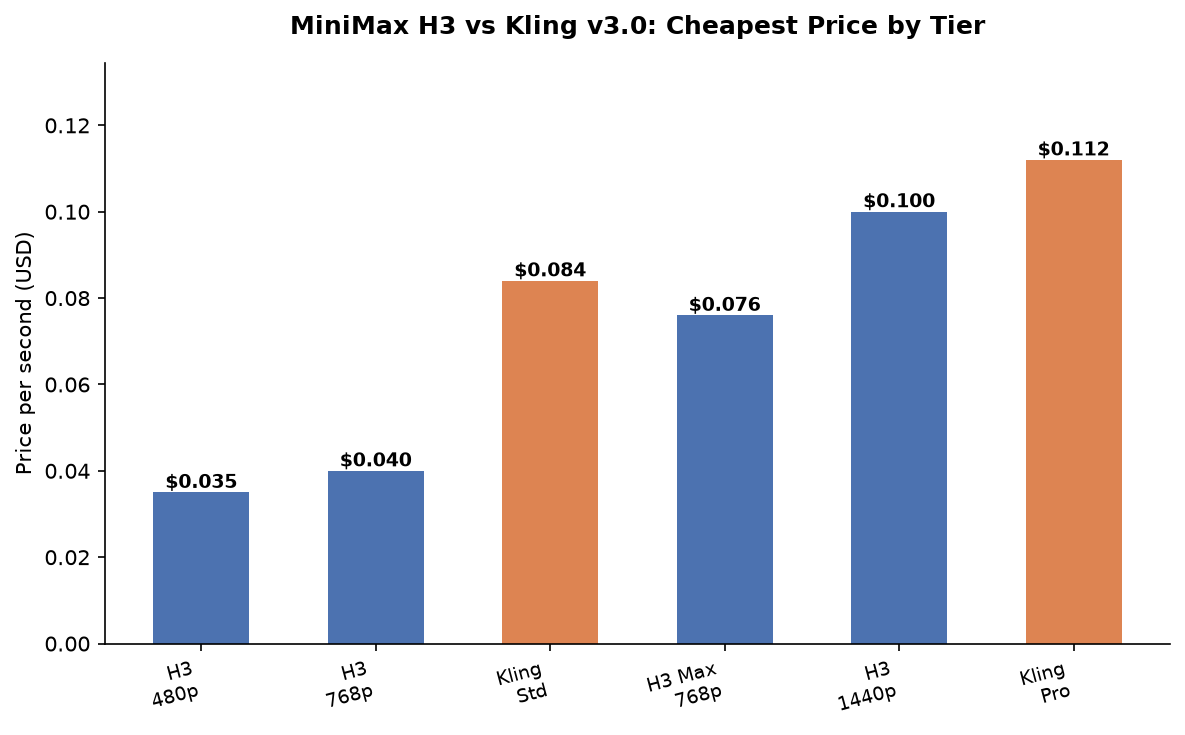
At the tiers that line up most naturally — H3's 768p against Kling's Std — H3 is a bit more than half the price. That gap narrows considerably at the next tier up: H3's 1440p/2K rate is only 11% below Kling Pro. Neither model currently lists a tier that maps cleanly onto Kling's 4K, so that row is left as a gap rather than an approximate comparison.
Why the gap narrows as tiers go up
H3's per-tier scaling is steeper than Kling's flat-per-tier structure: MachGen's H3 rate roughly triples from 480p ($0.035) to 1440p ($0.10), while Kling's three tiers are independently priced rather than scaled off a base rate. The practical effect is that H3's cost advantage is largest at its cheapest tier and compresses as you move toward higher fidelity — the opposite of what you'd get if H3 had a flat percentage discount against Kling at every tier. If your use case can ship on H3's lower or mid tier, the savings are substantial; if it needs H3's highest tier, the case for H3 over Kling Pro on price alone gets much thinner.
H3 Max: a closer, more direct comparison to Kling Std
MiniMax also ships an "H3 Max" variant, priced above base H3 but still well under Kling:
| Provider | H3 Max 480p | H3 Max 768p |
|---|---|---|
| Atlas Cloud | $0.0475/sec | $0.0760/sec |
At 768p, H3 Max ($0.076/sec) is just 10% below Kling Std ($0.084/sec) — a far closer race than base H3's 52% gap at the same nominal tier. If the improved fidelity H3 Max offers over base H3 matters for your output, that upgrade costs relatively little against base H3, and still lands meaningfully under Kling Std.
What this costs at real volume
A team generating 4,000 five-second clips a month at a comparable mid-tier resolution:
- MiniMax H3, MachGen (768p): 4,000 × 5 × $0.040 = $800/month
- H3 Max, Atlas Cloud (768p): 4,000 × 5 × $0.076 = $1,520/month
- Kling Std, Novita/WaveSpeedAI: 4,000 × 5 × $0.084 = $1,680/month
Base H3 saves $880/month (52%) against Kling Std at this volume; H3 Max still saves $160/month (10%) while offering the fidelity bump. Which of the three is the right default depends on whether base H3's output quality clears your bar — worth testing directly rather than assuming from price alone.
A second worked example: the higher tier
At 1,500 six-second clips a month, comparing H3's top tier against Kling Pro:
- MiniMax H3, MachGen (1440p/2K): 1,500 × 6 × $0.100 = $900/month
- Kling Pro, Novita/WaveSpeedAI: 1,500 × 6 × $0.112 = $1,008/month
Only a $108/month (11%) gap at this volume — small enough that if Kling Pro's motion coherence or prompt adherence is noticeably better for your prompts, paying the premium is easy to justify. This is a much lower-stakes price decision than the 768p/Std comparison above.
Frequently asked questions
Is H3's 768p tier really a fair comparison to Kling's Std tier? They're not guaranteed to be pixel-identical output resolutions — this comparison uses each model's own commonly-cited "standard" tier rather than a verified resolution match. If exact resolution parity matters for your use case, check each model's own listing for its precise output dimensions before treating this as a like-for-like comparison.
Does either model have a tier cheaper than H3's 480p? Not within these two model families specifically. If your use case needs to go cheaper still, check the Seedance 2.0 family (see Where to Get the Cheapest Seedance API), which prices its Mini tier under H3's 480p rate at some hosts.
Why does Kling have no equivalent to H3's wide host roster? MiniMax has licensed H3 to eleven separate hosts, while Kling's hosting market is limited to two independently-priced hosts plus one resale channel — a licensing decision on each model creator's part, not something either host or VideoRouter controls. That difference in host breadth is a real factor beyond price: H3 has meaningfully more redundancy options if a single host has an outage.
Should a team pick based on this price comparison alone? No — H3 and Kling have real differences in motion quality, prompt adherence, and style that this pricing comparison doesn't capture. Use the price gap to decide how much a quality difference would need to be worth before paying for it, not as a standalone recommendation.
Is MachGen consistently the cheapest host across the models in this series? It's a recurring pattern — MachGen is cheapest or near-cheapest for Seedance, Wan 3.0, MiniMax H3, and Veo 3.1's mid-tier pricing across this article series — but it isn't universal; Kling specifically isn't hosted by MachGen at all, and Wan's cheapest host is Replicate, not MachGen. Check each model individually rather than assuming.
How to call either one
import requests

# MiniMax H3
job = requests.post(
    "https://videorouter.sh/api/v1/videos",
    headers={"Authorization": "Bearer llmr_sk_live_...", "Content-Type": "application/json"},
    json={"model": "minimax/h3", "prompt": "a paper airplane gliding over a city", "duration_secs": 5},
).json()

# Kling v3.0 Std
job = requests.post(
    "https://videorouter.sh/api/v1/videos",
    headers={"Authorization": "Bearer llmr_sk_live_...", "Content-Type": "application/json"},
    json={"model": "kling-v3.0-std", "prompt": "a paper airplane gliding over a city", "duration_secs": 5},
).json()
See How to Call the MiniMax H3 API and How to Call the Kling API for the full integration walkthroughs, including provider pinning for each.