Veo 3.1 vs Wan 3.0: Premium vs Budget Video API Pricing
Google's Veo 3.1 and Alibaba's Wan 3.0 sit at opposite ends of the video model price spectrum — Veo as a premium flagship, Wan as an openly-licensed, aggressively-hosted budget option. That framing holds up at the flagship tier, but both models ship multiple variants, and once you compare across all of them the "premium vs budget" story gets a genuine twist: Google's own cheapest tier actually undercuts Alibaba's base model.
Every tier, 720p, cheapest verified host
| Tier | Cheapest host | Price (720p) |
|---|---|---|
| Veo 3.1 Lite | Pika / OpenRouter | $0.030/sec |
| Wan 3.0 (base) | Replicate | $0.050/sec |
| Veo 3.1 Fast | Pika / OpenRouter | $0.080/sec |
| Wan 3.0 Prime | Pika | $0.105/sec |
| Veo 3.1 (flagship) | Pika / Replicate / OpenRouter | $0.200/sec |
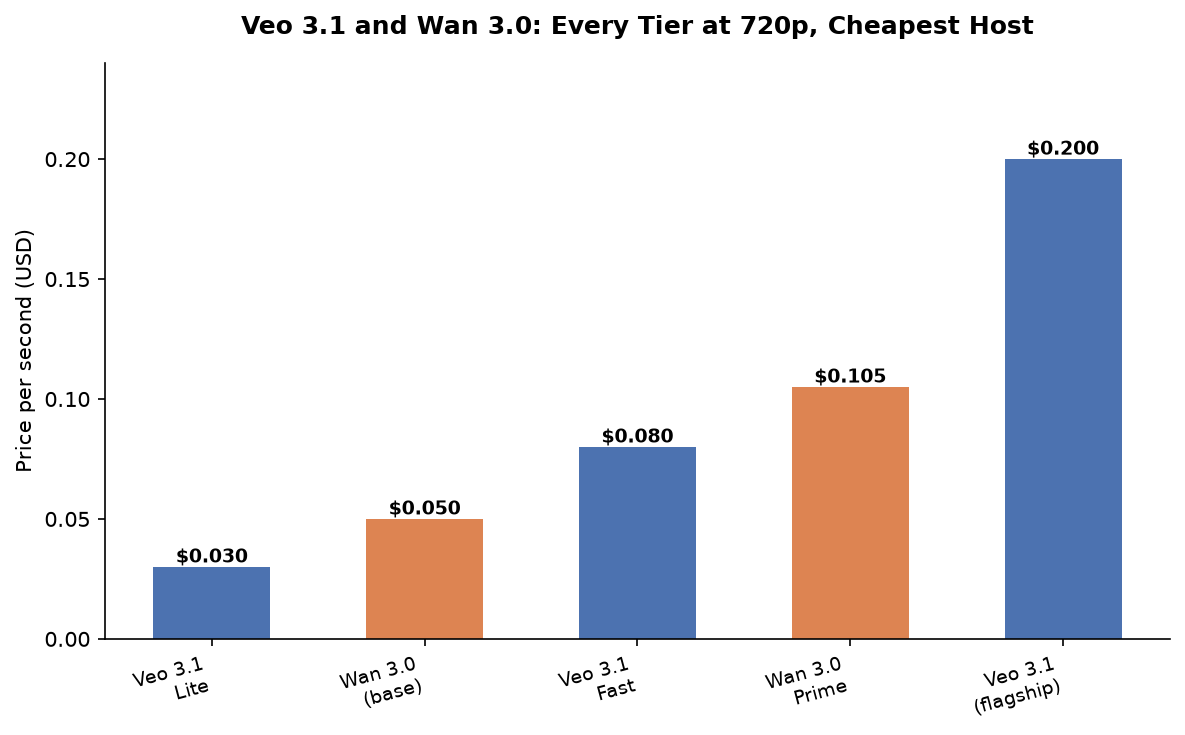
Sorted by price, the two model families interleave rather than cluster separately. Veo 3.1 Lite is the single cheapest option in this entire comparison — cheaper than Wan's base model, not just competitive with it. Wan 3.0 Prime, meanwhile, costs more than Veo 3.1 Fast. "Veo is the expensive one, Wan is the cheap one" is true if you're only looking at each family's flagship-equivalent tier, and false as a general statement about the two model families.
Flagship vs flagship: where the premium/budget framing holds
At the tier most people mean when they say "Veo" or "Wan" without qualification:
- Veo 3.1 (flagship), cheapest host: $0.20/sec
- Wan 3.0 (base), cheapest host: $0.05/sec
Wan is 75% cheaper — a 4x gap. This is the comparison that matches the premium-vs-budget intuition, and it's a real, large gap: Google's flagship model costs four times as much per second as Alibaba's openly-licensed one at their respective cheapest hosts.
Where the framing breaks: Lite vs base
- Veo 3.1 Lite, cheapest host: $0.03/sec
- Wan 3.0 (base), cheapest host: $0.05/sec
Veo 3.1 Lite is 40% cheaper than Wan 3.0's base model. If your comparison is "Google's cheapest tier vs Alibaba's cheapest widely-used tier" rather than "Google's flagship vs Alibaba's flagship," the premium/budget labels swap entirely. This matters in practice: a team that ruled out the entire Veo family as "the expensive option" based on flagship pricing alone would have missed the actual cheapest model in this whole comparison.
The middle: Fast vs Prime
- Veo 3.1 Fast, cheapest host: $0.08/sec
- Wan 3.0 Prime, cheapest host: $0.105/sec
Fast is 24% cheaper than Prime — a smaller gap than either the Lite/base or flagship/base comparisons, but still a real one. If you're choosing between "Google's mid-tier" and "Alibaba's premium tier," Google's is still the cheaper of the two, though not by the dramatic margin the flagship comparison suggests.
What this costs at real volume
A product generating 2,000 six-second clips a month, comparing flagship-tier options:
- Wan 3.0 (base), Replicate: 2,000 × 6 × $0.050 = $600/month
- Veo 3.1 (flagship), cheapest hosts: 2,000 × 6 × $0.200 = $2,400/month
A $1,800/month gap (75%) at flagship tier — the number that matches the premium/budget intuition.
The same volume, comparing each family's cheapest tier instead:
- Veo 3.1 Lite, Pika/OpenRouter: 2,000 × 6 × $0.030 = $360/month
- Wan 3.0 (base), Replicate: 2,000 × 6 × $0.050 = $600/month
Here Veo (Lite) is $240/month cheaper (40%) than Wan — the opposite ranking from the flagship comparison, at the same clip volume.
A second worked example: picking a tier pair by quality need, not label
A team that needs meaningfully better-than-draft quality but doesn't need flagship fidelity might reasonably compare Veo 3.1 Fast against Wan 3.0 Prime rather than either family's flagship or cheapest tier — these are two mid-tier options aimed at a similar use case. At 4,000 five-second clips a month:
- Veo 3.1 Fast, Pika/OpenRouter: 4,000 × 5 × $0.080 = $1,600/month
- Wan 3.0 Prime, Pika: 4,000 × 5 × $0.105 = $2,100/month
Fast saves $500/month (24%) over Prime at this volume — a real but much smaller gap than the flagship-tier comparison, which is exactly why comparing tiers by their actual quality target (not just by family) gives a more useful answer than always comparing "Google's option" against "Alibaba's option" at a fixed tier level.
The takeaway: compare tiers, not brands
The core lesson here generalizes past just these two models: "Veo is expensive, Wan is cheap" is a brand-level generalization that happens to be true only if you're implicitly comparing each brand's flagship tier. Once you account for the fact that both model creators ship a range of tiers at different price points, the right comparison is tier-to-tier based on the fidelity your use case actually needs — not family-to-family based on which company's name is attached to the flagship.
Frequently asked questions
Is Veo 3.1 Lite's quality actually comparable to Wan 3.0's base model? This article can't answer that — VideoRouter doesn't score generation quality, and Google and Alibaba's models have different strengths independent of price. Test both on your actual prompts before assuming price parity implies quality parity; a lower price on one side doesn't mean the outputs are interchangeable.
Does this tier-interleaving pattern hold at 1080p too, or just 720p? Check each model's own pricing article — Veo 3.1 vs Veo 3.1 Fast vs Veo 3.1 Lite and Wan 3.0 API Pricing — since resolution-scaling ratios differ enough between the two families that the exact ranking at 720p isn't guaranteed to hold at every other tier.
Why is Wan 3.0 Prime pricier than Veo 3.1 Fast, given Wan is generally the "budget" family? Prime is Alibaba's higher-fidelity checkpoint, priced roughly double the base Wan 3.0 model at most hosts (see Wan 3.0 vs Wan 3.0 Prime) — "budget family" describes Wan's base model specifically, not every tier Alibaba ships under the Wan name.
Should a new integration default to comparing flagship tiers, or the cheapest tier from each family? Compare whichever tiers actually match the fidelity your product needs — defaulting to a flagship-vs-flagship comparison when your use case would be fine on either family's cheaper tier overstates the real cost difference you'd face in production.
Do these numbers include VideoRouter's own routing fee? Yes — every rate above is the all-in per-second price billed through VideoRouter, not a host rate plus a separate markup layered on top.
How to call either one
import requests

# Veo 3.1 Lite
job = requests.post(
    "https://videorouter.sh/api/v1/videos",
    headers={"Authorization": "Bearer llmr_sk_live_...", "Content-Type": "application/json"},
    json={"model": "google/veo-3.1-lite", "prompt": "a lighthouse beam sweeping across a foggy harbor",
          "resolution": "720p", "duration_secs": 6},
).json()

# Wan 3.0 base
job = requests.post(
    "https://videorouter.sh/api/v1/videos",
    headers={"Authorization": "Bearer llmr_sk_live_...", "Content-Type": "application/json"},
    json={"model": "alibaba/wan-3.0", "prompt": "a lighthouse beam sweeping across a foggy harbor",
          "resolution": "720p", "duration_secs": 6},
).json()
See How to Call the Veo 3.1 API and How to Call the Wan 3.0 API for the full integration walkthroughs, including provider pinning for each.