Same AI Model, Different Output Quality: What Causes It (and How to Spot It)
We've written before about how the same video model can cost 2.5x to 3x more depending on which provider you call — identical checkpoint, wildly different price. Price is the easy half of that story, because it's a single number you can put in a table. The harder half, and the one almost nobody puts a number on, is that the same model name can also produce different quality depending on which host actually ran the job. Not a different model — genuinely the model you asked for — just a visibly worse version of it.
This matters more as the provider landscape gets crowded. Every popular open-source video and image model — Wan, Seedance, Flux, and others — gets picked up by a growing list of resale hosts, some backed by well-known infrastructure companies and some run by small teams nobody's heard of. The small, cheap host isn't automatically the untrustworthy one. But "cheaper" and "identical output" are two different claims, and right now there's no reliable, public way to tell whether a given host's version of a given model is actually holding up.
What "same model, worse output" actually looks like
Here's a concrete illustration — not of a specific model or provider, but of the kind of visible degradation this article is about, using a simple side-by-side:
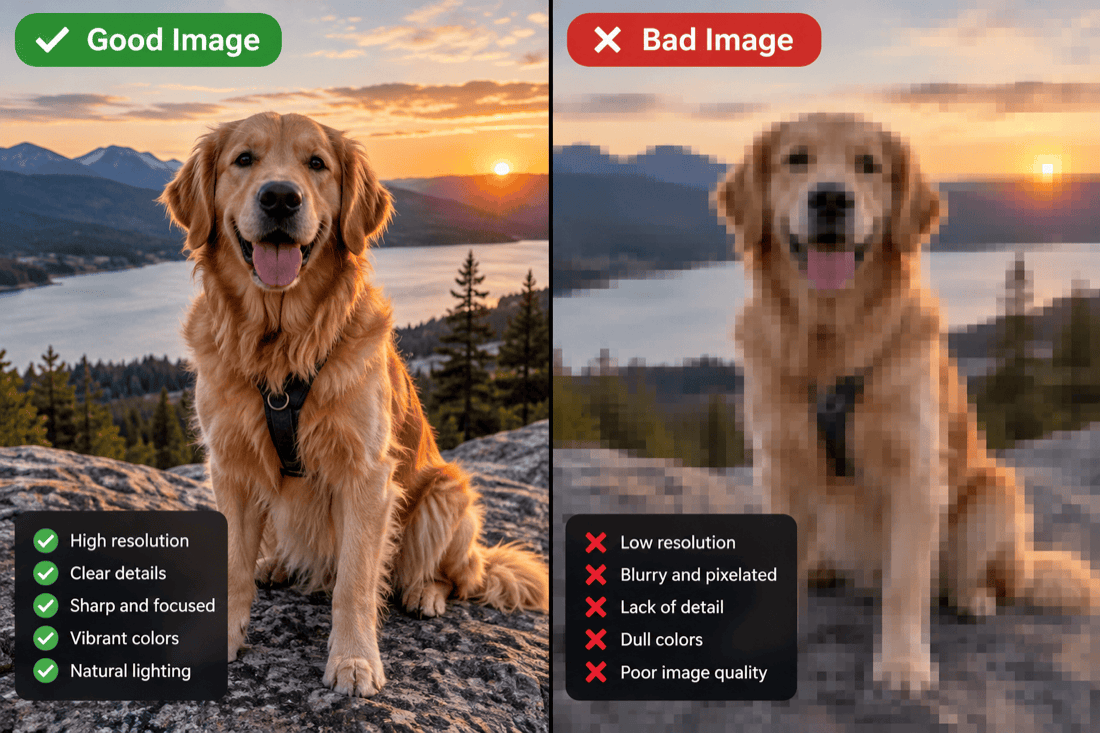
The "good" output on the left checks five boxes: high resolution, clear detail, sharp focus, vibrant color, natural-looking lighting. The "bad" output on the right is the same subject, the same composition, run through a degraded pipeline — pixelated, blurry, flat color, visibly lower resolution. Nothing about the prompt changed. What changed is the pipeline behind it: resolution settings, compression, decoding steps, or the underlying weights themselves. That's the entire problem in one picture — two providers can both truthfully say "we served Model X" and hand back outputs that don't look like they came from the same model at all.
Two different reasons this happens
It's worth separating these, because they call for different responses.
1. The provider quietly serves a cheaper substitute. This is the more serious case. A request specifies an expensive, high-quality model; the provider actually routes it to a smaller, cheaper model and pockets the difference. The bill says you paid for Model X. The output was never generated by Model X. This is functionally a billing fraud, and it's specifically hard to catch because a slightly-worse output doesn't come with a receipt explaining why it looks off — it just looks like the model "having an off day."
2. Legitimate but aggressive optimization. This one isn't malicious, and it's especially common with open-source checkpoints, precisely because anyone can host them and the competitive pressure to be the cheapest listing is real. A provider might quantize the model more aggressively, cap the output resolution, cut the number of decoding/sampling steps, or tune settings for speed over fidelity. The model that ran genuinely is the one you asked for — it's just been squeezed hard enough that the output suffered. You got what you paid for in the narrow sense, and something worse than you expected in the sense that matters.
Both produce the same visible symptom — a checklist like the one above tipping toward the "bad" column — with no signal in the API response telling you which cause it was, or that anything unusual happened at all.
Why "just check the leaderboards" doesn't solve this
The obvious answer is to lean on independent evaluation — sites like LMArena or Artificial Analysis, where models get scored on human preference. Those are genuinely useful, and worth checking. But they weren't built to answer the question this article is about, and they have two structural gaps that matter here:
They evaluate the model, not the (model, provider) pair. A leaderboard entry for "Wan 3.0" tells you how the reference implementation performed when the benchmark ran it. It says nothing about whether a specific reseller's deployment of that same checkpoint, running on their own inference stack with their own settings, produces the same quality. That's exactly the gap between "same model" and "same output" this article opened with.
Coverage skews toward famous labs. Submitting to a human-evaluated leaderboard takes effort, and mostly the well-known model creators bother. The long tail of resale providers serving those same models — often the ones competing hardest on price — simply never shows up. If you're evaluating whether a smaller, cheaper host's version of a popular model is trustworthy, there's usually no independent data point anywhere that speaks to that specific host at all.
A practical checklist for spotting it yourself, today
Until there's a systematic answer to this (more on that below), the most reliable thing a developer can do is exactly what the image above illustrates: actually look at output from the specific provider you're about to depend on, not just the model's reputation in general. A few concrete things to check before committing to a host for production volume:
| Check | What "bad" looks like | Why it's a signal |
|---|---|---|
| Resolution vs. what you requested | Output that's visibly softer or smaller than the resolution parameter you set | Some hosts silently cap output resolution below the request to cut compute cost |
| Fine detail (fur, text, hands, background elements) | Detail that smears into flat blobs of color under mild zoom | The clearest tell of aggressive quantization or reduced sampling steps |
| Color vibrancy | Washed-out, dull, or slightly-off color compared to the same prompt on a reference host | Color fidelity degrades early when a pipeline is optimized hard for speed |
| Compression artifacts | Visible blockiness or pixelation, especially in gradients (skies, skin tones) | A sign of aggressive output compression somewhere in the serving pipeline |
| Consistency across repeated calls | Quality varies noticeably run to run for the same prompt/seed | Suggests the provider may be load-balancing across mixed backend configurations, not one stable deployment |
Run the same prompt against two or three candidate providers side by side before picking one for volume. It takes a few minutes and it's the single highest-signal thing you can do that a leaderboard entry can't tell you, because it's testing the specific deployment you're actually about to depend on.
What we're building at VideoRouter
A manual spot-check is a reasonable stopgap, but it doesn't scale, and it's not something most teams keep doing after the initial integration — the same failure mode we've written about for price comparisons that get done once and never revisited. We're working on a systematic version of this instead: an automated-plus-human benchmark that scores every video and image model, per provider, on an ongoing basis — not once, at launch, but continuously as new hosts and deployments come online.
The design breaks quality into distinct dimensions rather than one opaque score: prompt adherence, visual quality, frame-to-frame consistency and motion for video, compositional correctness, physical/anatomical realism, and — for talking-head content — whether the spoken output actually matches the script it was given. Each dimension is scored with an established automated method (VideoScore, VBench, GenEval, and ImageReward, depending on the dimension), weighted differently depending on whether the use case is advertising, product demos, filmmaking, or UGC content, since "good" means different things for each.
This is a real design in progress, not a shipped feature yet — we're not going to claim a score exists for every provider today when it doesn't. But it's the direction we think this problem actually gets solved: not by asking developers to spot-check screenshots by hand, and not by waiting for a handful of famous labs to submit to a public leaderboard, but by measuring every model, from every provider VideoRouter routes to, on the same footing, automatically.
The takeaway
"Same model" is not a quality guarantee — it's a starting point. The provider actually running the job can change the output as much as the model choice itself, through either bad-faith substitution or ordinary over-optimization, and today there's no public, comprehensive signal that catches it, especially for the smaller providers who most need one to build trust. Until systematic, per-provider quality data exists, the checklist above — actually looking at output from the specific host you're about to depend on, not just the model's name — is the closest thing to a reliable answer.