Veo 3.1 vs Veo 3.1 Fast vs Veo 3.1 Lite: Pricing and When to Use Each
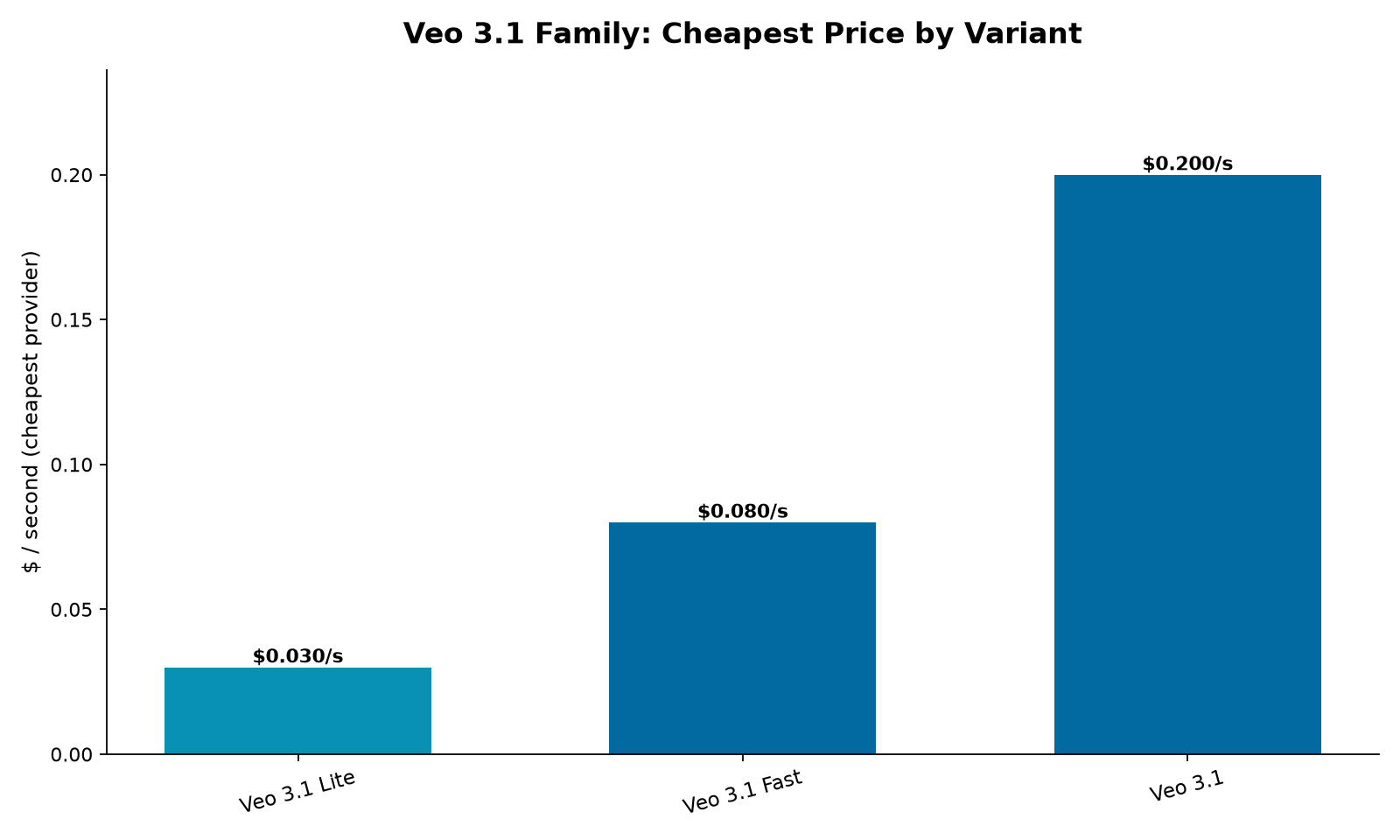
Google ships three tiers of Veo 3.1, and the pricing gap between them is bigger than the gap between any two hosts serving the same tier. At their respective cheapest hosts, Veo 3.1 Lite is $0.03/sec, Veo 3.1 Fast is $0.08/sec, and the flagship Veo 3.1 is $0.20/sec — a 6.7x range across one model family, before you've even started comparing hosts against each other.
Cheapest verified host, each tier
| Tier | Cheapest host | Price | vs. flagship |
|---|---|---|---|
| Veo 3.1 Lite | Pika | $0.03/sec | 6.7x cheaper |
| Veo 3.1 Fast | Pika / OpenRouter | $0.08/sec | 2.5x cheaper |
| Veo 3.1 | Pika / Replicate / OpenRouter | $0.20/sec | baseline |
Full per-provider breakdown
Veo 3.1 Fast:
| Provider | 720p | 1080p |
|---|---|---|
| Pika | $0.08 | $0.10 |
| OpenRouter | $0.08 | $0.10 |
| Replicate | $0.10 | $0.10 |
| Google (direct) | $0.10 | $0.12 |
| MachGen | $0.10 | $0.12 |
| WaveSpeedAI | $0.15 | $0.15 |
| DeepInfra | $0.15 (flat) | $0.15 (flat) |
Veo 3.1 Lite:
| Provider | 720p | 1080p |
|---|---|---|
| Pika | $0.03 | $0.05 |
| OpenRouter | $0.03 | $0.05 |
| WaveSpeedAI | $0.05 | $0.08 |
Lite is only listed by three hosts so far — a narrower market than the flagship or Fast tiers, which is worth knowing if host diversity (for failover, or for negotiating leverage) matters to your infrastructure decisions as much as raw price does.
What each tier is actually for
Veo 3.1 (flagship) is Google's highest-fidelity tier — the one to reach for when output ships directly to a paying customer and quality is the primary product differentiator.
Veo 3.1 Fast trades some of the flagship's fidelity for roughly 2.5x lower cost at a comparable resolution. In practice this is close enough to flagship quality for a lot of use cases that it's worth testing as your default before assuming you need full Veo 3.1 — the gap is smaller than the price difference implies for many prompts.
Veo 3.1 Lite is priced for volume: drafts, previews, A/B-testing prompts before spending flagship budget, or any pipeline generating far more clips than get shown to an end user. At $0.03/sec, an 8-second clip costs $0.24 — cheap enough to generate liberally rather than rationing generations the way you would at flagship pricing.
Picking a default tier for a new feature
If you're launching a new video-generation feature and haven't yet gathered data on which tier your users actually need, starting with Fast rather than the flagship is the more defensible default. Fast is close enough to flagship quality for a lot of prompts, at 2.5x lower cost, which means the downside of starting there and upgrading later (if user feedback shows the quality gap matters) is smaller than the downside of starting on the flagship and discovering later that Fast would have been indistinguishable to your users while costing 60% less. Reserve Lite specifically for internal/draft use rather than a customer-facing default — its quality step is large enough that most products will want a human or automated check before this tier's output reaches an end user.
Worked example: a three-tier pipeline
A product generating 2,000 clips a month at 6 seconds average, split 60% Lite drafts / 30% Fast previews / 10% flagship finals, all through Pika (the cheapest host across all three tiers):
- Lite: 1,200 × 6 × $0.03 = $216
- Fast: 600 × 6 × $0.08 = $288
- Flagship: 200 × 6 × $0.20 = $240
- Total: $744/month
Compare that to generating all 2,000 clips on the flagship tier alone: 2,000 × 6 × $0.20 = $2,400/month. The tiered pipeline cuts spend by 69% for the same total clip volume, by reserving flagship-tier cost for only the output that actually needs it.
Frequently asked questions
Is Lite's quality gap from the flagship larger than Fast's? Directionally yes — Lite is optimized further toward speed/cost than Fast, so expect a more noticeable quality step down. This is a claim worth verifying on your own prompts rather than taking on faith, since "noticeable" depends heavily on what your specific content looks like and how discerning your audience is.
Why does Lite have only three hosts listed, versus seven for the flagship? Newer or smaller-market variants within a model family often launch with a narrower set of hosts before wider adoption catches up — this is common across model families generally, not specific to Veo. Check back periodically, since a variant's host list tends to grow over time rather than shrink.
Can I mix tiers within a single user session? Yes — since all three tiers share the same request shape, nothing stops you from generating a Lite draft, letting a user iterate on the prompt cheaply, and then generating the final output on Fast or the flagship once they're satisfied. This is exactly the tiered-pipeline pattern the worked example above quantifies.
Does resolution affect the tier ranking, or just the tier prices? Both Fast and Lite show the same host ranking (Pika/OpenRouter cheapest) at both 720p and 1080p in the tables above — resolution changes the absolute price but hasn't reshuffled which host is cheapest for either tier in the current data.
Is there a Veo 3.1 tier cheaper than Lite? Not currently within the Veo family. If your use case needs to go cheaper still, that likely means looking at a different model family entirely rather than a lower Veo tier — see MiniMax H3 API Pricing or Where to Get the Cheapest Seedance API for lower price floors on other models.
How to call any tier
import requests

job = requests.post(
    "https://videorouter.sh/api/v1/videos",
    headers={"Authorization": "Bearer llmr_sk_live_...", "Content-Type": "application/json"},
    json={
        "model": "google/veo-3.1-lite",  # or "google/veo-3.1-fast", or "google/veo-3.1"
        "prompt": "a lighthouse beam sweeping across a foggy harbor",
        "resolution": "720p",
        "duration_secs": 6,
    },
).json()
Only the model field changes across all three tiers, which makes a tiered pipeline like the one above a routing decision in your own code rather than three separate integrations. See Veo 3.1 API Pricing Comparison Across Providers for the full flagship-tier breakdown, and /docs/video-generation for the complete request reference.