Seedance 2.5 vs Veo 3.1: Price Compared at Every Tier
Seedance 2.5 and Veo 3.1 are the current flagship checkpoints from ByteDance and Google respectively, and teams evaluating both usually start from a quality question, not a price one. But the price relationship between them isn't flat across resolution tiers, and the shape of that relationship is worth knowing before you pick a default — because it changes which model is the better value depending on which tier you actually ship on.
Cheapest verified host, both models
| Tier | Seedance 2.5 (MachGen) | Veo 3.1 (cheapest: Pika/Replicate/OpenRouter) | Difference |
|---|---|---|---|
| 480p | $0.085/sec | not offered | — |
| 720p | $0.190/sec | $0.200/sec | Seedance 5% cheaper |
| 1080p | $0.500/sec | $0.200/sec | Veo 60% cheaper |
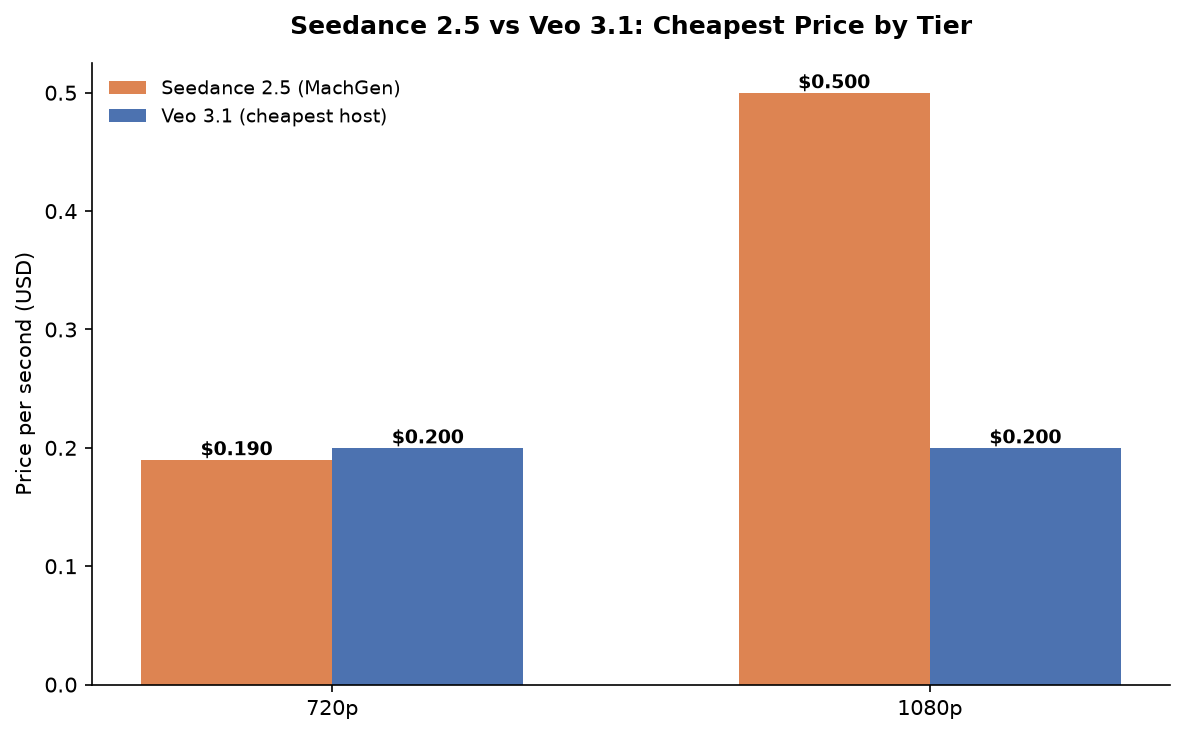
Two things jump out. First, Veo 3.1 doesn't ship a 480p tier at all through any host we track — its cheapest published resolution is 720p, so there's no direct comparison at Seedance's cheapest tier. Second, and more interesting: at 720p, the two flagships are within 5% of each other ($0.19 vs $0.20/sec) — close enough that host and quality preference, not price, should drive the decision at that tier. At 1080p, that near-tie breaks completely. Seedance's rate climbs to $0.50/sec while Veo's cheapest hosts hold flat at $0.20/sec, the same rate they charge at 720p.
Why the gap opens up at 1080p
Seedance 2.5's per-tier pricing scales steeply with resolution — roughly 2.6x from 720p to 1080p at MachGen, consistent with the ratio seen across every host in Seedance 2.5 API Pricing. Veo 3.1's cheapest hosts, by contrast, hold the identical rate across 720p and 1080p (Replicate and OpenRouter both charge $0.20/sec at either tier — see Veo 3.1 API Pricing Comparison Across Providers), only stepping up at the 4K/2160p tier. That's a structural difference in how the two models are priced, not a temporary promotional gap: Seedance's cost is more tightly coupled to resolution at every host that serves it, while Veo's cheapest hosts have effectively flattened the 720p-to-1080p step into their base rate.
The practical upshot: if your product ships at 720p, the two flagships are close enough on price that the decision should be about quality and style fit for your content. If your product ships at 1080p, Veo's cheapest hosts have a real, structural cost advantage that isn't going away because of temporary promotional pricing — it's baked into how each model's hosts price resolution.
What this costs at real volume
A product generating 1,000 eight-second clips a month:
At 720p: - Seedance 2.5, MachGen: 1,000 × 8 × $0.190 = $1,520/month - Veo 3.1, cheapest hosts: 1,000 × 8 × $0.200 = $1,600/month
An $80/month difference — small enough that it shouldn't be the deciding factor between the two models at this tier.
At 1080p: - Seedance 2.5, MachGen: 1,000 × 8 × $0.500 = $4,000/month - Veo 3.1, cheapest hosts: 1,000 × 8 × $0.200 = $4,000/month → $1,600/month
A $2,400/month gap at the same volume — 60% of Seedance's 1080p bill — purely from the resolution tier, with the model choice held constant on the Veo side. If your roadmap has any chance of shipping at 1080p rather than staying at 720p, that's worth factoring into a model decision made today, not revisited after the fact.
A second worked example: mixed-tier volume at scale
A larger product generating 20,000 clips a month, split 70% at 720p and 30% at 1080p, average 6 seconds:
- All on Seedance 2.5 (MachGen): (14,000 × 6 × $0.190) + (6,000 × 6 × $0.500) = $15,960 + $18,000 = $33,960/month
- All on Veo 3.1 (cheapest hosts): (14,000 × 6 × $0.200) + (6,000 × 6 × $0.200) = $16,800 + $7,200 = $24,000/month
At this mixed-tier volume, Veo 3.1's flat pricing across 720p/1080p makes it nearly $10,000/month cheaper than Seedance 2.5 overall — even though Seedance was marginally cheaper per-clip at 720p alone. The 1080p portion of the mix is what tips the total in Veo's favor. This is exactly the kind of result a per-tier price table can hide if you only check the tier you use most, rather than modeling your actual tier mix.
This isn't a quality recommendation
Nothing in this comparison says which model produces better output for your prompts — that's a separate, genuinely important question this article isn't positioned to answer, since VideoRouter doesn't score generation quality. ByteDance and Google have different strengths in motion coherence, prompt adherence, and style, and the right test is running your own representative prompts through both before committing budget either way. What this comparison answers is narrower and more concrete: given a resolution tier you've already decided to ship on, which model's cheapest host costs less for that specific tier.
Frequently asked questions
Why doesn't Veo 3.1 offer a 480p tier? That's a decision on Google's and its hosts' part, not something derivable from pricing data — Veo's tier structure starts at 720p across every host we track. If 480p specifically is a requirement, Seedance 2.5 (or a cheaper Seedance family member — see Where to Get the Cheapest Seedance API) is the only side of this comparison that offers it.
Does this 720p near-tie hold at every host, or just the cheapest ones? Just the cheapest ones on each side. At non-cheapest hosts, the gap can widen considerably — WaveSpeedAI charges $0.36/sec for Seedance 2.5 at 720p versus $0.40/sec for Veo 3.1 at the same host, a different ratio than the cheapest-host comparison above. Always compare like-for-like hosts, not just each model's own floor.
Is Veo 3.1 Fast or Lite a fairer comparison to Seedance 2.5 than the flagship? Possibly, if your quality bar for Seedance 2.5 output is closer to what Veo's cheaper tiers produce — but that's a quality judgment this article can't make for you. See Veo 3.1 vs Veo 3.1 Fast vs Veo 3.1 Lite for those tiers' pricing if you want to run that comparison yourself.
Which model should a new product default to if 1080p is a near-term roadmap item, not a current requirement? Given Veo 3.1's flat pricing across 720p and 1080p, standardizing on Veo now avoids a cost cliff later if you do ship 1080p — versus standardizing on Seedance and absorbing a 2.6x per-second cost increase whenever that roadmap item lands. This is a hedge against a possible future cost, not a guarantee Veo is the right creative choice; test both on your actual prompts regardless.
Do these numbers include VideoRouter's own fee? Yes — every rate above is the all-in per-second price billed through VideoRouter's routing, not a separate host rate plus a hidden markup.
How to call either one
import requests

# Seedance 2.5
job = requests.post(
    "https://videorouter.sh/api/v1/videos",
    headers={"Authorization": "Bearer llmr_sk_live_...", "Content-Type": "application/json"},
    json={"model": "bytedance/seedance-2.5", "prompt": "a paper airplane gliding over a city at sunset",
          "resolution": "720p", "duration_secs": 8},
).json()

# Veo 3.1
job = requests.post(
    "https://videorouter.sh/api/v1/videos",
    headers={"Authorization": "Bearer llmr_sk_live_...", "Content-Type": "application/json"},
    json={"model": "google/veo-3.1", "prompt": "a paper airplane gliding over a city at sunset",
          "resolution": "720p", "duration_secs": 8},
).json()
Both share VideoRouter's identical /v1/videos request shape, so testing both models on the same prompt is a one-line model field change — see How to Call the Seedance API and How to Call the Veo 3.1 API for the full integration walkthroughs, including provider pinning for each.