Most backends built in the last few years have a line somewhere that looks like from openai import OpenAI. It's become a default import the way import requests used to be — not because every team is OpenAI-exclusive, but because the OpenAI SDK's shape (a client object, a base_url, an API key, JSON in and JSON out with a predictable error envelope) got adopted widely enough that "OpenAI-compatible" became shorthand for "easy to plug in." So when developers go looking to add video generation to an existing app, a common first instinct is: can I just swap the base_url on the client I already have, instead of learning an entirely new SDK, auth scheme, and response shape?
Sometimes, yes. Often, not quite — and the honest answer requires knowing which platforms actually document OpenAI-SDK compatibility for video specifically, versus which ones just say "OpenAI-compatible" because their chat endpoint happens to be. There's also a genuinely strange wrinkle in 2026: the original reason "OpenAI-compatible" meant anything for video — OpenAI's own Sora API — is being shut down by OpenAI itself in a matter of days.
The irony: OpenAI is exiting its own video API
OpenAI notified developers on March 24, 2026 that the Videos API and the entire Sora 2 model family — sora-2, sora-2-pro, and dated snapshots — would be removed from the API on September 24, 2026. That's separate from the consumer Sora app, already discontinued back in April. OpenAI's deprecation table lists no recommended replacement model for the Videos API — it isn't being swapped for a newer version, it's simply going away, with no successor.
That means, very soon, "OpenAI-compatible video API" can no longer mean "compatible with OpenAI's own hosted video model," because there won't be one. What it increasingly has to mean instead is compatible with OpenAI's request and response shape — the JSON conventions, the bearer-token auth, the error envelope — regardless of which company's GPUs and which company's model actually handle the job. That's a meaningfully different claim, and it's worth being precise about which platforms are making it and how far the compatibility actually goes. A handful of resellers (Pika, Replicate, and others) reportedly still serve Sora 2 Pro through business agreements with OpenAI's backend as of this writing, since they call OpenAI's infrastructure directly rather than running their own copy of the model — but that's a "true for now" arrangement contingent on OpenAI's own API existing to call, which, again, it won't be in a matter of days.
What "the pattern" actually looks like
Before getting into who supports what, here's the shape developers mean when they say "just swap the base_url." This is illustrative of the pattern — it is not a copy-paste snippet guaranteed to work against every platform mentioned in this article, since actual parameter names, response shapes, and endpoint paths for video generation specifically vary by vendor even among those that call themselves OpenAI-compatible. Check each platform's own docs before wiring this into production.
from openai import OpenAI

client = OpenAI(
    api_key="YOUR_API_KEY",
    base_url="https://api.example-platform.com/v1",  # swap this per platform
)

# Illustrative only — the actual method/endpoint for video generation
# varies by platform even among those documenting OpenAI-SDK compatibility.
response = client.videos.generate(
    model="some-video-model",
    prompt="a paper airplane gliding over a city at sunset",
)
The appeal is obvious: if this works, you don't add a new dependency, you don't learn a new auth flow, and your existing retry/logging/observability wrapper around the OpenAI client keeps working unmodified. The catch is that "chat completions are OpenAI-compatible" and "video generation is OpenAI-compatible" are two separate claims a platform has to make and support, and a lot of vendors only fully commit to the first one.
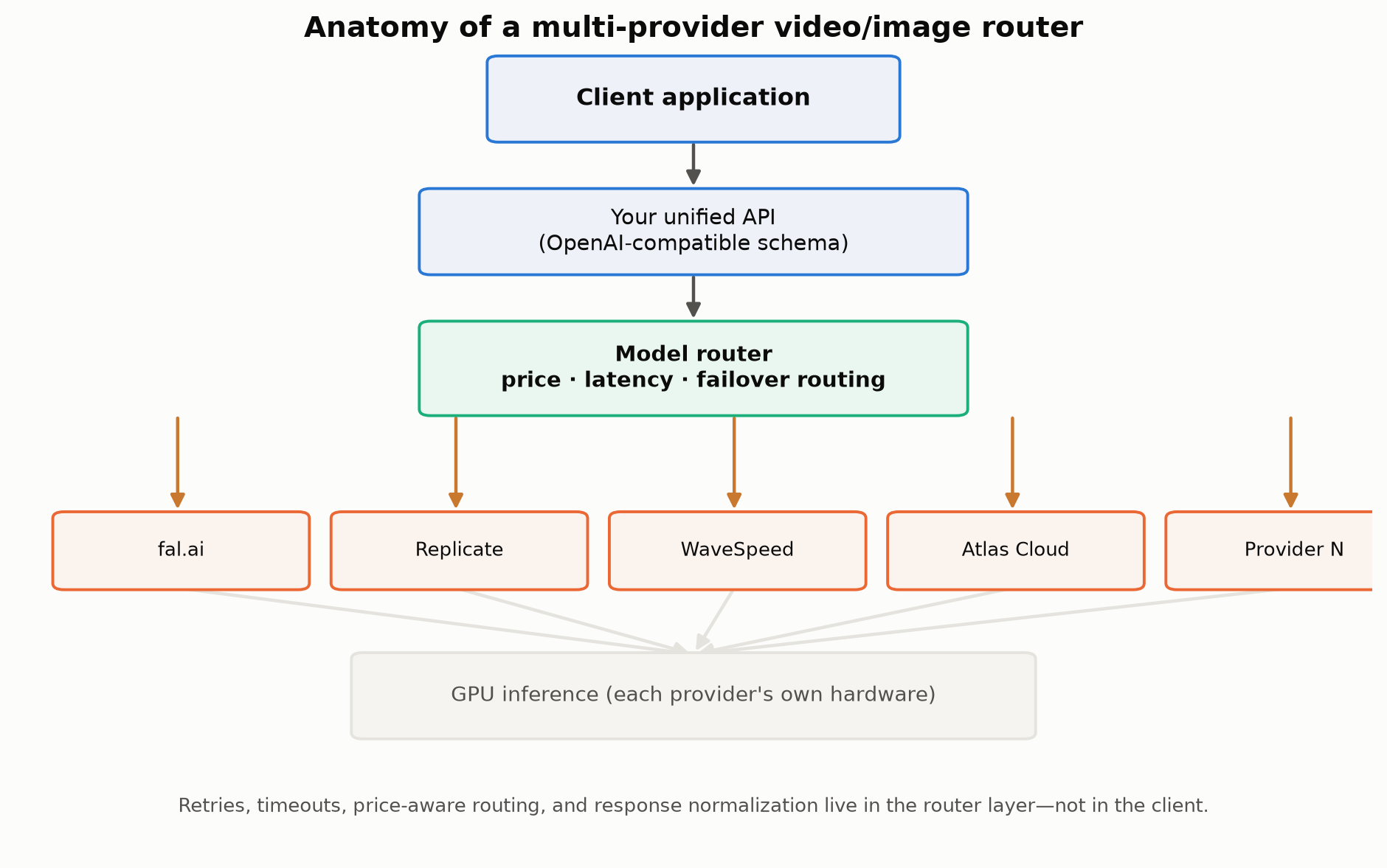
The diagram above is the general shape all of these gateway-style platforms share: one OpenAI-shaped surface in front, multiple actual backends behind it, with the gateway responsible for translating a single consistent request into whatever each backend actually expects. The difference between platforms is how much of that translation layer they've built out for video specifically, versus chat.
Who actually documents this for video, and who's bespoke
OpenRouter is the clearest case of a platform explicitly documenting OpenAI-SDK compatibility across modalities, video included. OpenRouter's docs describe every modality — chat, image, video, audio, embeddings, transcription — running through the same base URL, https://openrouter.ai/api/v1, with video generation reachable at /api/v1/videos (OpenRouter docs; OpenRouter video generation guide). Point the OpenAI SDK's base_url at that address, swap the key, and — per OpenRouter's own documentation — the rest of your existing chat-completions code should keep working, with video/image calls following the same conventions. Worth noting from a broader comparison of OpenRouter's video catalog: it added video generation in April 2026 and an image API in June 2026, so the modality is newer and, at least for some individual models, thinner on multi-provider redundancy than OpenRouter's long-established chat catalog — for many video/image listings there's a single upstream host behind the model rather than several OpenRouter is shopping across the way it does for chat.
LiteLLM takes a slightly different angle: rather than being a hosted platform itself, it's a proxy/SDK layer you run (self-hosted or via its cloud proxy) that normalizes many different backends — OpenAI's own Sora 2, Azure's Sora deployment, Google's Veo through Gemini, and other providers — behind one OpenAI-shaped interface, including /videos/generations, /videos/remix, /videos/status, and /videos/retrieval endpoints (LiteLLM video docs). If you're already running LiteLLM as your routing layer, this means you can add or swap video backends without touching your calling code — but you're adopting LiteLLM as infrastructure, not just pointing a base_url at somebody else's hosted endpoint.
Atlas Cloud documents a general OpenAI-compatible endpoint at api.atlascloud.ai/v1 and is explicit that this is a drop-in swap for chat — base_url and API key, model string changes, streaming and tool calls keep working (Atlas Cloud developer docs). Its catalog does include video and image models alongside chat, but the OpenAI-SDK-compatibility claim in its own docs is demonstrated primarily around the chat/LLM endpoint; treat video-specific compatibility as something to verify against Atlas Cloud's current docs for the exact model you want, rather than assuming the same guarantee extends unchanged to the video endpoint.
fal.ai, by contrast, is explicitly not OpenAI-shaped for its core media generation models — it uses its own SDKs and fal-ai/<model> style paths, so existing OpenAI client code doesn't drop in as-is (it does offer an OpenRouter-proxied chat completions path for LLMs specifically, but that's a different surface from its video/image generation models). Replicate is similar: it has its own client libraries and its own request shape (predictions, version IDs, polling semantics) that don't mirror OpenAI's conventions. WaveSpeed AI ships its own official Python and JavaScript SDKs, plus a provider package for the Vercel AI SDK, rather than positioning itself as OpenAI-SDK-compatible.
Why video is a harder compatibility target than chat in the first place
It's worth understanding why "OpenAI-compatible" spread so easily for chat completions but is messier for video, because it explains why some platforms only commit to the chat half of the claim. Chat completions are a synchronous request/response shape: you send messages, you get a completion back (or a stream of chunks) in the same connection, and that shape is simple enough that dozens of providers converged on mimicking it almost exactly, down to the field names. Video generation doesn't fit that mold nearly as cleanly. A render can take anywhere from several seconds to a couple of minutes depending on the model, resolution, and duration requested, which is too long to hold open a single synchronous HTTP request the way a chat completion does. So almost every video API — OpenAI's own Sora API included, while it existed — ends up using some version of an asynchronous create-then-poll pattern: submit a job, get an ID back immediately, poll a status endpoint until it's done.
That async pattern is where "OpenAI-compatible" gets genuinely ambiguous as a label. There's no single, universally agreed-upon OpenAI-authored standard for what a polling-based video job API should look like the way there is for chat completions — OpenAI's own Videos API was one implementation of that pattern, not a spec other companies were contractually obligated to mirror. So when a platform says its video API is "OpenAI-compatible," what they usually mean is a family resemblance: JSON bodies, bearer-token auth, an error envelope shaped like OpenAI's, and a request/response vocabulary that feels familiar to someone who's used the OpenAI SDK before — not necessarily a method-for-method match to client.videos.generate() and client.videos.retrieve() as OpenAI itself defined them. That's not a knock on any of these platforms; it's just worth knowing precisely what's being promised before you assume a full drop-in swap.
What to actually check before you commit
Given that ambiguity, a few concrete things are worth verifying against a platform's current docs — not this article — before you wire a video integration into production: whether the video endpoint is actually documented as OpenAI-SDK-compatible specifically, separate from the platform's chat endpoint being compatible; whether the exact method and field names the SDK expects (model, prompt, duration, resolution, reference images) map onto the platform's actual request body, since even compatible-in-spirit platforms sometimes use different field names for video-specific parameters that don't exist in chat completions at all; whether the job-status polling shape matches what you'd expect (a status enum, a completed-state payload with a URL, a failed-state payload with an error message); and whether the platform's error envelope on a failed or rejected request matches the {"error": {...}} shape closely enough that your existing error-handling code won't silently misparse it. None of these take long to check against a single test call, and doing it once up front is considerably cheaper than discovering a field-name mismatch in production.
Compatibility posture, at a glance
| Platform | Compatibility posture | Notes |
|---|---|---|
| OpenRouter | Fully OpenAI-SDK-compatible | Documented across modalities incl. video (/api/v1/videos); newer, thinner multi-host redundancy per model than its chat catalog |
| LiteLLM | Fully OpenAI-shaped (as a proxy layer) | You run it yourself; normalizes OpenAI, Azure, Google Veo, and others behind one shape |
| Atlas Cloud | Partial | Documented OpenAI-compatible endpoint, demonstrated mainly for chat; verify per model for video |
| VideoRouter | OpenAI-compatible-style | Chat is OpenAI-compatible; video is job-based (create + poll), matching the same JSON/bearer-auth/error conventions rather than a literal Sora-shaped endpoint |
| fal.ai | Bespoke own SDK | Own client library and fal-ai/<model> paths for media models |
| Replicate | Bespoke own SDK | Own client libraries, predictions-based request shape |
| WaveSpeed AI | Bespoke own SDK | Official Python/JS SDKs, Vercel AI SDK provider |
Where VideoRouter fits
VideoRouter's own documented API follows the same conventions this whole conversation is about: a bearer-token Authorization header, JSON in and out, and an OpenAI-shaped error envelope ({"error": {"message", "type", ...}}) across endpoints. Chat completions are directly OpenAI-SDK-compatible — the documented pattern is exactly the base_url-swap described above, pointed at VideoRouter's endpoint with an existing OpenAI client. Video generation itself is async and job-based: a POST to create a job returns a queued status immediately, and you poll a GET endpoint for in_progress → completed/failed, billed once at creation time regardless of how long polling takes. That's not a literal drop-in replacement for OpenAI's now-departing Sora endpoint method-for-method, but it follows the same request/response idioms developers are used to from the OpenAI SDK, and it fronts models from multiple hosting providers (Fal, WaveSpeed, Atlas Cloud, Replicate, Novita, MachGen, and more) behind that one shape rather than requiring a separate integration per host.
If you're specifically looking for the base_url-swap experience for video generation — one key, one client, JSON conventions you already know, with a live price comparison across the hosts actually serving whichever model you pick — that's the gap VideoRouter is built to fill, and it's worth a look regardless of which model you land on.