What Is a Video and Image Model API Gateway?
If you've tried to ship a product feature that generates video or images with more than one underlying model, you've probably already hit the problem this article is about, even if you didn't have a name for it. You integrated one provider's API, it worked, and then someone asked "can we also offer Kling?" or "can we fall back to something else when Veo is slow?" and you realized you were about to write a second, mostly-different integration from scratch. A video and image model API gateway is the piece of infrastructure that exists specifically to stop that from happening.
The term, defined narrowly
"API gateway" already means something in general backend engineering — think Kong, Apigee, AWS API Gateway, or Envoy. Those tools sit in front of your own microservices and handle routing, rate limiting, authentication, and observability for traffic you control end to end. That is not what this article is about, and conflating the two causes real confusion when people go looking for one and find documentation about the other.
A video and image model API gateway (sometimes called a model router, an inference aggregator, or a model-serving proxy) is a narrower, domain-specific idea: it sits between your application and a set of third-party AI model providers — Google's Veo, Alibaba's Wan, ByteDance's Seedance, Black Forest Labs' Flux, Kuaishou's Kling, and dozens of others — and gives you one consistent way to call any of them. It's not managing your own services. It's managing someone else's, dozens of someone elses, each with their own API design decisions, and hiding that variance behind a single interface.
Why one integration per model doesn't scale
It's worth being concrete about what "different SDKs, auth schemes, async patterns, and pricing units" actually looks like in practice, because on paper it sounds like a minor inconvenience and in practice it's a real, recurring engineering tax.
Authentication is not uniform. Some providers use a simple bearer API key. Others require signed requests, workspace or project IDs alongside the key, or OAuth flows for certain endpoints. If you integrate five providers directly, you maintain five different auth implementations, and when a key rotates or a provider changes its auth requirements, you find out in production.
Request and response shapes diverge, sometimes wildly. One provider wants a flat JSON body with a prompt field and a duration integer. Another nests generation parameters inside a settings object and expects duration as a string with a unit suffix. A third splits image-to-video and text-to-video into entirely separate endpoints with different required fields. None of this is arbitrary cruelty on the providers' part — it reflects real differences in how their underlying models work — but it means your application code ends up full of per-provider branching logic if you integrate each one natively.
Video and image generation is asynchronous in ways chat completions are not. A chat completion request returns (or streams) a result in the same request-response cycle. Video generation almost never does — you submit a job, get back a job ID, and then either poll a status endpoint until it's done or wait for a webhook callback. Every provider implements this differently: different polling intervals, different status enum values, different webhook payload shapes, different conventions for what happens when a job fails partway through. If you're integrating directly, you're writing a bespoke polling or webhook handler per provider, and testing each one's edge cases (timeouts, partial failures, malformed callbacks) separately.
Pricing units aren't standardized either. Some models bill per second of output video. Others bill per generated image regardless of resolution. Some scale price by resolution or duration in ways that aren't linear. If you want to show a user a cost estimate before they submit a job, or reconcile your own bill against usage, you need to understand each provider's specific pricing model, not a generic one.
Taken individually, none of these differences is hard to handle. Taken together, across five, ten, or twenty providers, they add up to a meaningful and ongoing engineering commitment — one that has nothing to do with your actual product and everything to do with plumbing.
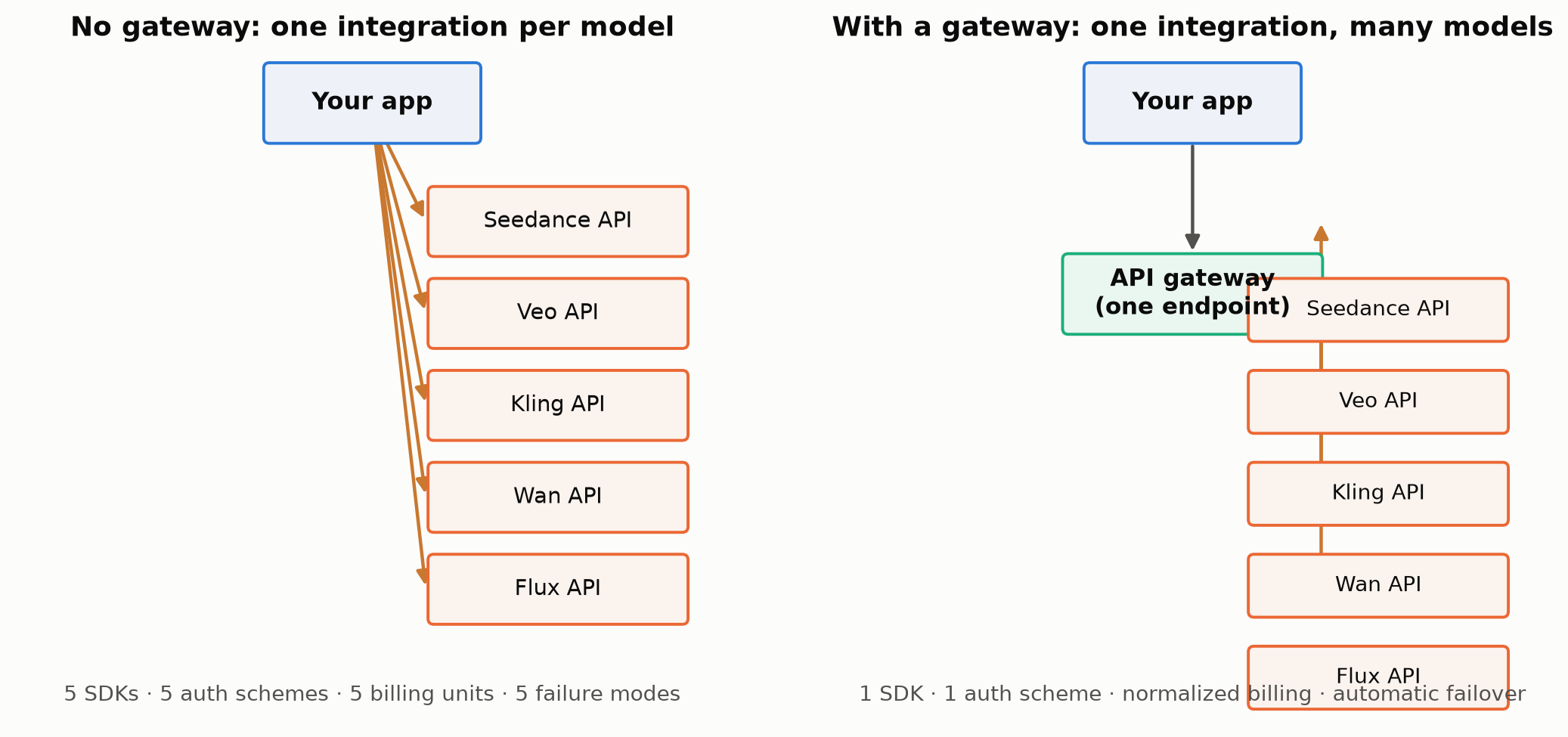
The image above is the whole argument in one picture. Without a gateway, your application maintains a direct line to every provider you support, and that line count grows linearly (or worse) with every new model or provider you add. With a gateway, your application maintains exactly one integration, and the gateway absorbs the complexity of talking to each provider on the other side.
What a good gateway actually provides
Not every product that calls itself a gateway does all of this well, but here's what the category aims to deliver:
A unified request/response schema. You send one shape of request — say, a prompt, a duration, a resolution, maybe a reference image — and get back one shape of response, regardless of whether the model underneath is Seedance, Wan, or Veo. The gateway translates your generic request into whatever a specific provider's API actually expects, and translates that provider's specific response back into the generic shape you asked for.
Model discovery. A catalog you can query or browse to see what models are available, what each one costs, what parameters it accepts, and what its capabilities are (resolution options, max duration, image-to-video support, and so on) — instead of reading a dozen separate provider docs pages to answer the same question.
Provider abstraction. The auth handling, the request translation, and — critically for video and image specifically — the async job lifecycle (submission, polling or webhook delivery, retrieval, error normalization) are handled once, inside the gateway, instead of once per provider inside your application.
Normalized billing. One bill, one unit of account, ideally with cost visible per request rather than needing to reconcile several providers' invoices in different currencies of "per second" versus "per image" versus "per megapixel."
Beyond that baseline, the more capable gateways in this category add two things that matter a lot in practice but that not every product in the space actually does: live price comparison (since, as it turns out, the identical model is very often available through more than one upstream host at meaningfully different prices) and automatic failover (routing a request to a different host serving the same model if your first choice is down, rate-limited, or slow, rather than surfacing the failure to your user).
The current landscape, briefly
This space isn't empty — several products already occupy different parts of it, and it's worth knowing the shape of the landscape even at a glance before you decide whether to buy or build:
| Platform | What it's primarily known for |
|---|---|
| OpenRouter | LLM/chat routing at large scale, with a newer (April/June 2026) video and image API layered on top |
| fal.ai | Serving platform for diffusion and generative media specifically, usually first to list new open-weight models |
| Replicate | Serverless-GPU model host with a huge community catalog, plus a curated set of "Official Models" |
| WaveSpeed AI | Large (1,000+ model) catalog marketed on inference speed, with live per-model pricing shown before you submit |
| Atlas Cloud | Broad pay-as-you-go aggregator spanning chat, image, video, and audio, no subscription required |
Each of these takes a different angle on the same underlying problem — some started in chat and expanded into media, some were built for media from day one, some optimize for catalog breadth, some for raw speed. A separate, more detailed comparison is worth its own read if you're picking one; the point here is just that "gateway for video and image models" is a real, populated category, not a hypothetical.
Following a single request through a gateway
It helps to walk through what actually happens end to end, because the term "gateway" can sound more abstract than the mechanics really are. Your application sends one request to the gateway's API — a prompt, a model identifier, some generation parameters, maybe a reference image — using the gateway's own consistent schema, the same shape regardless of which underlying model you asked for. The gateway looks up that model in its catalog, determines which upstream provider (or providers, if more than one host serves it) can fulfill the request, and translates your generic request into that provider's specific expected format, attaching whatever auth credentials that provider requires. The provider does the actual work — running the model on its own GPU infrastructure — and eventually returns a result in its own response shape. The gateway translates that back into its unified schema, normalizes the billing into its own unit of account, and hands your application a consistent response, regardless of which provider actually did the work underneath. If that provider was unavailable or too slow, a gateway with failover support can redirect the same request to a different host serving the same model, transparently to your application, instead of just returning an error.
None of the individual steps in that sequence is exotic. What makes it valuable is that your application only ever has to understand the gateway's side of that exchange — one schema, one auth scheme, one billing unit — no matter how many providers are working behind it, and no matter how many get added or swapped out over time.
Lock-in is a real, present-tense risk, not a hypothetical
It's tempting to treat provider lock-in as a theoretical concern worth hedging against "someday." It isn't always theoretical. OpenAI notified developers in March 2026 that its own Videos API and the entire Sora 2 model family — sora-2, sora-2-pro, and their dated snapshots — are deprecated and scheduled for removal from the API on September 24, 2026, with no replacement model announced in OpenAI's own deprecation table. Anyone who built a product feature directly against OpenAI's native video API now needs a new host for that workload on short notice. Third-party resellers that call OpenAI's backend under their own business agreements have continued serving Sora 2 Pro as of this writing, but that's a "for now" arrangement, not a guarantee.
This is precisely the scenario a gateway is built to absorb. If your integration point is the gateway's unified schema rather than a specific provider's native API, swapping which upstream host actually serves a request — or which model serves it, if the model itself goes away — is a routing change behind an interface you don't have to touch, rather than an emergency rewrite of your application code under a deadline someone else set for you.
Price spread is a real, measurable reason this category exists
It's easy to assume that once you know which model you want, the only remaining decision is which provider's docs you like best. That's not quite true, and the gap can be large. Take Seedance 2.5, ByteDance's video model, at 720p text-to-video: across hosts we've checked, per-second pricing for the identical checkpoint ranges from $0.19 on the cheap end up to $0.473 on the expensive end — a 2.5x spread for the same output.
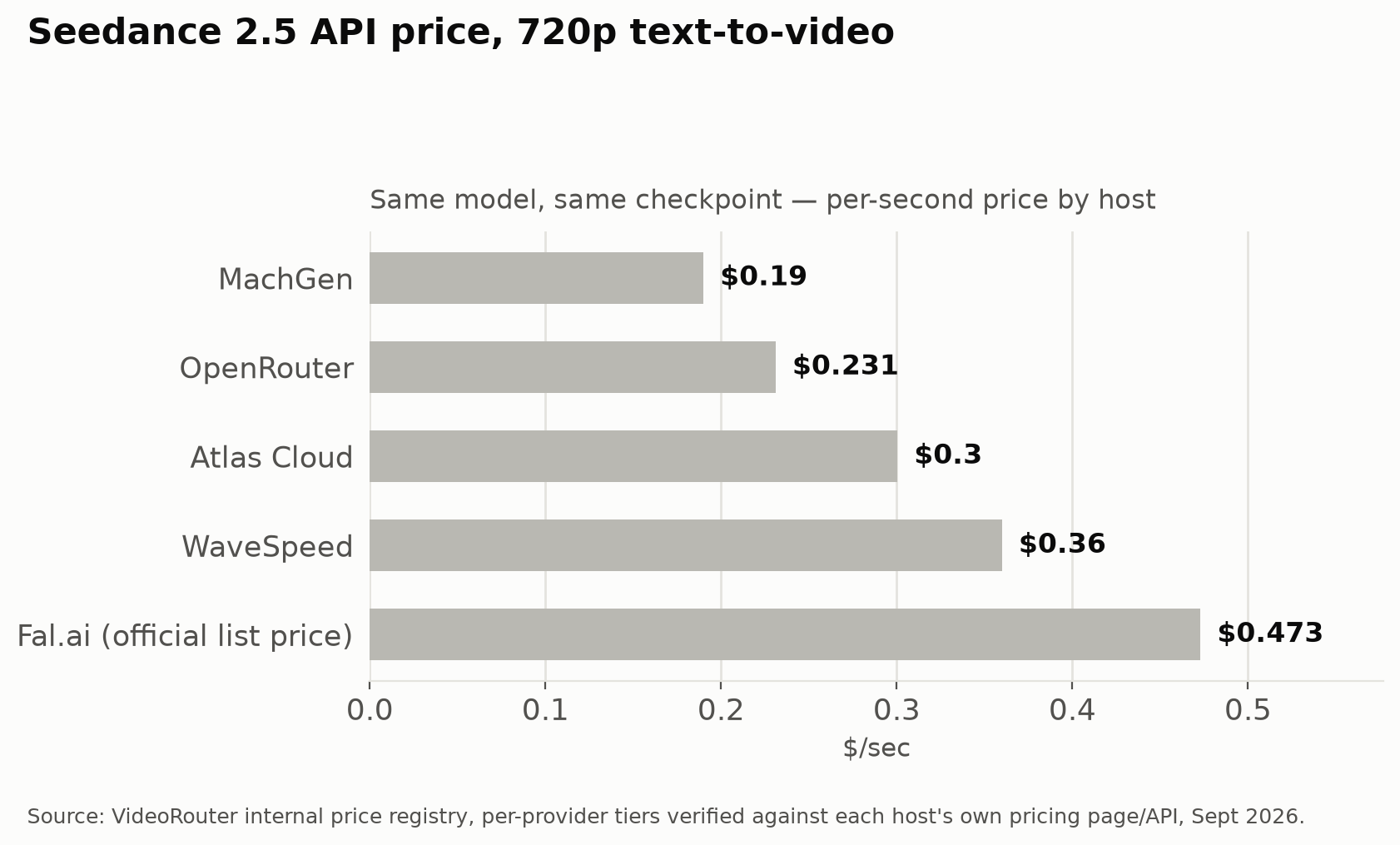
That spread isn't a one-off. Wan 3.0 Prime, Alibaba's video model, shows a greater than 3x spread between the cheapest and most expensive hosts we've tested at 480p. This is exactly the kind of variance a gateway with live price comparison is positioned to surface automatically, instead of leaving you to discover it by manually pricing out every host yourself, or worse, not discovering it at all and quietly overpaying.
Where VideoRouter fits
VideoRouter (videorouter.sh) is one example of this category: a single OpenAI-compatible-style API for video, image, and speech models across a number of hosting providers. On top of the baseline gateway capabilities described above, it specifically adds a live per-model price-comparison table (so you can see, for a given model, which host is currently cheapest) and automatic failover across hosts if one is down, with a flat low fee rather than a markup hidden inside a single host's price. If the plumbing problem described in this article sounds familiar, it's a reasonable place to look at what that layer looks like in practice.