OpenRouter vs VideoRouter for Video and Image Models: Which Should You Use?
If you're building a product feature on top of a video or image generation model, you've probably run into both names by now. OpenRouter is the well-known unified API for LLMs that expanded into video (April 2026) and image (June 2026) generation. VideoRouter is a newer, narrower gateway built specifically around video, image, and speech models, with live cross-provider price comparison as its core mechanic.
They overlap enough that it's a fair question to ask directly: which one should you actually point your API calls at? The honest answer depends on what you're optimizing for, and this article tries to lay that out concretely instead of picking a winner.
What OpenRouter is built for
OpenRouter's reputation was built on chat and completion routing — hundreds of LLMs from dozens of labs, behind one API key, with genuine multi-provider failover for many of its core text models. If a hosting provider for a given chat model goes down or gets slow, OpenRouter's provider.order, sort, and allow_fallbacks parameters can shift traffic to another provider serving the same model, often without the caller noticing. That's mature, well-tested infrastructure, and it's the reason OpenRouter became the default choice for a lot of LLM-heavy products.
Video and image generation are newer additions to that platform, not a redesign of it. The video API launched in April 2026 with a day-one lineup that included Seedance 2.0/1.5, Veo 3.1, Wan 2.7/2.6, and Sora 2 Pro. The unified image API followed in June 2026, covering 30+ models across eight providers — Google, OpenAI, Black Forest Labs, Recraft, ByteDance, Sourceful, Microsoft, and xAI — and by September 2026 that list includes current models like Nano Banana 2 and Seedream 4.5. That's a real, fast-moving catalog, and if you're already calling OpenRouter for chat completions, bolting on video or image generation under the same account and API key is close to free in integration cost.
What doesn't automatically carry over from the chat side is the multi-provider redundancy. OpenRouter's provider-routing parameters are real infrastructure, and for chat models with several inference providers behind one listing, they work as advertised. But for most individual video and image listings today, there's typically a single upstream host behind the model — so "provider routing" for media mostly means choosing which model to call, not shopping across hosts serving the identical checkpoint at different prices. That's not a flaw so much as a statement about where the video/image catalog is in its lifecycle: it's newer, and multi-provider depth for media hasn't caught up to what exists for text.
What VideoRouter is built for
VideoRouter starts from the opposite direction: instead of a broad model router that added media as a category, it's a gateway built specifically for video, image, and speech generation, where the primary feature is per-model cross-provider price comparison plus automatic failover across the hosts that serve a given model. The API is intentionally OpenAI-compatible in shape, so switching a request from one underlying host to another doesn't mean rewriting your integration — the router picks the host, you keep calling the same endpoint.
Because the catalog is scoped to media generation rather than trying to cover the entire model landscape, VideoRouter can go deeper on the specific thing that matters for this category: knowing, for a given model, which of several hosting providers is currently cheapest, and being able to fail a request over to a different host automatically if the first one is down, slow, or rate-limited. That's a narrower job than what OpenRouter does, but it's the job video/image-heavy products usually care most about, since generation cost is often a meaningfully larger line item than chat completion cost, and outages on any single media host are common enough to plan around.
A concrete comparison
| Dimension | OpenRouter | VideoRouter |
|---|---|---|
| Primary focus | Broad LLM/chat routing, hundreds of text models, video/image as newer additions | Video, image, and speech generation specifically |
| Video/image catalog breadth | Growing fast (video since Apr 2026, image since Jun 2026); shorter list than its chat catalog | Scoped entirely to media models across multiple resale and official hosts |
| Cross-provider price comparison per model | Not generally available for media — most listings are single-host | Core feature — live per-model price comparison across hosts on each model's page |
| Cross-provider automatic failover | Mature for many chat models; typically unavailable for individual video/image listings today | Built around this specifically for media models |
| Chat/LLM support | Extensive, core product | Not the focus — video/image/speech only |
| Billing model | Per-model pricing set by whichever provider serves that listing | Flat low fee on top of the routed provider's real cost, rather than a hidden markup baked into one host's price |
Neither column is strictly better across every row — they're built for different jobs, and the table is meant to make that legible rather than to declare a winner.
What "no live price comparison for media" costs in practice
It's easy to wave at "provider routing" as a checkbox, but the dollar impact is worth seeing directly. VideoRouter's own price registry includes a live-tested data point for Wan 3.0 Prime, Alibaba's video model, at 480p:
- Pika (via a fal.ai resale listing): $0.051/sec
- Atlas Cloud: $0.0612/sec
- DashScope (Alibaba's own official API): $0.068/sec
- fal.ai: $0.068/sec
- WaveSpeed: $0.075/sec
- OpenRouter: $0.17/sec, real invoiced rate
That OpenRouter figure isn't pulled from a rate card — it's from a real, live-invoiced test job (a 2-second generation billed at $0.34 total, which works out to $0.17/second), and it came out to roughly 2.5x OpenRouter's own advertised catalog price for that model. Compared against the cheapest host tested for the identical checkpoint, it's more than a 3x gap.
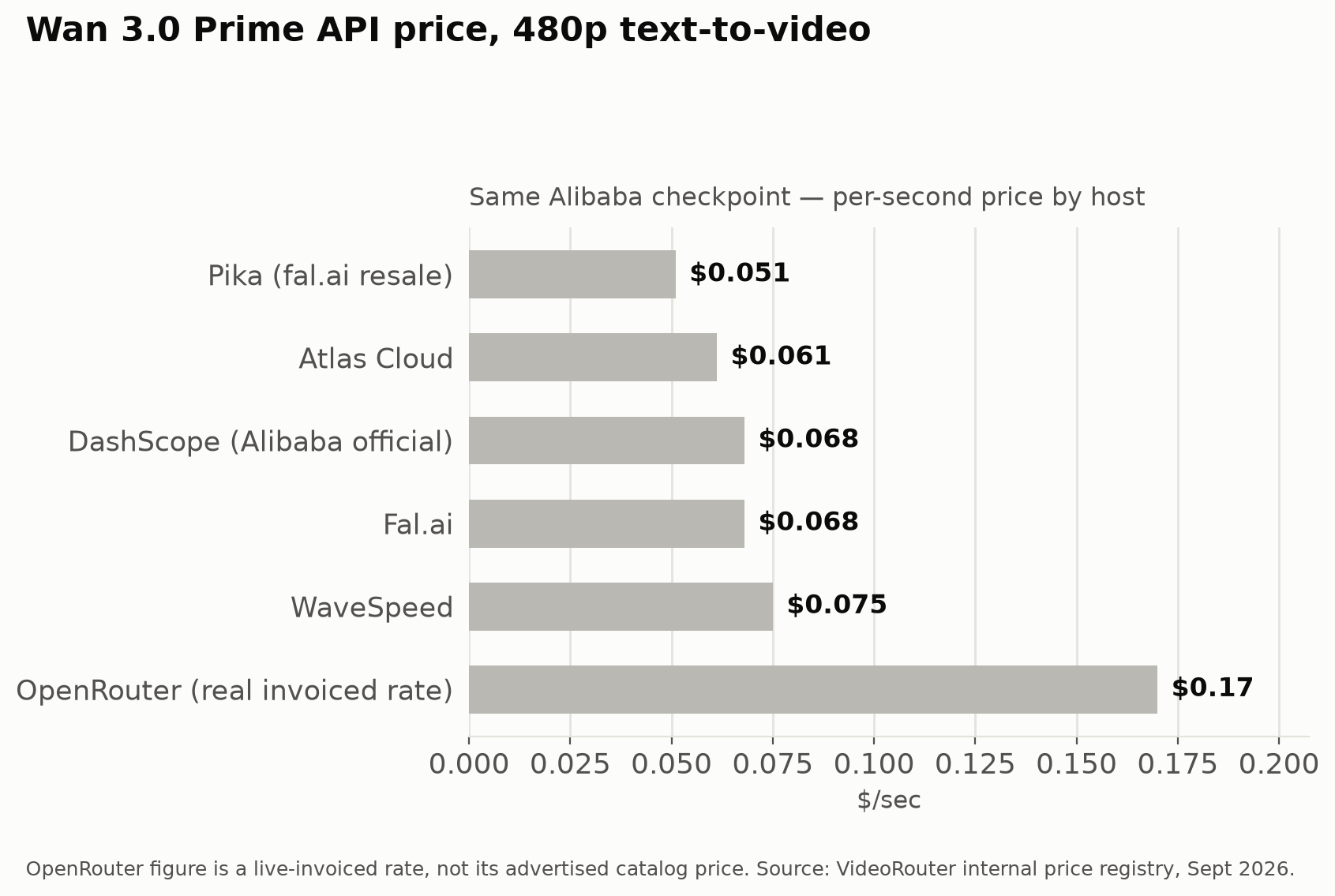
This isn't a knock on OpenRouter's engineering — it's the direct, predictable consequence of a listing sitting behind exactly one upstream provider with its own margin, and no second host inside the same platform to undercut it. If you're calling that one listing without checking what the same model costs elsewhere, you have no way to know you're paying more than three times the going rate for identical output. That's the specific gap live cross-provider price comparison closes: not a claim that any one host is always cheapest, but visibility into which one currently is, for the exact model you're calling.
For models where prices across hosts are already close together — Seedream 4.0, for instance, runs about $0.027 to $0.03 per image across WaveSpeed, fal.ai, and Pika, roughly an 11% spread — this kind of comparison matters less. But you don't know which situation you're in for a given model until you check, and most single-host gateways don't surface that comparison at all.
When OpenRouter is the right call
If you're already deep in OpenRouter's chat ecosystem — calling multiple LLMs through it, relying on its provider routing for text, billing everything through one account — and video or image generation is a secondary feature rather than a core product surface, OpenRouter's media API is a genuinely reasonable default. The integration cost of adding it is close to zero, the catalog covers the models most people ask for, and consolidating vendors has real operational value: one invoice, one rate limit budget, one support relationship.
It's also the more sensible choice if you want a single vendor for everything, including future LLM needs you haven't built yet, and you'd rather not manage a second API relationship purely to optimize the media-generation slice of your costs.
When VideoRouter is the right call
If video or image generation is a primary feature of what you're building — not a bolt-on but a core part of the product — the calculus shifts. In that situation, the per-second or per-image cost of generation is likely to be one of your largest infrastructure line items, and a 2-3x pricing gap between hosts for the identical model (as with Wan 3.0 Prime above) is worth actively managing rather than accepting by default.
The same logic applies if provider resilience matters to you: if a generation outage on a single host would visibly degrade your product, automatic failover across hosts serving the same model is a meaningful reliability improvement that single-vendor gateways, OpenRouter included, don't currently offer for media. And if you specifically want per-model price visibility — the ability to see, before or during integration, which host is cheapest for the exact checkpoint you're calling — that's the feature VideoRouter is built around rather than one it's adding on top of a broader product.
Why provider dependency is worth thinking about now
There's a timely reason to take the failover question seriously beyond the abstract case for resilience: OpenAI notified developers in March 2026 that its Videos API and the entire Sora 2 model family — sora-2, sora-2-pro, and their dated snapshots — will be removed from the API on September 24, 2026, with no recommended replacement listed in OpenAI's own deprecation table. Anyone who built a product directly on OpenAI's native Sora 2 endpoint has a hard deadline to move that workload somewhere else, and as of now there's no OpenAI-hosted successor to move it to. Third-party resellers — Pika, Replicate, DeepInfra, MachGen among them — still serve Sora 2 Pro under their own business agreements with OpenAI, but that's a "true as of today" fact, not a guarantee.
This is a useful case study regardless of which router you use, because it's a concrete example of a risk that's easy to ignore until it isn't: building against a single vendor's native endpoint means that vendor's roadmap decisions become your outage. It doesn't matter whether the model is discontinued, rate-limited, or just having a bad day on their infrastructure — if your integration only knows one path to a given model, that model's availability is entirely out of your hands. A router that can fail a request over to a different host serving the same or a comparable model doesn't make this risk disappear, but it does turn "our video feature is down because a vendor made a decision" into a routing problem instead of an outage, which is a meaningfully better place to be.
Integration and workflow differences worth knowing
Beyond pricing and failover, there are smaller but real differences in how the two platforms are shaped day to day. OpenRouter's chat-first heritage shows up in its API ergonomics for text — streaming, tool calling, and structured outputs are all mature there — but video and image generation are inherently async, job-based workflows (submit a request, poll or receive a webhook, retrieve the result once it's ready) that behave differently from a chat completion call. Because OpenRouter's media API is newer, its queueing and webhook ergonomics for that pattern are still catching up to platforms that were built around generation workflows from day one.
VideoRouter, having started from the generation-workflow side of the problem, is built around that async pattern natively, and the OpenAI-compatible request shape means most teams don't need custom client code to accommodate it. That's less about either platform being "better engineered" and more about which problem each one started from — text-first versus generation-first — and that starting point still shows in the day-to-day experience of integrating either one.
The practical takeaway
These aren't mutually exclusive tools, and plenty of teams could reasonably use both — OpenRouter for chat, and a media-specialist router for the video/image slice of the stack, whether that's VideoRouter or another specialist platform. The decision that actually matters is less "which vendor is better" and more "how central is video/image generation to what I'm shipping, and how much does the price and resilience of that specific slice matter to my margins." If the answer is "not very central," OpenRouter's all-in-one convenience is hard to beat. If the answer is "very central," a gateway built specifically around per-model price comparison and cross-provider failover for media — like VideoRouter — is solving the problem you actually have.