Why Are AI Video API Prices So Different?
If you've shopped around for an API to run a video generation model in production, you've probably run into something that looks like a mistake at first: the exact same model, same weights, same output quality, priced completely differently depending on who you call. Provider A charges $0.20 per second of generated video. Provider B charges $0.10. Provider C charges $0.05. Same model. Same checkpoint. Wildly different bills.
It isn't a mistake, and it isn't rare. It's the normal state of the video and image generation API market in 2026, and once you understand why it happens, the spread stops looking confusing and starts looking like useful information you can act on.
A real example: Seedance 2.5 at 720p
Rather than talk in the abstract, look at ByteDance's Seedance 2.5 model, served at 720p resolution, priced per second of output. This is one checkpoint — every provider below is running the identical model, not a fine-tune or a distilled variant. Here's what it actually costs to call, per second of generated video, across five real hosting providers as of September 2026:
| Provider | Price per second (720p) |
|---|---|
| MachGen | $0.19 |
| OpenRouter | $0.231 |
| Atlas Cloud | $0.300 (discounted from $0.376) |
| WaveSpeed | $0.36 |
| Fal.ai | $0.473 |
MachGen, the cheapest, charges $0.19. Fal.ai, the most expensive, charges $0.473. That's a 2.5x spread for generating output from the same model. If you're building a product that generates, say, 10,000 seconds of video a month, the difference between the cheapest and priciest host here is over $2,800 a month — for identical output.
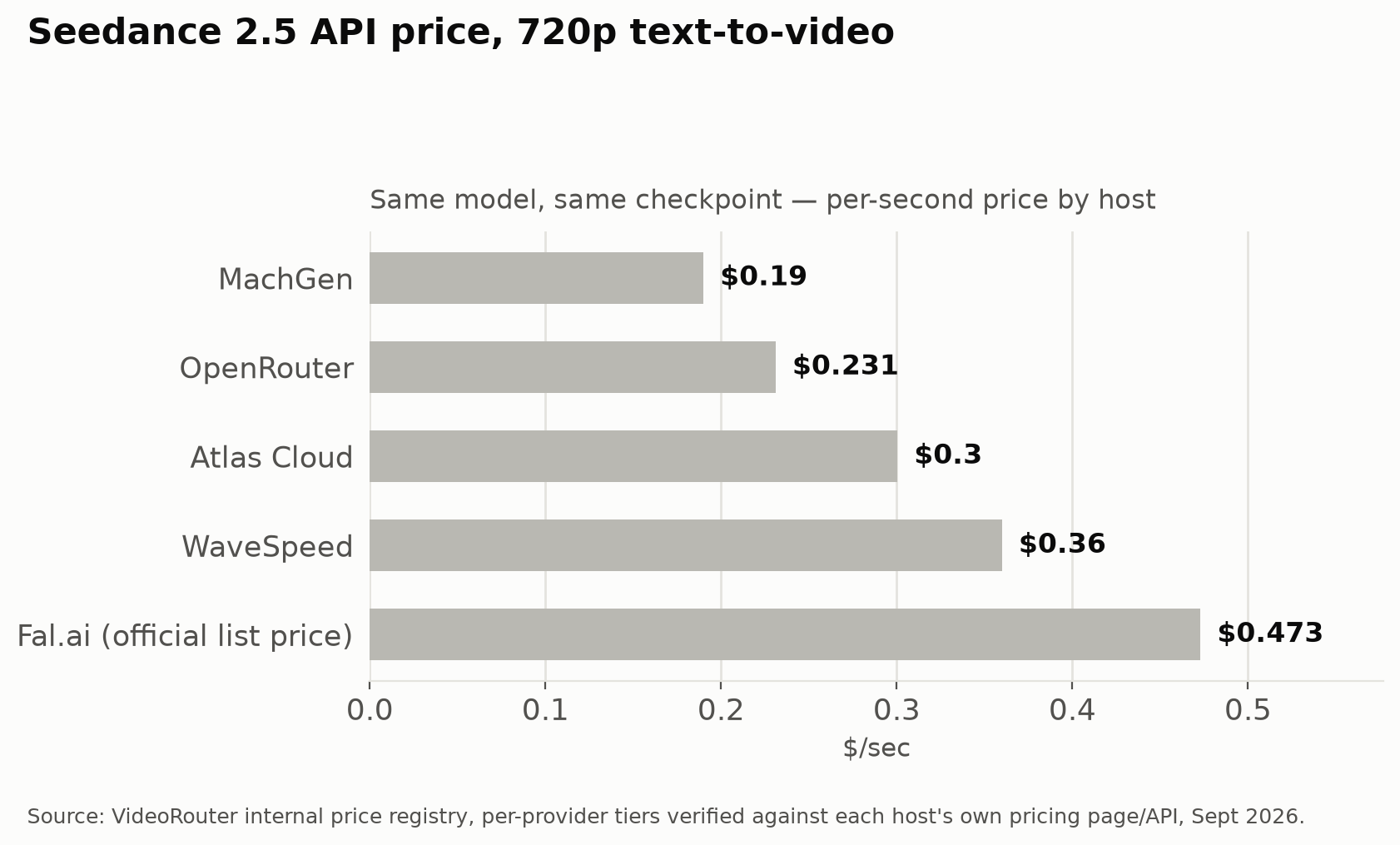
This isn't a fluke specific to Seedance 2.5. It's a pattern that shows up, to varying degrees, across essentially every popular video model that's available through more than one host. The question worth actually answering is: where does that 2.5x go? What is Fal.ai's price paying for that MachGen's isn't, or vice versa? The answer is a combination of five structural factors, and none of them are arbitrary.
GPU utilization and batching efficiency
Video generation models run on expensive accelerator hardware, and that hardware is billed (or depreciated, if owned) whether or not it's doing useful work at any given moment. A provider that keeps its GPU fleet running near full utilization — request after request queued up, batched efficiently, minimal idle time between jobs — can spread its fixed hardware cost across far more billable seconds of output than a provider whose GPUs sit half-idle waiting for the next request.
This matters more for video than for most other AI workloads because video generation is comparatively rare and bursty compared to, say, chat completions. A host serving a huge, diverse customer base with steady request volume can keep utilization high around the clock. A smaller host, or one serving a narrower customer base with spiky traffic, ends up paying for GPU-hours that never turn into revenue. That gap has to be recovered somewhere, and the obvious place is the per-second price charged to every customer, including the ones whose requests land during the idle stretches.
Batching compounds this. Modern inference serving stacks can often process several generation requests concurrently on the same hardware if the scheduler is built to exploit it — sharing memory bandwidth and overlapping compute across requests rather than running them one at a time. A provider with a mature batching implementation gets meaningfully more throughput out of the same GPU than one running requests strictly sequentially. More throughput per GPU-hour means a lower true cost per generated second, which flows straight through to what they can afford to charge and still turn a profit.
Inference optimization: quantization, distillation, and custom kernels
Not every provider runs the exact same software stack on top of the same model weights. Even when the underlying checkpoint is identical, the serving implementation around it varies enormously, and that variance has a direct cost impact.
Some hosts run the reference implementation released by the model's creator, essentially unmodified. That's the safest option from a correctness standpoint — least likely to introduce subtle quality regressions — but it also tends to be the least efficient in terms of raw compute per output. Other hosts invest engineering time into optimizing the serving path: quantizing the model to lower precision where it doesn't meaningfully hurt output quality, writing custom CUDA kernels tuned for the specific hardware they run on, or applying distillation techniques that reduce the number of denoising steps needed to reach an acceptable result. Each of these can meaningfully cut the compute — and therefore the cost — required to generate a given amount of video, sometimes by a large margin.
This is genuinely hard, specialized engineering work, and providers that do it well have earned a real cost advantage, not a shortcut. It's also part of why the platforms that specialize narrowly in serving diffusion and generative media models (rather than trying to be a general-purpose compute marketplace) sometimes show up on the cheaper end: optimizing inference for this specific class of model is close to their entire business, so it gets disproportionate engineering attention relative to a broader, more general host.
Wholesale compute pricing and owned vs. rented hardware
Underneath the serving stack is a more basic question: what does the provider actually pay for the GPU-hour it's running on? This varies more than people expect. Large-scale compute buyers who commit to long-term reservations or buy in bulk typically negotiate meaningfully better rates from cloud GPU vendors than a smaller buyer paying on-demand spot pricing. A provider that owns its hardware outright — rather than renting it from a cloud vendor — has a different cost structure entirely, trading upfront capital expense for the elimination of a rental markup, which can be a substantial saving at scale, though it comes with its own risks around utilization and depreciation.
None of this is visible to you as an API customer. You see a price per second; you don't see whether that price reflects a hyperscaler's on-demand GPU rate, a negotiated reserved-capacity discount, or owned infrastructure amortized over years. But the underlying compute cost is the floor beneath every provider's pricing, and it isn't the same floor for everyone.
Different hardware choices
Related to the point above, but distinct: not every provider is running the same generation of accelerator. Newer chips generally deliver more throughput per dollar than older ones for the same class of workload, but newer chips are also more expensive to acquire or rent, and providers adopt new hardware generations on their own schedules based on their own capital cycles and availability. A provider running on newer, faster accelerators might generate the same second of video for meaningfully less compute time than one running on an older generation, even before accounting for any of the optimization work described above. Hardware choice interacts with everything else on this list — a provider running older hardware with a highly optimized serving stack can still come out ahead of a provider running newer hardware with an unoptimized one, and vice versa.
Provider margin
Finally, and least technical: providers set margins based on how price-competitive a given model category is, and that varies a lot by how many hosts are fighting for the same customer. A model that's available from a dozen hosts, all racing to be the cheapest listing customers will find when comparison shopping, tends to get priced close to the provider's real cost, with thin margins baked in. A model that's newer, harder to serve well, or available from fewer hosts gives whoever's serving it more room to price further above cost, because there's less competitive pressure forcing the price down.
This is why you'll sometimes see close-to-identical pricing across hosts for one model and wide spreads for another, even from the exact same set of providers. It isn't inconsistency — it's each provider pricing according to what the market for that specific model will bear, and that pressure differs model by model.
Image generation models make this point especially clearly, because the spread on some of them is genuinely small. Flux 1.1 Pro from Black Forest Labs, for instance, runs at roughly $0.04 flat across most hosts that serve it — SiliconFlow, WaveSpeed, and direct access all land close to the same number, with the higher-end Flux 1.1 Pro Ultra tier running around $0.06 on SiliconFlow. Seedream 4.0 from ByteDance shows a similar pattern: WaveSpeed prices it around $0.027 per image against roughly $0.03 on Fal.ai and Pika, a spread of only about 11%. Compare that to the 2.2x gap seen on Google's Nano Banana Pro, where MachGen's $0.067 sits well below Fal.ai's $0.15 for the same model. Same underlying dynamics — utilization, optimization, wholesale cost, hardware, margin — but a model that's cheap and easy to serve well, with several hosts competing hard on it, ends up commoditized in a way a newer or harder-to-optimize model doesn't. The spread isn't a fixed property of "video and image APIs" as a category; it's a property of each specific model's competitive landscape at a given point in time.
Why this matters for how you build
Put these five factors together — utilization, inference optimization, wholesale compute cost, hardware generation, and margin — and the picture that emerges is important: the price spread you see across providers for the same video model isn't noise. It's the visible output of real, structural differences in how efficiently each provider has built their serving infrastructure and how much margin the competitive landscape lets them charge. That has a direct practical consequence. Because the causes are structural rather than random, the spread doesn't average out or resolve itself over time — a provider that's 2x more expensive today for a given model is likely to still be meaningfully more expensive next quarter, unless something changes about their underlying infrastructure or the competitive pressure they're under.
That means price comparison across providers isn't a one-time due-diligence step you do before signing a contract and then forget about. It's worth checking every time you're making an integration decision, because a model you've already integrated can shift in relative price ranking as new hosts add it, existing hosts optimize their stack, or competitive pressure changes. For a team running any real volume of video generation, the dollar difference between the cheapest and priciest available host for the same model compounds fast, the way the Seedance 2.5 example above shows: a 2.5x spread on a workload generating a few thousand seconds a month is not a rounding error.
The practical difficulty is that checking this manually — pulling up pricing pages for half a dozen providers, normalizing units, re-checking periodically as prices shift — doesn't scale well, especially across a growing catalog of models you might want to use. That's the specific gap VideoRouter (videorouter.sh) is built to close: a single OpenAI-compatible-style API for video, image, and speech models that shows a live per-model price comparison across hosting providers on each model's page, so the "which host is actually cheapest for this model right now" question has an answer you can check in seconds rather than research from scratch, along with automatic failover across hosts if one provider is degraded or unavailable.