Wan 3.0 vs Wan 3.0 Prime: Which Should You Call?
Alibaba ships two separate checkpoints under the Wan 3.0 name: the base model and a "Prime" variant. They're not resolution tiers of the same weights — every host that lists both prices them as distinct model IDs, with Prime consistently more expensive. The question worth answering before you pick one isn't "which is cheaper" (the base model always is) — it's whether Prime's premium is buying you something your use case actually needs.
Cheapest verified host, side by side
| Wan 3.0 | Wan 3.0 Prime | Prime premium | |
|---|---|---|---|
| Cheapest host | Replicate — $0.025/sec | Pika — $0.051/sec | +104% |
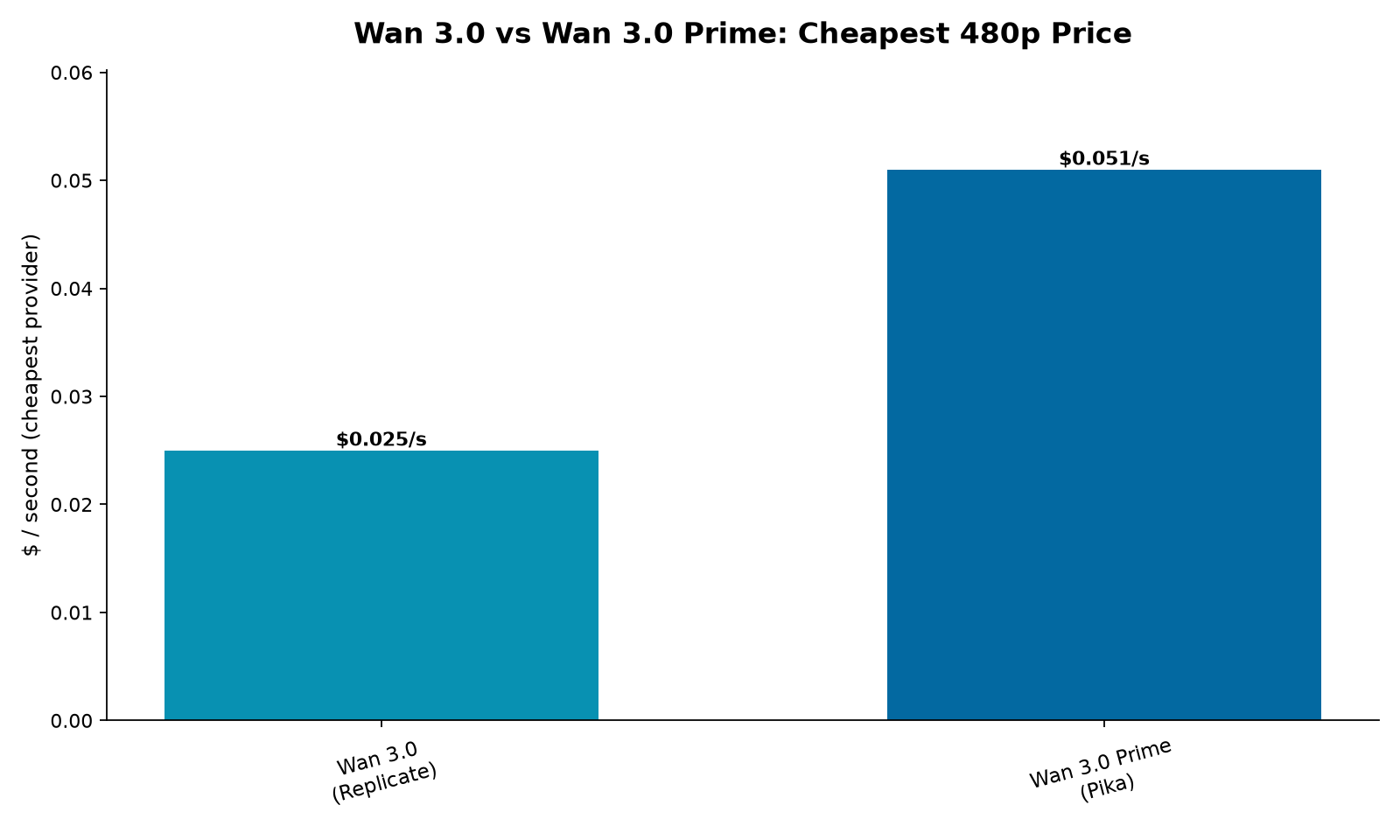
At each model's own cheapest host, Prime costs a bit more than double. That's a meaningfully larger gap than you'll typically see between two hosts serving the identical checkpoint — which means the Prime-vs-base decision usually matters more to your bill than which host you pick for either one.
Full per-provider breakdown, 480p
| Provider | Wan 3.0 | Wan 3.0 Prime |
|---|---|---|
| Replicate | $0.0250 | — |
| Pika | $0.0325 | $0.0510 |
| Atlas Cloud | $0.0400 | $0.0612 |
| MachGen | $0.0410 | — |
| Fal | $0.0500 | $0.0680 |
| Alibaba (direct) | $0.0500 | $0.0680 |
| WaveSpeedAI | $0.0500 | $0.0750 |
| OpenRouter | $0.1063 | $0.1700 |
Two things worth noticing: Replicate and MachGen — the two cheapest hosts for base Wan 3.0 — don't carry Prime at all, so if Prime is a hard requirement, your cheapest-host options narrow to Pika, Atlas Cloud, Fal, or Alibaba direct. And Prime's premium over base, at any given host that carries both, sits in a tighter 26-36% range (Fal, Alibaba, WaveSpeedAI) than the 104% gap between each model's own cheapest host — a reminder that comparing "cheapest vs cheapest" across two different models can overstate the real premium if you'd end up on different hosts anyway.
What Prime actually changes
Alibaba positions Prime as a higher-fidelity variant of the same architecture — better fine detail and motion consistency at the same resolution tier, at the cost of more compute per generation (which is what the price premium reflects; it's not a markup with nothing behind it). The practical question is whether your specific prompts and use case show a visible quality difference worth 30-100% more spend. That's genuinely worth testing directly rather than assuming — run the same 10-20 prompts through both at whichever host carries both (Fal or Alibaba direct are the simplest apples-to-apples comparison, since they price both at the same host) and look at the outputs side by side before committing budget either way.
Worked example
A team generating 1,500 four-second clips a month, deciding between standardizing on base Wan 3.0 versus Prime, both at Fal:
- Base, Fal: 1,500 × 4 × $0.05 = $300/month
- Prime, Fal: 1,500 × 4 × $0.068 = $408/month
The $108/month gap is a real number, but it's small enough at this volume that if Prime's quality improvement is genuinely visible to your users, it's likely worth paying. The calculation changes at higher volume — at 15,000 clips instead of 1,500, that same per-clip gap becomes a $1,080/month difference, which is a much harder number to justify without a concrete, tested quality difference behind it.
Designing a fair A/B test between the two
If you're going to test Prime against base Wan 3.0 before committing budget either way, control for the variables that would otherwise confound the comparison: run both through the same host (Fal or Alibaba direct, since both carry both models), at the same resolution tier, with the same prompt and the same seed if the host exposes one. Testing base Wan 3.0 at Replicate against Prime at Pika introduces two variables at once — host and checkpoint — and you won't be able to tell which one is responsible for any quality difference you observe. A clean test isolates the checkpoint as the only variable, which is why the "same host carries both" hosts (Fal, Alibaba direct) are the right ones to run the comparison through, even if neither is the cheapest host for either model individually.
Once you've run that test on a representative sample of your actual prompts — not a handful of generic ones — you'll have a defensible answer for whether Prime's premium is worth paying for your specific use case, rather than a guess based on Alibaba's own marketing description of what Prime improves.
A hybrid approach
Since both checkpoints share the same request shape, a reasonable default is generating drafts on base Wan 3.0 and re-running only the prompts a user actually keeps through Prime — the same tiered-generation pattern that works for the Seedance family (see Where to Get the Cheapest Seedance API). This captures most of Prime's quality upside on the output that ships, without paying its premium on every generation that gets discarded.
Frequently asked questions
Is Prime just a higher resolution tier of the base model? No — both models offer the same 480p/720p/1080p tier structure; Prime is a separate set of weights, not a resolution upgrade. You pay Prime's premium at every resolution tier, not just at the top one.
Why don't Replicate and MachGen carry Prime at all? That's a hosting decision on each provider's part, not something derivable from pricing data alone — some hosts choose to carry a model creator's full lineup, others pick up only the checkpoint with the widest demand. If Prime access at the lowest possible price matters to you, Pika is currently your best option (see the table above), since Replicate and MachGen simply aren't a comparison point for Prime specifically.
Does Prime's premium hold steady across resolution tiers, or does it change? At Fal and Alibaba direct — the two hosts pricing both models identically — the ratio is consistent: Prime costs roughly 36% more at 480p ($0.068 vs $0.05) and the same proportional gap holds at 720p and 1080p, since both tiers scale by the same per-host multiplier described in Wan 3.0 API Pricing.
Should a new integration default to Prime or base Wan 3.0? Default to base Wan 3.0 and upgrade specific prompts to Prime only after testing shows a visible difference for your content — starting with the pricier option "just in case" is the opposite of how the tiered-generation pattern in this article is meant to work.
Is there a third Wan 3.0 variant beyond base and Prime? Alibaba also ships Wan 2.7, an earlier-generation model with its own separate pricing and a narrower host list — it's not a tier of Wan 3.0 and isn't covered in this comparison. Check VideoRouter's Wan 3.0 page and Wan 2.7's page separately if you need that comparison too.
How to call either one
import requests

job = requests.post(
    "https://videorouter.sh/api/v1/videos",
    headers={"Authorization": "Bearer llmr_sk_live_...", "Content-Type": "application/json"},
    json={
        "model": "alibaba/wan-3.0-prime",  # or "alibaba/wan-3.0" for the base checkpoint
        "prompt": "a paper boat floating down a rain-slicked street at night",
        "resolution": "480p",
        "duration_secs": 4,
    },
).json()
Only the model field changes between the two — see Wan 3.0 API Pricing: Every Provider Compared for the full base-model breakdown across every tier, and /docs/video-generation for the complete request reference.