Is OpenRouter Good for Video and Image Models?
OpenRouter is excellent for LLM routing, but developers evaluating video and image generation have different requirements — and OpenRouter's media offering, while real and growing fast, is still a different product shape than its chat routing.
That's a more useful answer than a flat "no," so this article is about what specifically differs, backed by real numbers rather than a vibe.
What OpenRouter gets right
OpenRouter earned its reputation for good reasons, and most of them carry over to its newer video and image products:
- A genuinely unified API. One endpoint, one auth scheme, one request/response shape across every model — you're not learning five different SDKs.
- Model discovery. The
/collections/image-modelsand/collections/video-modelspages, plus per-model comparison pages, make it easy to browse what's available without leaving the platform. - Provider routing infrastructure. OpenRouter's
provider.order,only,ignore,sort, andallow_fallbacksparameters are real, and for its core LLM catalog they do what they say — many chat models are served by several inference providers behind one listing, with automatic failover between them if one goes down or gets slow. - The broader ecosystem. If you're already calling OpenRouter for chat completions, adding video or image generation on the same account, same billing, same API key is a real integration-cost win.
Where the video/image catalog is still a younger product
OpenRouter's video generation API launched in April 2026; the unified image API followed in June 2026 with 30+ models across eight providers (Google, OpenAI, Black Forest Labs, Recraft, ByteDance, Sourceful, Microsoft, and xAI — by September 2026 the image collection includes current models like Nano Banana 2 and Seedream 4.5). That's genuine, fast progress. But a few things are different from the chat side of the business:
Model availability is narrower. OpenRouter's chat catalog spans hundreds of models. Its video catalog, while it includes the models people actually want — Seedance 2.0/2.5, Veo 3.1, Wan 2.6/2.7, Sora 2 Pro — is a much shorter list, and new releases don't always land there as fast as they land on media-specialist platforms like fal.ai or resale aggregators like MachGen and WaveSpeed.
Provider selection, for media specifically, is mostly single-sourced. The routing parameters exist and work for models that have multiple providers behind them. But for most individual video and image listings, there is one upstream host — so in practice, "provider routing" for media usually means picking which model to call, not shopping across hosts serving the identical checkpoint at different prices the way chat routing does. You can confirm this yourself: look up the same model (say, Seedance 2.5 or Wan 3.0 Prime) on OpenRouter and on two or three other gateways, and you'll typically find OpenRouter offers it through exactly one path.
Pricing differences are real, and sometimes surprising. Because OpenRouter is one listing among several for a given model, its price for that model isn't automatically the best (or even a typical) one. Two examples from our own price registry, both for models OpenRouter also lists:
| Model | Tier | Cheapest host found | OpenRouter's price |
|---|---|---|---|
| Seedance 2.5 (ByteDance) | 720p | MachGen — $0.19/sec | $0.231/sec |
| Wan 3.0 Prime (Alibaba) | 480p | Pika (resale) — $0.051/sec | $0.17/sec (real invoiced rate) |
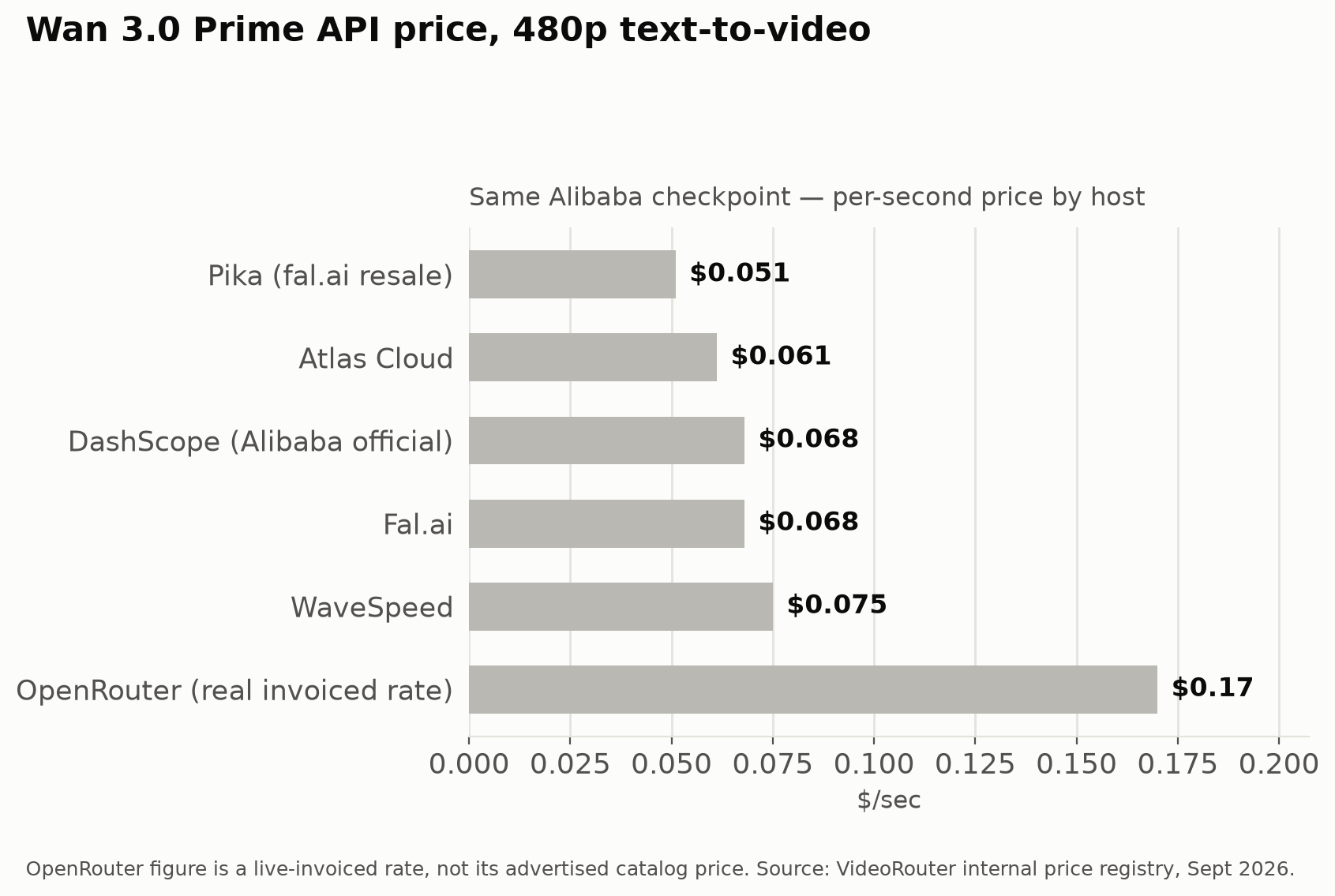
The Wan 3.0 Prime number is worth sitting with. We ran a real, live-invoiced test job against OpenRouter's Wan 3.0 Prime endpoint and the actual billed rate came out to roughly 2.5x OpenRouter's own advertised catalog price for that model — and more than 3x what the cheapest tested host (a Pika resale listing) charges for the same checkpoint. That's not a criticism of OpenRouter's engineering; it's just what happens when a listing sits behind one upstream provider with its own margin, with no second host to undercut it inside the same platform.
Video-specific request parameters need care. Because fallback behavior in OpenRouter is designed around chat-style modality compatibility, a fallback model that can't process video input won't produce a meaningful result — so for video specifically, you generally want to treat "which model can actually serve this request" as a first-class constraint rather than relying on automatic fallback to save you, the same caution OpenRouter's own cookbook gives for video generation.
Latency and generation-specific ergonomics. Video and image generation are async, job-based workflows (submit, poll or webhook, retrieve) in a way chat completions aren't. Platforms built around media specifically — fal.ai, WaveSpeed, Replicate — have had longer to build ergonomics specifically for that pattern (queueing, webhook delivery, progress polling) than OpenRouter's media API, which is newer.
A third real data point makes the same pattern clear on a completely different model family — this time video from MiniMax rather than ByteDance or Alibaba:
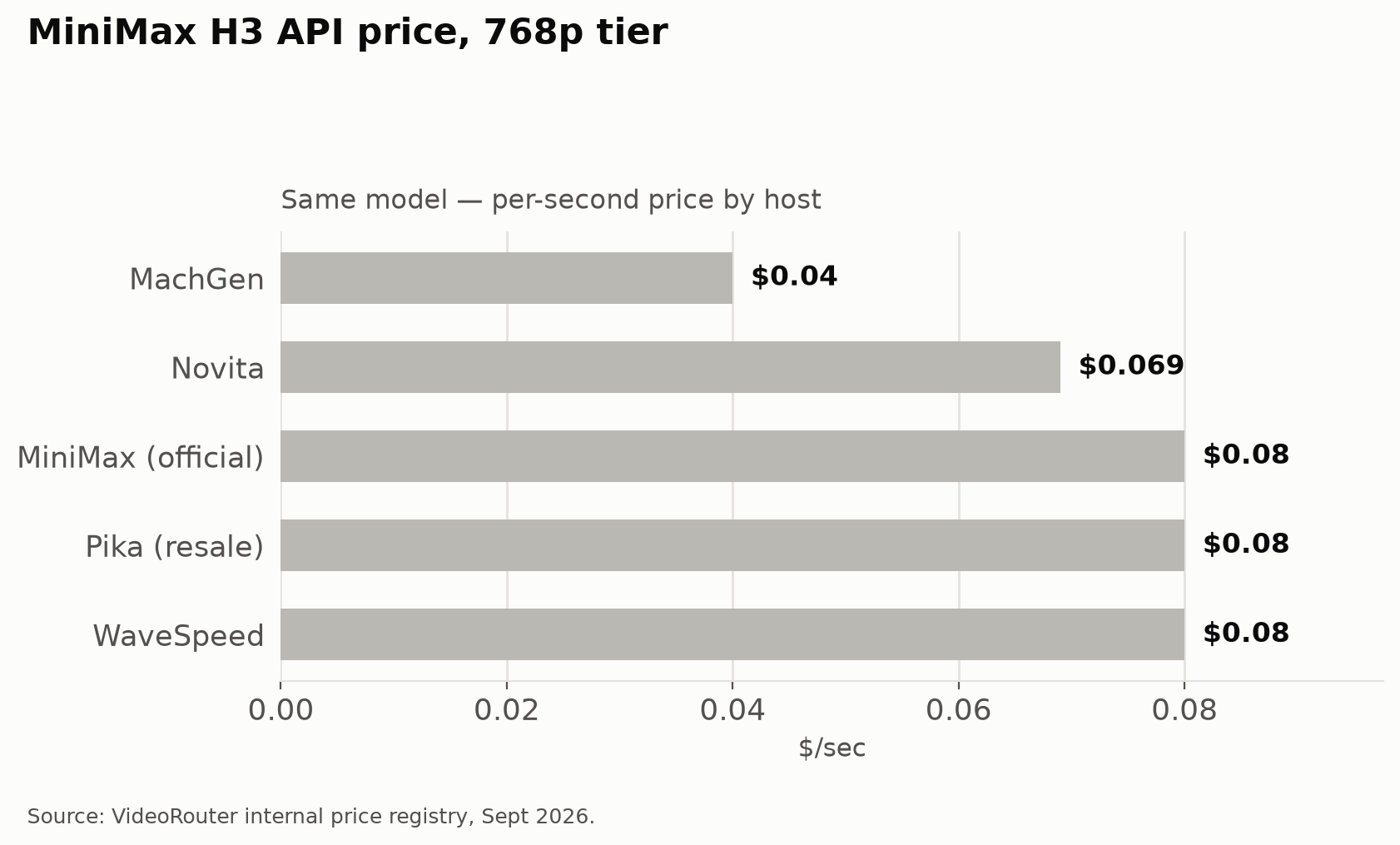
MiniMax H3 at the 768p tier runs $0.04/sec through MachGen, $0.069/sec through Novita, and $0.08/sec through both MiniMax's own official API and a Pika resale listing. OpenRouter doesn't currently list MiniMax H3 as of this writing, which is itself a useful illustration of the "narrower catalog" point above — a model with real cross-provider price competition elsewhere, and no listing on OpenRouter to compare against at all.
Image models: a genuinely different story
It's worth separating video from image here, because they don't behave the same way on OpenRouter. The image API is the newer of the two launches (June 2026) but has grown into a real catalog fast — 30+ models across eight providers by mid-2026, and by September 2026 it includes current-generation releases like Nano Banana 2 (Gemini 3.1 Flash Image) and Seedream 4.5, not stale snapshots of last year's models. For image generation specifically, OpenRouter's breadth argument holds up better than it does for video, where the day-one catalog (Seedance, Veo, Wan, Sora 2 Pro) has grown more slowly.
That said, the same underlying dynamic from the pricing table above still applies once you drop down to a specific model: OpenRouter is a listing, not a marketplace, for any individual image checkpoint. Our own registry shows image-model pricing spreads are generally smaller than video (a Seedream 4.0 image costs about $0.027–$0.03 no matter which of several hosts you use, essentially commoditized), but that's a property of the model, not of OpenRouter specifically — a differently-competitive image model (Nano Banana Pro, for instance, where MachGen's $0.067 undercuts Fal.ai's $0.15 by more than 2x) will show the same kind of spread video models do. The lesson carries over either way: check the specific model, not the platform's reputation in general.
So, is it good?
For the actual question people usually mean by this — "if I need one API key and reasonable model choice for a video or image feature, is OpenRouter fine?" — yes, genuinely: it works, the catalog covers the models most people ask for, and if you're already on OpenRouter for chat, the integration cost of adding media is close to zero.
For the more specific question — "will OpenRouter get me the best price, the widest model selection, or resilience if one host has an outage, for video and image specifically?" — the honest answer is that OpenRouter has expanded into image and video, but its architecture and ecosystem are still primarily optimized around the broader model-routing problem it built its reputation on. For teams that care specifically about video inference price, latency, and provider arbitrage, a specialized video/image router can add real value on top of (or instead of) OpenRouter for that slice of the stack.
A practical checklist
Use this to decide which situation you're in:
- Prototyping a feature, already on OpenRouter, don't want another vendor relationship yet → OpenRouter's media API is a reasonable default.
- Shipping a cost-sensitive product where video/image generation is a meaningful line item → check the per-second or per-image price for your specific model against at least one media-specialist host before committing; the spread is frequently large enough to matter (see the table above).
- Need a model that isn't in OpenRouter's video/image collections yet → a media-specialist platform (fal.ai for freshest releases, or a resale aggregator like WaveSpeed/Atlas Cloud/MachGen) will likely have it sooner.
- Need resilience if a single host goes down → none of the single-vendor gateways, OpenRouter included, fail over across hosts for the same model today. That's a genuinely open gap.
- Need a model OpenRouter doesn't carry at all yet → check a media-specialist host's catalog directly; the MiniMax H3 example above shows this isn't hypothetical.
A note on timing
One more reason not to treat any single provider — OpenRouter or otherwise — as a permanent foundation: OpenAI itself notified developers on March 24, 2026 that its native Videos API and the entire Sora 2 model family (sora-2, sora-2-pro, and their dated snapshots) will be removed from the API on September 24, 2026, with no replacement model listed in OpenAI's own deprecation table. Anyone who built directly against OpenAI's first-party video endpoint now has to migrate on short notice. Third-party resellers (Pika, Replicate, DeepInfra, MachGen) still serve Sora 2 Pro under their own agreements with OpenAI as of this writing, but that's a "for now," not a guarantee — and it's a clean, concrete example of why routing through an abstraction layer, rather than integrating a single vendor's API directly, is a hedge worth having even when everything is working fine today.
That last point is the specific niche VideoRouter is built for: live cross-provider price comparison per model (so you can see, for any model, who's cheapest right now) and automatic failover across hosts if one goes down — the piece that's still missing whether you're calling OpenRouter, a media specialist, or any other single-vendor gateway directly.