Kling v3.0 API Pricing: Std vs Pro vs 4K Compared
Kuaishou's Kling v3.0 ships in three tiers — Std, Pro, and 4K — and unlike some video models where a dozen resellers compete on price, Kling's hosting market is narrow: effectively two independent price points (Novita and WaveSpeedAI, priced identically to each other) versus one resale markup (OpenRouter). That makes Kling one of the cleaner cases for showing exactly what a resale markup costs versus going to either of the two hosts pricing at parity.
Full pricing table
| Tier | Novita | WaveSpeedAI | OpenRouter | Resale markup |
|---|---|---|---|---|
| Std | $0.084/sec | $0.084/sec | $0.140/sec | +67% |
| Pro | $0.112/sec | $0.112/sec | $0.187/sec | +67% |
| 4K | $0.420/sec | $0.420/sec | — (not listed) | — |
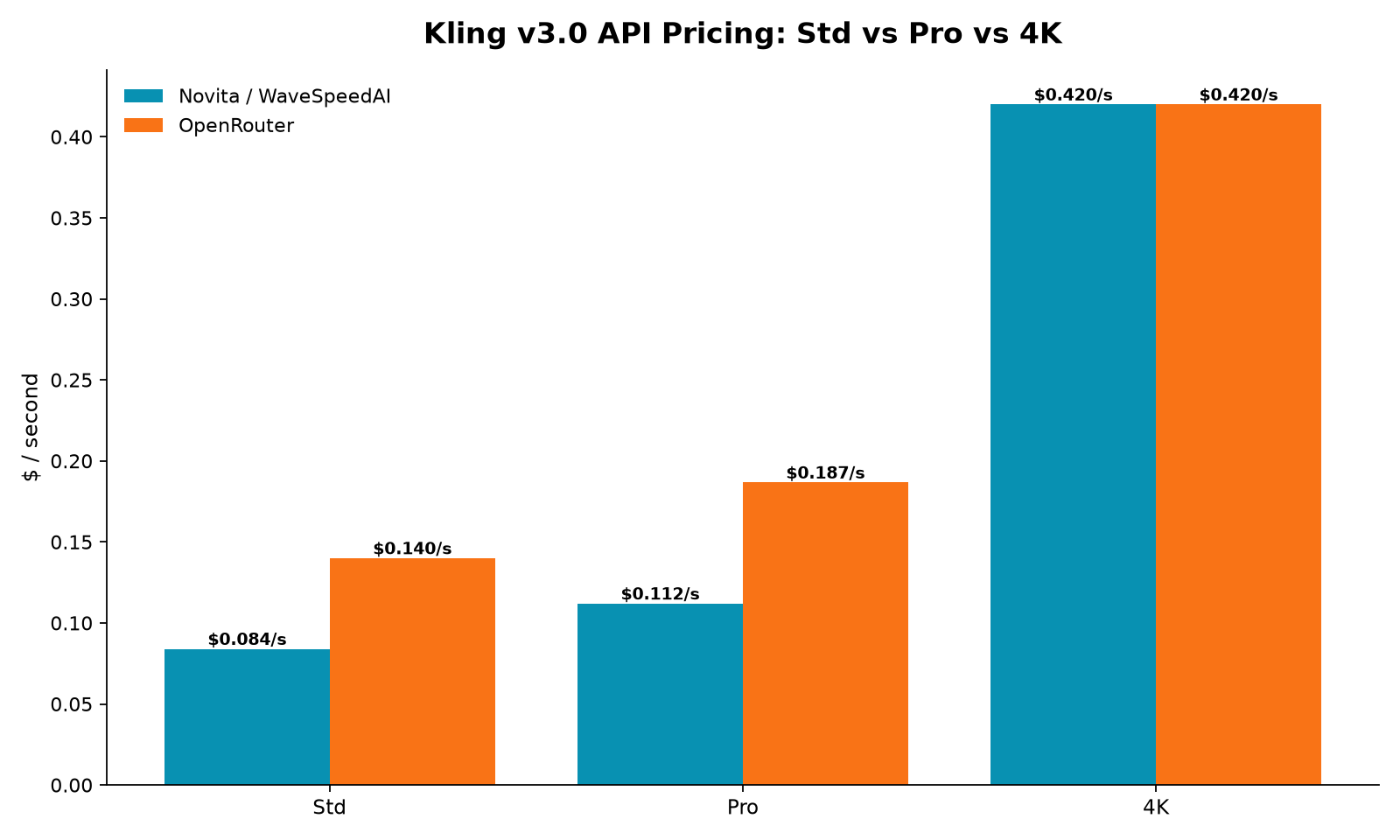
That 67% markup is remarkably consistent between Std and Pro — not a coincidence, but a sign that OpenRouter's resale rate is a flat percentage on top of the underlying host price rather than an independently negotiated rate. Whenever you see a resale markup line up at almost exactly the same percentage across multiple tiers of the same model, that's the pattern to look for — it means the underlying host price is doing all the work, and you can usually predict the markup on a tier you haven't checked yet from one you have.
Novita and WaveSpeedAI price identically — does the choice matter?
At Std, Pro, and 4K, Novita and WaveSpeedAI charge exactly the same rate. When two independent hosts land on identical pricing for the same model, it's a strong signal that one is effectively reselling the other's capacity, or that both are pricing off the same upstream rate card with no margin difference between them. Either way, the price comparison stops being the deciding factor between these two — the decision comes down to whichever host you already have better latency, uptime, or account relationship with. This is a genuinely different conclusion than most of the comparisons in this series, where price is the whole story; here, it isn't.
For more on this exact question — Novita vs WaveSpeedAI head-to-head — see Novita vs WaveSpeedAI for Kling API Access.
What the tiers actually buy you
Std is Kling's baseline tier — solid general-purpose quality at the lowest per-second rate in the family.
Pro costs 33% more than Std at either Novita or WaveSpeedAI, for improved motion coherence and detail. Whether that's worth paying depends on whether your output is customer-facing at a resolution/quality level where the difference is visible — for background or draft generation, Std is very likely good enough.
4K jumps to exactly 5x Std's rate ($0.084 → $0.420) and isn't listed at all through OpenRouter's resale channel — if you need Kling at 4K specifically, Novita or WaveSpeedAI are currently your only two options.
What this costs at real volume
A team generating 2,500 five-second Kling clips a month at Std tier:
- Novita or WaveSpeedAI: 2,500 × 5 × $0.084 = $1,050/month
- OpenRouter: 2,500 × 5 × $0.140 = $1,750/month
Skipping the resale channel saves $700/month — 40% of the bill — at this volume, with zero change to the model or its output. That gap only grows if you're on Pro tier instead of Std, since the same 67% markup applies to a larger base rate.
A second worked example: the 4K tier at scale
4K is priced at exactly 5x the Std rate at every host that carries it, which makes it easy to project costs at any volume once you know the Std rate. A team generating 500 four-second Kling clips a month at 4K:
- Novita or WaveSpeedAI: 500 × 4 × $0.420 = $840/month
- Compare to the same volume at Std: 500 × 4 × $0.084 = $168/month
The jump from Std to 4K costs 5x more for the same clip count — a bigger multiplier than moving from Std to Pro (which is only 1.33x). If your use case doesn't specifically require 4K output, staying at Std or Pro is a much larger saving than any host-shopping decision within a single tier.
Frequently asked questions
Is Kling Pro worth the 33% premium over Std for most use cases? It depends on whether the specific improvements Pro offers (typically better motion coherence and detail) are visible in your output at the resolution and context your users will actually view it in. Test both on your actual prompts before committing either way — the price difference here is smaller than several other tier-vs-tier comparisons in this series, which makes it a lower-stakes decision to get wrong.
Why isn't Kling 4K available through OpenRouter? That's a listing decision on OpenRouter's part, not something derivable from the pricing data alone — some resale channels don't carry every tier a model creator or its hosts offer. If 4K is a hard requirement, Novita or WaveSpeedAI are currently your only two options regardless of price preference.
Does Kling v3.0's pricing pattern hold for earlier Kling versions? Not necessarily — check each version's own listing rather than assuming the Std/Pro/4K structure or the Novita/WaveSpeedAI tie carries over to Kling v2.x or other versions, since hosting arrangements can differ by version.
Is the 67% OpenRouter markup consistent, or does it fluctuate? It's been consistent across both tiers where OpenRouter lists Kling (Std and Pro) as of this article's data — but resale markups can and do change independently of the underlying host price, so treat this as a current observation, not a permanent guarantee.
Should I always avoid resale channels entirely? Not universally — a resale channel can be worth a markup if it bundles other value (a single integration across many models, a billing relationship you already have, SLA terms) that direct-host access doesn't. For Kling specifically, though, the underlying hosts (Novita, WaveSpeedAI) are just as easy to integrate against directly, which makes the 67% premium harder to justify here than it might be elsewhere.
How to call it
import requests

job = requests.post(
    "https://videorouter.sh/api/v1/videos",
    headers={"Authorization": "Bearer llmr_sk_live_...", "Content-Type": "application/json"},
    json={
        "model": "kling-v3.0-std",  # or kling-v3.0-pro, kling-v3.0-4k
        "prompt": "a kite surfer carving across a turquoise bay",
        "duration_secs": 5,
    },
).json()
With no explicit provider pin, requests route toward the cheaper healthy deployments (Novita, WaveSpeedAI) rather than the resale channel — see /docs/provider-selection to pin explicitly. VideoRouter's Kling v3.0 Std and Kling v3.0 Pro model pages keep this comparison live.