Ask ten developers which image generation API to use and you'll get ten different answers, mostly because "image generation API" is doing double duty for two separate decisions that don't have to be made together. One is the model: the specific network that turns your prompt into pixels, built and trained by a specific lab. The other is the platform: the service you actually send an HTTP request to, which may or may not be the model's creator. Flux is built by Black Forest Labs, but you can call it from half a dozen different hosts at half a dozen different prices — and knowing that changes how you should shop.
This piece walks through the major image models worth knowing in 2026, the platforms that serve them, and a pricing nuance that most "best API" roundups skip entirely: video model pricing spreads wildly across hosts, but image model pricing often doesn't — and knowing which situation you're in changes whether it's worth your time to comparison-shop at all.
The models
Flux, from Black Forest Labs, is probably the closest thing the image-generation space has to a default choice for developers who want strong general-purpose output without a lot of prompt-engineering overhead. It's widely hosted — SiliconFlow, WaveSpeed, and BFL's own direct API all serve it — and it comes in tiers, with Flux 1.1 Pro as the workhorse option and a Flux 1.1 Pro Ultra step above it for higher-fidelity output.
Seedream, from ByteDance, is a strong pick when you need fast, high-throughput generation — it's commonly used in pipelines that need to produce a lot of images rather than agonize over a handful, and the 4.0 release is broadly available across resellers.
Nano Banana and Nano Banana Pro are the popular names for Google's Gemini 3 Pro Image family — Google's image generation model surfaced through the Gemini stack. It's grown a reputation for strong instruction-following and photorealism, and it's become common enough that it now shows up as an option across most multi-model aggregators, not just Google's own surfaces.
GPT Image, from OpenAI, is OpenAI's current image generation line, and it's had a fair amount of churn — DALL-E 2 and DALL-E 3 were removed from OpenAI's API in 2026, GPT Image 1 is itself now on a deprecation track, and GPT Image 2 is the current recommended model for new projects. OpenAI's API pricing for GPT Image 2 scales with output resolution — public pricing pages put it at roughly $0.03 per image at 1K resolution, $0.05 at 2K, and $0.08 at 4K, with quality tier (low/medium/high) also affecting the final number (source). If you're on GPT Image today, it's worth checking OpenAI's deprecation table directly before you build anything long-lived on a specific model alias.
Qwen Image, from Alibaba, is Alibaba's image model, and Qwen Image Edit — its editing-focused variant — is priced simply and consistently across the providers that serve it, which makes it an easy one to budget for without a lot of surprises.
Ideogram stands somewhat apart from the others on this list because it's a model creator that also runs its own first-party API rather than relying primarily on third-party resale — you can call Ideogram directly. Its API prices per generated image and varies by model version and quality tier; public pricing breakdowns put the 4.0 line at roughly $0.03 per image for the Turbo tier up through about $0.10 for the Quality tier, with older 1.0/2.x Turbo variants available even cheaper (source). Ideogram has built a particular reputation around typography and text-in-image rendering, which is a weak spot for a lot of other image models.
The platforms
The hosting landscape for image models overlaps heavily with the video-model hosting landscape, which makes sense since it's often the same infrastructure serving both. fal.ai is a diffusion/generative-media-focused serving platform, typically fast to list new open-weight releases, with transparent per-model pricing and no subscription required. WaveSpeed AI hosts over 1,000 models across image, video, audio, and more, and shows live pricing before you submit a job, scaled to your exact output parameters. Atlas Cloud is a broad pay-as-you-go aggregator across chat, image, video, and audio — often competitively priced on older or "turbo" model variants. Replicate offers both a community model catalog (billed by raw compute) and a curated "Official Models" set with flat per-output pricing. And VideoRouter, despite the name, routes image generation requests too, sitting in front of most of the hosts above with a live per-model price comparison rather than being a host itself.
The pricing nuance most roundups miss: spread varies enormously by model
Here's the part that's easy to miss if you're just skimming rate cards: not every model has the same pricing spread across hosts. Some are wildly inconsistent from one host to the next. Others are practically commoditized — you'll pay close to the same price no matter where you call them from, and shopping around barely moves the needle.
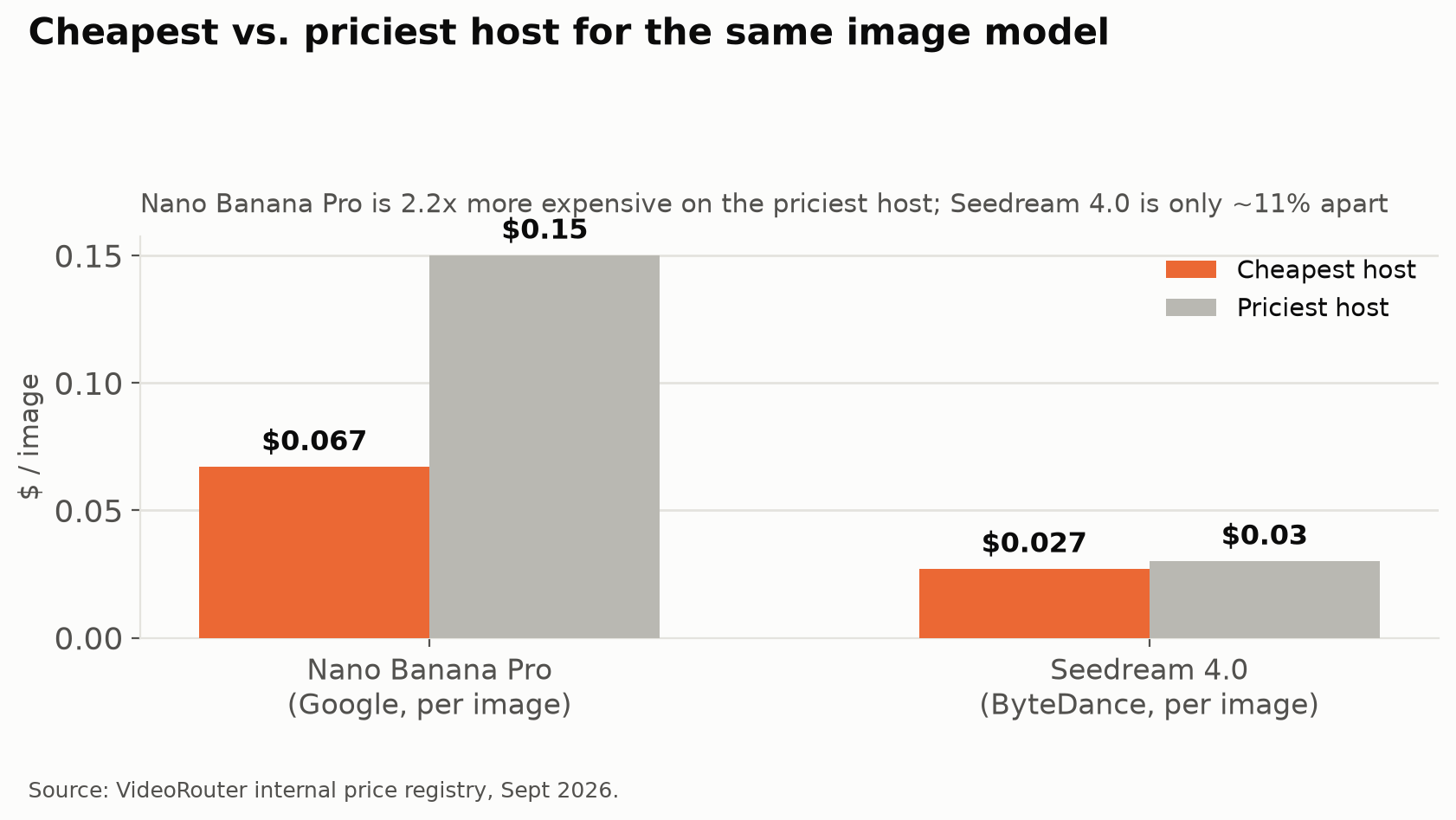
Look at Nano Banana Pro versus Seedream 4.0. Nano Banana Pro runs about $0.067 per image on MachGen versus roughly $0.15 per image on fal.ai — a 2.2x spread for what should be the identical model output. Seedream 4.0, on the other hand, runs about $0.027 per image on WaveSpeed versus roughly $0.03 on fal.ai or Pika — a spread of around 11%, which is close enough that picking a host on price alone barely matters; you're better off picking on latency, reliability, or whichever platform is easiest to integrate. Flux 1.1 Pro tells a similar story to Seedream: it runs a flat $0.04 across most hosts that serve it (SiliconFlow, WaveSpeed, BFL direct), with the step-up Flux 1.1 Pro Ultra tier at $0.06 on SiliconFlow — another case of a fairly commoditized, low-spread model where comparison shopping isn't where your time is best spent.
The table below rounds up what's discussed above, mapping each model to a few of the platforms that serve it.
| Model | Creator | Notable hosting platforms | Price spread across hosts |
|---|---|---|---|
| Flux 1.1 Pro / Ultra | Black Forest Labs | SiliconFlow, WaveSpeed, BFL direct | Low — roughly commoditized |
| Seedream 4.0 | ByteDance | WaveSpeed, fal.ai, Pika | Low — about 11% |
| Nano Banana Pro | Google (Gemini 3 Pro Image) | MachGen, fal.ai, others | High — about 2.2x |
| GPT Image 2 | OpenAI | OpenAI direct, resellers | Scales with resolution/quality tier |
| Qwen Image Edit | Alibaba | Provider API (DashScope and resellers) | Low — flat per-image rate |
| Ideogram 4.0 | Ideogram | Ideogram direct API | Varies by tier (Turbo/Default/Quality) |
So why does one model spread 2x across hosts while another sits within a rounding error no matter where you call it from? The honest answer is that it mostly comes down to how many independent hosts are actually running the model versus reselling someone else's inference, and how aggressively each host is discounting to win volume — neither of which is knowable from a pricing page alone. The practical implication is that "is it worth comparison-shopping this specific model" is itself a question worth asking before you assume every rate card needs auditing. For something like Nano Banana Pro, the spread is real money at any meaningful volume. For something like Seedream or Flux, you're mostly choosing on reliability and speed, because the price difference won't move your bill much either way.
Text-to-image versus editing: a second axis that matters as much as price
Pricing spread is one axis to evaluate on, but it's worth separating two different jobs that get lumped under "image generation API": pure text-to-image generation, and image editing (taking an existing image plus a prompt and producing a modified version — swapping a background, changing an outfit, extending a canvas, compositing a reference object into a scene). Not every model is equally strong at both, and not every host exposes editing even for a model that technically supports it upstream.
Qwen Image Edit is a useful example of a model built specifically around the editing use case rather than being a general text-to-image model with editing bolted on afterward — if your product's core loop is "user uploads a photo, describes a change, gets a modified photo back," that's a meaningfully different evaluation than picking the sharpest text-to-image model on a leaderboard. Nano Banana Pro and GPT Image 2 both handle editing-style prompts reasonably well within a broader general-purpose capability set, while a model like Ideogram is comparatively more associated with from-scratch generation and its typography strengths than with iterative editing workflows. If editing is your actual product surface, it's worth testing that specific capability directly rather than assuming a model that tops a text-to-image quality comparison will handle "take this photo and change the lighting" equally well.
There's also a practical API-shape difference worth knowing about before you design your integration: some hosts treat text-to-image and image-to-image as genuinely separate endpoints with different request bodies, while others fold both into a single endpoint where you optionally attach reference images to an otherwise identical request. The latter is simpler to build against if you expect to support both modes in the same product feature, since you're not maintaining two parallel code paths for what is, from the user's perspective, one "generate an image" action.
A quick note on how these APIs actually respond
One more practical difference worth flagging: image generation APIs are usually synchronous — you send a request and get the image (or a real, billable error) back in the same HTTP response, unlike video generation, which is almost universally an asynchronous job-queue-then-poll pattern because a video render simply takes longer than a request timeout comfortably allows. That makes image APIs simpler to integrate in one sense (no polling logic, no job-status state machine to manage), but it also means your client code needs to handle a slower-than-usual synchronous response gracefully — a 2K or 4K generation at a high quality tier can still take several seconds, and a naive short timeout on the calling side will produce spurious failures that have nothing to do with the model or host actually failing.
If you're the kind of team that wants to know which situation you're in — high price spread worth shopping, or low spread where it's not — without manually checking five pricing pages every time a new model drops, that's the specific problem VideoRouter is built around: a live per-model price comparison table across the hosts that serve it, so you can see at a glance whether a given model is worth shopping around for, plus one API to actually call whichever host comes out ahead, for both text-to-image and image editing in the same request shape.