How to Build a Multi-Provider AI Video API
At some point, most teams shipping AI video or image generation features ask the same question: should we build our own routing layer across providers, or just call one provider's API directly and deal with the consequences later? This article is for teams leaning toward "build." It's a walkthrough of what that actually involves, written the way you'd want it written if you were about to be the one maintaining it — including the parts that are more work than they look like from the outside.
The basic architecture
At a high level, the shape is consistent regardless of exactly how you implement it: a client calls your unified API, your unified API hands the request to a model router, the router picks a backend provider and dispatches the request, and that provider runs the actual GPU inference and eventually returns a result.
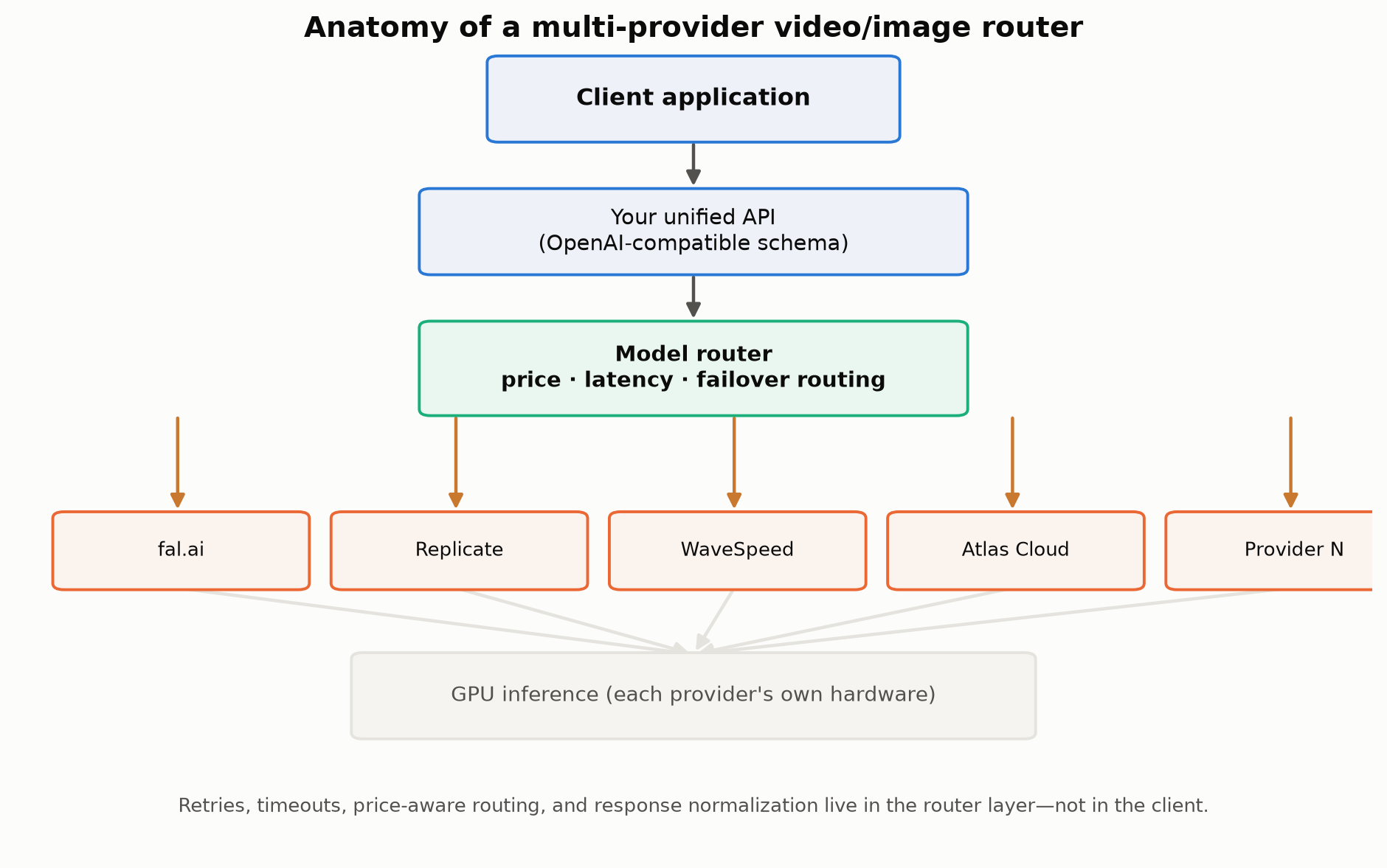
The interesting engineering is almost entirely inside the "model router" box. Everything on either side of it — accepting requests from your client, running inference on a provider's GPUs — is comparatively well-trodden. What the router has to do is translate between one consistent interface on the client side and N inconsistent interfaces on the provider side, make a good decision about which provider to use for a given request, and handle the reality that "handle the reality" here mostly means "handle failure and inconsistency gracefully." Below are the concerns that actually consume engineering time, roughly in the order teams tend to discover them.
Provider abstraction: normalizing wildly different shapes
This is the first wall everyone hits, and it's bigger than it looks from a distance. Say you want to support fal.ai, Replicate, and WaveSpeed behind one endpoint for the same conceptual operation — text-to-video generation. Each of those platforms structures the request differently: parameter names differ (duration vs duration_seconds vs a nested video.length), some parameters that are required by one provider are optional or absent on another, resolution might be expressed as a string preset on one platform and explicit width/height integers on another, and authentication headers differ in both name and required accompanying fields (a plain bearer token versus a token plus a workspace or account identifier).
The response side is just as inconsistent. A successful generation might come back as a direct URL to the output file, a signed URL with a short expiry, a base64-encoded payload, or a reference you have to resolve with a second API call. Error responses vary even more: HTTP status code conventions aren't consistent (some providers return 200 with an error field in the body for what should arguably be a 4xx), and error message formats and field names differ enough that building one generic "did this fail, and why" parser across providers is real, ongoing work — not something you write once and forget, because providers change these shapes without much warning.
The practical answer is to define your own internal canonical schema for "a video generation request" and "a video generation result," and write a thin adapter per provider that translates in both directions. This is the right approach, but be honest with yourself about the maintenance cost: every provider adapter needs updating whenever that provider changes its API, and you won't always get advance notice.
Retries and timeouts for async, job-polling workloads
Unlike a synchronous chat completion, video and image generation is a job-based workflow: submit, wait, retrieve. This changes what "retry" and "timeout" even mean.
A naive retry-on-failure approach breaks quickly here. If a job submission times out, did the provider actually receive it? Retrying blindly risks double-submitting (and double-billing) a job that actually succeeded on the provider's end but whose acknowledgment was lost in transit. You need idempotency handling — ideally a client-supplied idempotency key the provider honors, or failing that, your own de-duplication logic based on request fingerprinting — before blind retries are safe.
Polling itself needs real design, not just a while loop. Poll too aggressively and you'll get rate-limited by the provider (or add meaningful load and cost to your own infrastructure); poll too slowly and you add latency your user notices. Different models take wildly different amounts of time to generate — a short low-resolution clip might finish in seconds, a longer high-resolution one can take minutes — so a fixed polling interval that works for one model is wasteful or insufficient for another. Exponential backoff with sensible bounds, plus per-model expected-duration hints so you can tune the initial poll delay, is the practical middle ground.
Timeouts need a policy for what happens when a job legitimately takes longer than expected versus when it's actually stuck. Providers occasionally leave jobs in a "processing" state indefinitely without ever resolving to success or failure — you need your own ceiling, and a decision about whether to fail the request, retry it against a different provider, or keep waiting past that ceiling with a warning.
Price-aware routing
If you're routing across providers at all, price-aware routing is one of the more valuable things you can add, and also one of the easier ones to get partially wrong. The core idea is simple: before dispatching a request, check current pricing across the providers that can serve the requested model, and route to the cheapest one that meets your other constraints (availability, latency requirements, feature support for the specific request).
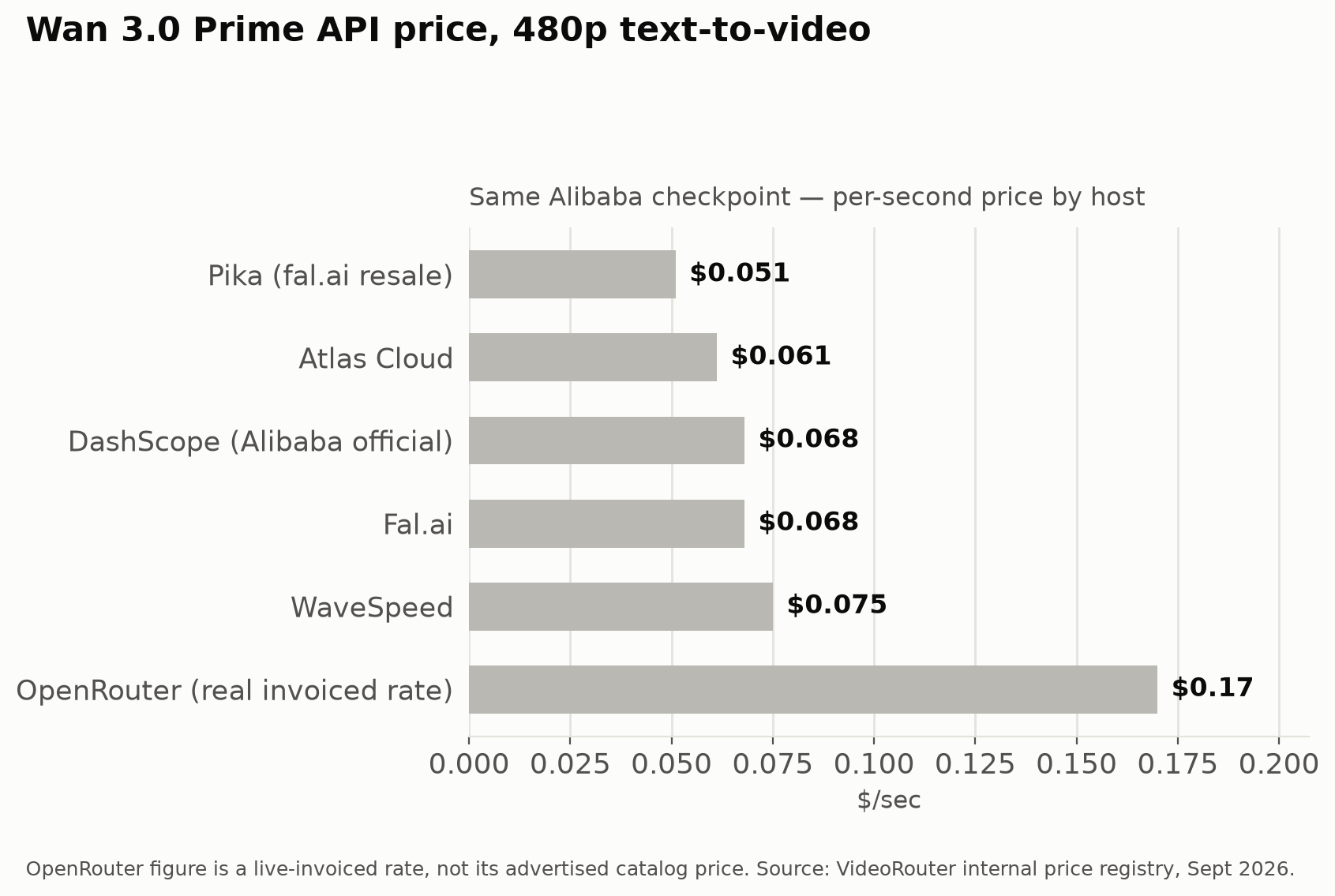
The reason this matters more than it might seem is that price spread between providers for the identical model is often large and not intuitive. Seedance 2.5, ByteDance's video model, prices between $0.19 and $0.473 per second at 720p depending on host — a 2.5x spread for the same checkpoint. Wan 3.0 Prime shows a greater than 3x spread at 480p between the cheapest and most expensive hosts. These aren't edge cases; they're representative of how uneven media-model pricing actually is across the market right now.
| Model | Tier | Cheapest observed | Most expensive observed | Spread |
|---|---|---|---|---|
| Seedance 2.5 | 720p, $/sec | $0.19 | $0.473 | 2.5x |
| Wan 3.0 Prime | 480p, $/sec | $0.051 | $0.17 (live-invoiced) | >3x |
| Veo 3.1 (flagship) | $/sec | $0.20 | $0.40 | 2x |
| MiniMax H3 | 768p, $/sec | $0.04 | $0.08 | 2x |
The Wan 3.0 Prime row deserves a specific callout because it illustrates a failure mode price-aware routing has to account for: advertised catalog prices and actually-billed prices aren't always the same thing. A real, live-invoiced 2-second job against one provider's Wan 3.0 Prime endpoint came back billed at roughly $0.17 per second — about 2.5x that same provider's own advertised catalog rate for the model. If your router only checks published price lists and never reconciles against real invoices, you can build a system that thinks it's routing optimally while actually paying a meaningfully worse rate than it believes. Budget for periodic reconciliation against actual billing data, not just trust in providers' pricing pages, and refresh cached prices on a schedule tight enough to catch changes — providers do update pricing without much notice.
It's also worth noting that price spread isn't universal — some models are close to commoditized. Seedream 4.0 shows only about an 11% spread across hosts we've checked, and Flux 1.1 Pro runs a flat $0.04 across most hosts. A well-built router should treat "is this model worth routing on price" as a per-model question, not assume every model has a big spread to capture.
Latency-aware routing
Price isn't the only axis worth routing on, and for some products it isn't even the primary one. Providers vary in typical response time for the same model, and that variance can shift over time as a provider's load changes. A router that's purely price-optimizing can end up consistently picking a provider that's cheap but slow for a workload where your users are sitting in front of a loading spinner. The practical approach is to track rolling latency statistics per provider per model (not just globally — the same provider can be fast for one model and slow for another) and let routing decisions weigh a configurable blend of price and observed latency, rather than optimizing either one in isolation.
Webhook normalization
Providers that support webhook delivery of completed jobs (rather than requiring you to poll) each implement it differently: different payload shapes, different signature-verification schemes for confirming a webhook is genuinely from the provider and not spoofed, different retry behavior if your endpoint is briefly unavailable, and different conventions for what a partial-failure or timeout notification looks like versus a clean success. If you support webhooks from multiple providers, you need a normalization layer here too — one internal event shape that all providers' webhook payloads get translated into before the rest of your system touches them, plus per-provider signature verification logic that you're on the hook for keeping current if a provider rotates its signing scheme.
Unified response schema design
Pulling the above together, the design decision that most affects how painful all of this is downstream is your internal canonical schema: the shape every provider's response gets normalized into before your application code ever sees it. Getting this right early matters more than almost any other decision in the project, because it's the one contract that has to remain stable even as you add providers, add models, and absorb upstream API changes behind it. A reasonable canonical shape typically needs, at minimum: a status enum that's consistent regardless of provider-specific status strings, a normalized output reference (ideally a stable URL your own infrastructure controls, rather than re-exposing a provider's possibly-expiring signed URL directly to clients), normalized cost information in one unit of account, and a normalized error representation that distinguishes retryable failures from permanent ones.
Being honest about the tradeoff
None of the above is exotic engineering — a competent team can build all of it. But it's worth being clear-eyed about what "build" actually commits you to: this isn't a project you finish once. Providers change pricing without much notice, change request and response schemas, change webhook payload formats, and occasionally change auth requirements. Each of those changes is small individually, but across a growing set of providers, keeping every adapter current becomes a standing maintenance line item, not a one-time build cost. There's also a timing risk worth naming plainly: OpenAI notified developers in March 2026 that its own Videos API and the entire Sora 2 model family are being removed from the API on September 24, 2026, with no announced replacement model. Anyone who built directly against that API now needs a new host on short notice — exactly the kind of single-vendor exposure a multi-provider router is meant to insulate you from, but only if the router itself is being actively maintained to track which providers still serve which models.
That maintenance cost is the real tradeoff against buying an existing gateway rather than building one. Building gives you full control over routing logic and no dependency on a third party's roadmap. Buying trades that control for not owning the ongoing work of tracking provider changes yourself.
VideoRouter (videorouter.sh) is, in effect, the already-built version of the architecture described in this article: a unified OpenAI-compatible-style API across many video, image, and speech providers, with the provider abstraction, job-polling, price-aware routing, and failover pieces already implemented and maintained, plus a live per-model price-comparison table so the pricing data in the table above is something you can check yourself rather than take on faith. For teams that have concluded the engineering above is worth having but not worth owning, it's a reasonable option to evaluate before starting the build.