Why You Should Compare AI Video API Providers Before Using a Model
Most teams building an AI video feature make two decisions, but only one of them gets any real scrutiny. The first decision is which model to use — Seedance, Kling, Veo, Wan, whatever fits the use case and the budget. Teams spend real time on this: reading model cards, comparing sample outputs, running their own test prompts. The second decision, which host actually serves that model, usually gets no scrutiny at all. A developer opens the model creator's documentation, or the first result in a search for "[model name] API," gets it working, and moves on. That second decision turns out to matter just as much as the first, and unlike the model choice, it's rarely revisited once it's made.
The same model is not the same price
The cleanest illustration of this is Seedance 2.5, ByteDance's video model, at 720p text-to-video. This is the identical checkpoint, the identical output quality, served by several different hosting providers. The price per second of generated video is not close to the same across them.
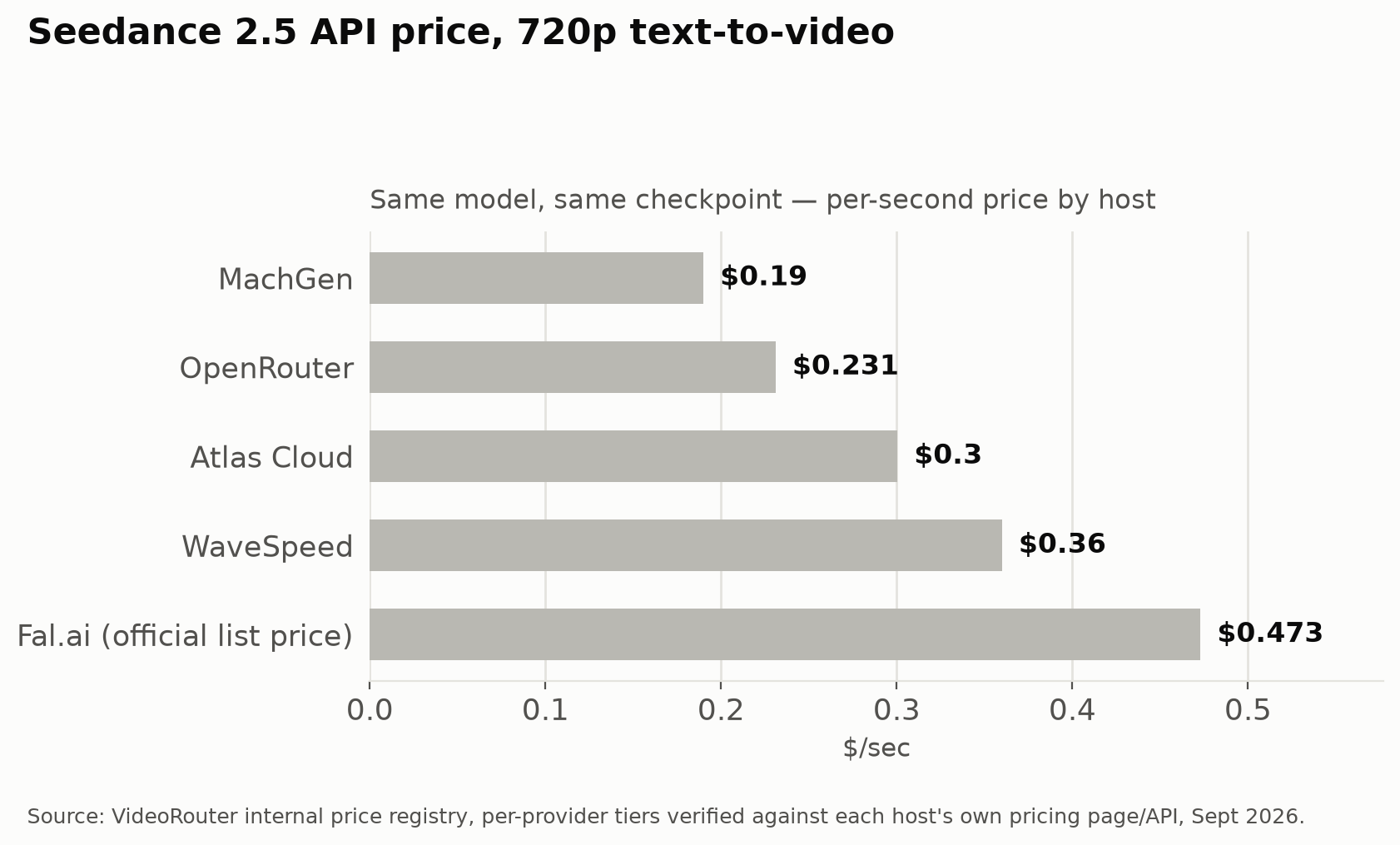
MachGen serves it at $0.19 per second. OpenRouter, cross-checked against a real invoiced job on its own pricing_skus API, comes in at $0.23112. Atlas Cloud's current discounted rate is $0.300456 (20% off its official $0.37557). WaveSpeed lists it at $0.36. Fal.ai, at its official page-quoted rate, is $0.473. That's a 2.5x spread between the cheapest and most expensive host for exactly the same model output. A team generating a modest volume of video — say, a few thousand seconds a month — pays materially different amounts depending purely on which piece of documentation they happened to read first, with no difference whatsoever in what they get.
This isn't a one-off anomaly specific to Seedance 2.5. Wan 3.0 Prime, Alibaba's video model, shows a similar pattern at 480p text-to-video: Pika, resold through fal.ai, prices it at $0.051 per second; Atlas Cloud at $0.0612; DashScope (Alibaba's own official API) and Fal.ai both at $0.068; WaveSpeed at $0.075. OpenRouter is a genuinely interesting outlier here — its advertised catalog price is lower, but a real, live-tested 2-second job on OpenRouter was invoiced $0.34 total, which works out to $0.17 per second, roughly 2.5x its own advertised rate for that same job. That gap between advertised and actually-invoiced pricing is exactly the kind of thing you only find by testing a provider directly rather than trusting a rate card, and it's a reminder that "compare providers" has to include checking what you're actually billed, not just what's published. Either way, from the cheapest host (Pika) to the most expensive one actually tested (OpenRouter's live invoice), the spread is more than 3x for the same underlying model.
Not every model shows this pattern to the same degree — Seedream 4.0 pricing across WaveSpeed and Fal.ai/Pika differs by only about 11%, and Flux 1.1 Pro sits at a flat $0.04 across most hosts, so commoditized models can converge on price. But you don't know which category a given model falls into until you actually check, and for the models above, not checking costs real money.
Why teams end up single-sourced in the first place
None of this happens because developers are careless. It happens because of how integration work actually gets done under a deadline. A ticket says "add video generation," someone searches for the model name plus "API," reads whichever documentation ranks first or whichever page the model's own creator links to, gets a working integration by end of day, and ships it. That's a completely reasonable way to move fast on a first pass. The problem is what happens next: nothing. The integration works, so nobody revisits it. Six months later a cheaper host appears, or the original host raises its effective price, or a discount the team was relying on quietly expires, and the team never notices, because there was never a second look built into the process — only a first one.
This is made worse by the fact that pricing itself isn't static. Atlas Cloud's Seedance 2.5 rate in the numbers above is already a discounted rate off a higher official price, which means the "current" price for any given host is a moving target even without a new host entering the market. A comparison done once at integration time has a shelf life; it isn't a fact you can treat as permanently true.
What "comparing providers" should actually include
Price is the easiest thing to compare because it's a single number, but it's not the only thing that matters, and treating it as the whole picture leads to its own mistakes.
Latency and throughput. Two hosts serving the same model can have meaningfully different job completion times, especially under load. A host that's 10% cheaper but consistently slower during peak hours may not be a net win if your product has a time-sensitive user flow.
Uptime history, not just uptime claims. Every provider will tell you they're reliable. What you actually want to know is how that host has behaved during its worst week, not its average week — and that's usually only knowable by asking around, checking status page history, or simply running on it long enough to find out yourself.
Whether the host resells or is the first-party creator. Some of the cheapest options in the data above, like Pika's resale of Wan 3.0 Prime through fal.ai, are third parties reselling someone else's model, while DashScope is Alibaba serving its own model directly. Neither structure is automatically better — resellers can be cheaper because of volume deals or different margin targets, and first-party hosts can be more directly accountable when something breaks — but it's a fact worth knowing about who you're actually depending on, and what recourse you have if a job fails.
Rate limits. A provider's advertised price is irrelevant if its rate limit caps you well below the volume your product needs. This is easy to miss during a small-scale proof of concept and painful to discover during a launch.
What happens during an outage. This is the one teams think about least until it happens to them, and it's the subject of the rest of this article.
The single-host failure mode
If you integrate directly with one provider for one model, you have implicitly made a decision: when that provider has an outage, your feature has an outage. There is no automatic failover built into a single-vendor integration, because there is nothing to fail over to — your code only knows how to talk to the one host you wired it up to. This is true no matter how reliable that host normally is, and it's true regardless of price; even the cheapest host in the comparison above is still a single point of failure if it's the only one your application code can reach.
For most teams, this risk stays theoretical for a long time, right up until it isn't. And there's a very current, very concrete example of exactly this risk turning real.
The Sora 2 shutdown is the risk made real
OpenAI notified developers on March 24, 2026 that its Videos API and the entire Sora 2 model family — sora-2, sora-2-pro, and their dated snapshots — would be removed from the API on September 24, 2026. That's nine days from today. This is separate from the consumer Sora app, which OpenAI had already shut down back on April 26, 2026; this is the developer-facing API specifically. OpenAI's own deprecation table lists no recommended replacement model. There is currently no OpenAI-hosted video model for an affected developer to migrate to — the option is simply gone.
Any team that built its video feature exclusively on OpenAI's native Sora 2 API now has a hard, externally imposed deadline to find a new home for that workload, with essentially no runway and no vendor-provided migration path. Some third-party resellers — Pika, Replicate, DeepInfra, and MachGen among them — do still serve Sora 2 Pro as of this writing, since they call OpenAI's backend under their own business agreements, which gives affected teams somewhere to move to right now. But that continuity is worth flagging as "true as of now," not something guaranteed indefinitely, since those resellers' access ultimately depends on OpenAI's own backend continuing to support it.
Here's the part worth sitting with: this situation only became an emergency for teams that had a single integration point. A team that called Sora 2 through an abstraction layer covering multiple hosts, rather than OpenAI's native API directly, could plausibly redirect that same code path to a different model or a different host serving Sora 2 through one of the resellers above, without touching their application logic under deadline pressure. A team with only the native OpenAI integration has to write new integration code, under a hard external deadline, for a capability they thought was already shipped and done. The model risk (will this model stay good) is one thing teams already price in. The provider risk (will this specific host still be reachable, at any price, next month) is the one that gets ignored — until an announcement like this one turns it into a countdown.
What this argues for, concretely
The practical takeaway isn't "always use the cheapest provider" — cheapest isn't always right once you weigh in latency, reliability, and rate limits. It's that the comparison itself should happen, deliberately, before you commit engineering time to an integration, and it should happen again periodically rather than being treated as a one-time step. The Seedance 2.5 and Wan 3.0 Prime numbers above show that skipping this step can mean paying 2.5x to 3x more than necessary for identical output. The Sora 2 shutdown shows that skipping it can mean an emergency migration with no notice and no replacement, rather than a routine failover.
Here's a quick reference for what a provider comparison should weigh, beyond just the sticker price:
| Factor | What to check | Why it matters |
|---|---|---|
| Price per unit | $/second of video, $/image, at the resolution you'll actually use | Direct cost; can vary 2-3x for identical model output |
| Latency under load | Job completion time during peak hours, not just idle benchmarks | Slow generation can break time-sensitive product flows |
| Uptime history | Status page history, not marketing claims | Determines how often you'll be down if single-sourced |
| First-party vs. resale | Is this the model creator, or a third party reselling access | Affects accountability and pricing stability |
| Rate limits | Max throughput at your target volume | A cheap host with a low cap doesn't scale with you |
| Failover options | Can you redirect to a different host if this one is unavailable | Determines whether an outage or shutdown is routine or an emergency |
Where VideoRouter fits
Comparing providers manually, the way this article just walked through, is a legitimate way to make a good first decision — but it's a chore most teams do once and then never repeat, which is exactly how the Seedance 2.5-style price gaps and the Sora 2-style lock-in risk both creep in. VideoRouter (videorouter.sh) is built around making that comparison the default state rather than a one-time manual exercise: a single OpenAI-compatible-style API in front of many hosting providers, with a live per-model price comparison shown on each model's page, and automatic failover across hosts when one of them is unavailable. It doesn't change the underlying advice in this article — compare before you commit, and don't stay single-sourced without a reason — it just makes following that advice something the system does continuously instead of something a developer has to remember to redo.